The vast majority of our reviews come from verified purchases. Reviews from customers may include My Best Buy members, employees, and Tech Insider Network members (as tagged). Select reviewers may receive discounted products, promotional considerations or entries into drawings for honest, helpful reviews.
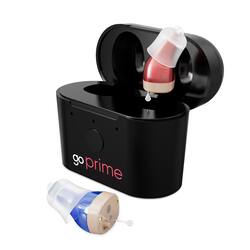
I've been wearing hearing aids (and Amaz0n hearing amplifiers) 2 different animals, trust me, since 2010. The expensive ones do what they do but strike fear into your wallet and heart when the cats find the new toy or you get caught in a downpour. Maybe even *cough* drop one in the lake. For this price and quality, you have me! I've paid more for products I've had to return. I've had mine since the week they went over the counter, best purchase I've made in the whole 12 years of "officially hard of hearing" the decade before that I just said HUH? a LOT.. picture is a small sample of the last 12 years and another of relative size. 99% of people just think I have in earbuds for my phone.
This review is from Go Hearing - Go Prime OTC Hearing Aids - Black
Posted by KindraB
On the bright side: It works well for some things. The first time I used them I heard my neighbors working next door - with the windows closed. At that point, I was pleased. The longer I had them, the less I liked the results. 1. Each bud has a button to adjust the volume. The left has a button near the top and the right near the bottom. Confusing. They can be difficult to find and operate. To control the volume, you must cycle through all the levels which can really hurt. Also, since the antenna sticks out more than the volume button, I ended up having to fiddle with it. 2. Unfortunately, the hearing aids did not help at all with people talking. I ended up listening to miscellaneous noise while trying to hear the person in front of me. 3. I did not find them uncomfortable, but they had a tendency to loosen while wearing them. My hearing loss is moderate with the loss at both the top and bottom of the range. For me, I was just as well off using earbuds with the tv as the hearing aids did not really help me with anything else.
This review is from Go Hearing - Go Prime OTC Hearing Aids - Black
Posted by Journeywoman
I started wearing hearing aids about 25 years ago. The real game changer for me was the arrival on the market of Made for iPhone (MFI) hearing aids. The ability to answer phone calls, and hear it clear and crisp in BOTH ears simultaneously was quite a game changer. Additionally, it was a wireless receiver for streaming music to my hearing aids, much like the eventual development of wireless ear buds. Further advancements have continued, notably Lithium ion rechargeable devices, so fiddling with the tiny zinc air batteries once a week to toss the spent ones becomes not only more convenient but a cost savings, spending $100 a year on batteries. So coincident with the advances in wireless, digital, Bluetooth, rechargeable amplification came the political will to open up the market to consumer purchase of such devices without regulations on the sale of such devices. As a consumer of such products over the past decades, I was pleased to have the opportunity to “test drive” just such a pair courtesy of BestBuy. I was provided a pair of OTC (over the counter, that is not requiring a prescription before purchase) hearing aids for my assessment and opinion. The Go Hearing company is not one I have previously known about, but I was impressed with the fit and finish of their product. Many of the advances that I outlined above were nicely incorporated in the hearing aids. Notably, rechargeable, compact and lightweight, binaural (that is, “stereo”). Whereas getting “medical grade” hearing aids requires an audiogram, where you sit in a sound proof booth, with over the ear headphones on, and are given tones at different frequencies and increasing volume. With this process, previously required to be able to purchase hearing aids, you had a graph of where your deficits were located over the entire sound wavelength spectrum. My hearing loss was greatest at the higher frequencies, not so much in the bass end, which is a very common pattern. No such audiogram is required to dispense an OTC pair of hearing aids, which merely amplify the entire spectrum, and the only customization is just “turning up the volume”. The medical grade hearing aids that I have actually split up the audible spectrum into about a dozen segments across what the human ear can perceive. But with digital hearing aids, custom programmed, you get a hearing spectrum corrected for amplification in the areas of the spectrum where you have the deficit. This customization is not offered with the Go Ultra device, understandably given the price point being 10% of what “prescription” hearing aids can cost. The OTC hearing aids are specifically indicated for those with “mild to moderate hearing loss”. As such they can make a major difference in people who just need a bit of help, where non-customized amplification can make a big difference. The situations are easy to forecast: at a movie theatre or a school play or orchestra performance, during a church service, in a restaurant with lots of background noise to hear the conversation of those at your own table, watching television so you can turn up the volume for yourself without blasting out everyone else in the room, etc. The Go Hearing devices are a common “behind the ear” device, where the amplifier is in the main body, and the sound is passed down a thin hollow tube into the ear canal where a soft, flexible silicone dome sits close to the eardrum. They provide three different sizes of this curved tubing, to fit best the distance from the top of the ear (where the device sits) around the curve into the canal. Those with a bigger head, for example, need a longer tube. From there there are three different sizes of dome, that fit into the canal, to accommodate differences in the diameter of the ear canal. And finally there are two choices in the dome: whether it is solid, or has venting perforations in the silicone rubber. The solid is more effective in delivering the applied sound, but the vented will be more “natural” in how the amplified tones seem to the person. So a whole lot of customization is available for personal size and preferences in an inexpensive device. The entire field of now available OTC hearing aids spans a wide price difference, and indeed you get what you pay for. The Go Hearing Ultra I would put in the moderate price range; you can easily find models twice the price. Many of the technological advances are here: rechargeable batteries that charge while in the case from a battery inside the case. You can recharge on the go using the case, and only need to plug into a wall source periodically Bluetooth pairing with your phone, computer, tablet, MP3 player (remember those?) Adjustable setting for volume on the hearing aid. Able to turn on and adjust volume without having to fire up an app and navigate to the right section, which certainly could be difficult in a movie theatre or inconvenient during a restaurant meal. Phone and online support available from the company, and probably from BestBuy Geek Squad as well Limitations no phone app for setting preferences or adjustments. The on/off and volume switches are pretty tiny. It takes some dexterity and learning to be able to turn them on and off and volume up and down. This could be difficult with age, arthritis, etc. no ability to choose different listening environments. Everything is amplified the same, but they do have feedback and background noise reduction management. My experience with wind noise is that such circuitry is of some benefit, but not perfect. I found that a cover for the hearing aid cuts wind noise, and protects the hearing aid from sweat while doing outdoors strenuous activity (search for “hearing aid sweat bands”). No streaming capacity beyond straight Bluetooth connection. Some higher priced OTC hearing aids offer MFI (“made for iPhone”) features that go beyond simple Bluetooth connection. You accept and disconnect an incoming phone call with a push of the lower button on the hearing aid. An MFI certified hearing aid will accept with a tap on your iPhone screen which automatically goes to your hearing aids. No customization for your particular hearing spectrum deficits. Some OTC hearing aids have an app from which you can customize for your perceived deficits. This is called “self-fit”, getting you closer to an actual audiogram based customization. The Go Hearing Ultra has 4 different programs that adjust the listening program from normal setting, to high frequency (difficulty with higher frequency, think children’s voices or noisy environment), low frequency environment (think a full orchestra concert), or across the board general amplification as in music listening. I noted that the on line web page only mentioned 3 programs, whereas the instruction booklet and my pair of hearing aids had 4 distinct programs. I confess that my perception of any difference in these was minimal, given my more profound hearing disability. Higher priced units offer a receiver in the canal configuration. This has the actual speaker embedded in the dome that is in the canal, only a few millimeters from the eardrum, rather than the sound traveling down a tube from the speaker that is in the body of the hearing aid behind your ear. This allows a smaller, more discrete instrument behind the ear. However, the receiver in the canal configuration is not available in even prescription higher power hearing aids, for more severe hearing loss than “moderate” loss. Limited color selection of the device to gray, which matches my hair, but perhaps not yours. In summary, I think the Go Hearing Ultra would be an excellent hearing aid, for the right customer. They lack the power for more severe hearing loss (like mine) and lack the ability to customize for your particular spectrum of hearing loss. For me, they will not suffice for a back up pair of hearing aids. I had hoped that they would function for me, for example, if I had a hearing aid failure while traveling, to tide me over until I could be my primary hearing aids serviced. They don’t have enough power to do me any good; not worth even trying. However, they will function well for my wife, who assisted me in the trial of these. She cannot wear most brands of ear buds, due to a contact allergy to many plastics. She will notice a burning and itching within the ear canal in about 15 minutes, whereas she can wear the Go Hearing ultras for a 1.5 hour TV viewing of a movie. Her hearing deficit is much less than mine, but we can choose to have her wear the Go Ultras, and I turn on the closed captioning of the movie, and we don’t have to crank up the volume to keep us connected to the voice track. That disturbs those in an adjacent room while we are watching the TV. It was easy to swap out the tubes and domes to customize to personalize for ear canals and head morphology. The hearing aids are comfortable to wear, so light to be imperceptible while wearing them, and discretely small enough. If you find that your needs exceed what these provide, then the next step would be to try a more expensive set; most OTC hearing aids offer a 30 - 45 trial period. GoHearing offers a 45 day money back guarantee, for example.
This review is from Go Hearing - Go Ultra OTC Hearing Aids - Gray
Posted by Josenieve