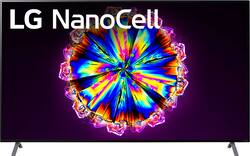
Equip your home theater for family movie night with this 75-inch LG smart TV. The third-generation a7 processor and 4K Nanocell display deliver sharp, detailed video content, while IPS technology supports comfortable viewing from various sides of the room. This LG smart TV is AMD FreeSync compatible for flawless 4K game rendering, and LG ThinQ AI supports voice recognition for hands-free control.
Q: What is the difference between a NAnoCell and OLED?
A: NanoCell TV technology is different from OLED technology that is present in LG TVs. Previously, LG used to refer to NanoCell technology as IPS-Nano. It is because the technology was a combination of LG’s IPS (In-Plane Switching) LCD technology and nano cells. The result is a two-fold improvement in the viewing experience. NanoCell technology comprises of using a light-absorbing material that blocks the wavelengths between green and red color filters. Generally, the colors in this wavelength of 580 and 610 nm pass through in the standard TV technology. As a consequence, this contributes to the desaturation of red and green colors. It is also called bleeding of the red light in green and vice-versa. By blocking this light, the NanoCell technology ensures the production of pure red and green color on the TV screen. The cutting-edge NanoCell technology filters out the dull colours to enhance the prominent RBG colours to ensure the display of vibrant and lifelike images on the LG TV screen. NanoCell technology allows viewing from angles as wide as 178 degrees, thereby providing a fantastic viewing experience for the entire family. NanoCell technology can produce incredible contrast with the Full Array Local Dimming feature available on some of the top-end LG NanoCell TV models. The precise controlling of backlighting ensures the production of the deepest blacks on the TV screen. The LG NanoCell TVs are available in Ultra HD and 4K Cinema HDR resolution, including Dolby Vision. OLED does not have any backlight. Therefore, this technology can create perfect blacks., thereby producing high-quality contrast. The additional advantage is that this technology can fit into the thinnest of TV screens. It can also fit into the curved screens. Therefore, it improves the viewing angle considerably. OLED is "emissive," meaning the pixels emit their own light. OLED stands for Organic Light-Emitting Diode. Somewhat surprisingly, the “Light Emitting-Diode” part of that name has nothing to do with an LED backlight as it does with LED TVs. Instead, it refers to the fact that every single pixel in an OLED TV is also a teeny, tiny LED light — but one that is incredibly thin and can produce both light and color in a single element. In other words, OLED TVs don’t need a backlight because each pixel produces its own light. If you want to impress your friends, you can use the industry terms for these kinds of displays: “Emissive,” or “self-emissive.” There are several advantages to this design, but most would agree that when it comes to OLED TVs, the biggest advantage is the superb black level that can be achieved. Unlike an LED TV that must dim its backlight and block what remains for dark scenes, an OLED TV simply turns off the pixel. When the pixel is off, it emits no light and no color, making it as dark as when the TV itself is turned off. With no separate backlight, it’s also a lot easier to make an OLED screen flexible, which is why OLED pioneer LG has developed several OLED TVs that roll up (or down) to disappear entirely. Only one company currently makes OLED TV panels: LG Display. It sells those panels to its sister company, LG Electronics, which uses them to build some of the very best TVs you can buy. But LG Display also sells OLED panels to companies like Sony, Philips, and Panasonic, which is why you’ll see OLED TVs from these companies too. Even though the panels themselves are essentially identical, the image processing that Sony, LG, and others do is proprietary, so you’ll still see significant differences in picture quality from one OLED TV to another...^IFV
Q: How far apart are the feet/stands on the 75 inch model?
A: The stand legs on the LG NanoCell 90 Series 2020 75 inch Class 4K Smart UHD NanoCell TV w/ AI ThinQ® (74.5'' Diag), Model # 75NANO90UNA have a width of 56.9"...^IFV
A: The TVs are basically the same with the only differences being that the LG NanoCell 91 Series 2020 75 inch Class 4K Smart UHD NanoCell TV w/ AI ThinQ® (74.5'' Diag), Model # 75NANO91ANA uses a curved arcline stand while Model # 75NANO90UNA uses stand legs and that the TVs are sold through different retailers. The 75NANO91ANA is a club piece that is sold through Walmart, Costoc etc., and the 75NANO90UNA is sold through national retailers like BestBuy etc.,^IFV
A: Did this TV work good for the new Xbox?
A: Hello Bat. We do not have a 2020 Model # 75SM9070PUA. The "M" in the model number for the TV identifies it as a 1019 model and 2020 models are identified by an "N" in the model number. This year's models are either the LG NanoCell 90 Series 2020 75 inch Class 4K Smart UHD NanoCell TV w/ AI ThinQ® (74.5'' Diag), Model # 75NANO90UNA or the LG NanoCell 91 Series 2020 75 inch Class 4K Smart UHD NanoCell TV w/ AI ThinQ® (74.5'' Diag), Model # 75NANO91ANA. The difference between the two 2020 models is the retailers through which the TVs are sold and that the 785NANO90UNA uses stand legs while the 75NANO91ANA uses the arcline stand. The differences between the 2020 models and the 2019 models is the new LG α7 Gen 3 Processor 4K, Sports Alert Mode, inema HDR w/ Dolby Vision IQ, Filmmaker Mode™, Support for HGiG (HDR Gaming Interest Group) and that the 2020 models will receive a firmware upgrade that adds support for FreeSync, and that the 2020 models have HDMI 2 and HDMI 4 as HDMI 2.1 ports and the other ports are HDMI 2.0 ports.. As for any blooming or dark color issues, regrettably we do not have that information. That information is usually available from reviewers that we submit our TVs to so they can test the units for that type of information...^IFV
A: Of the four HDMI ports on the LG NanoCell 90 Series 2020 75 inch Class 4K Smart UHD NanoCell TV w/ AI ThinQ® (74.5'' Diag), Model # 75NANO90UNA, HDMI 2 and HDMI 4 are HDMI 2.1 ports and the others are HDMI 2.0 ports...^IFV
A: Hi jtron9K. The HDMI 3 being an HDMI eARC port on the LG NanoCell 90 Series 2020 75 inch Class 4K Smart UHD NanoCell TV w/ AI ThinQ® (74.5'' Diag), Model # 75NANO90UNA does not mean it is an HDMI 2.1 port. It is a port that supports the HDMI eARC feature. HDMI allows manufacturers to cherry pick HDMI 2.1 features and assign them to specific HDMI ports...^IFV
Q: Does this tv have the newer ATSC 3.0 tuner?
A: No, this TV does not have next-gen ATSC 3.0 active. It has the hardware and will receive a firmware update by year-end, 2020. ^Daphane