Only @ Best Buy
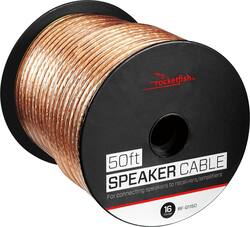
This 50' spool of oxygen-free copper speaker wire allows you to connect your speakers to any receiver or amplifier and is a convenient solution to your home theater and other audio needs.
Q: how do u know which is black and which is negative
A: One wire side has a marking along the length of insulation. Use this wire for all positive connections to avoid out of phase wiring.
Q: How do I differentiate + and - wires with Rocketfish wiring?
A: It has a trail of +++++ on one side of the cable which of course means positive.
A: copper clad
Q: Why does thicker speaker wire supposedly sound better than let's say 20 gauge?
A: I believe it has something to do with thicker wire will lower the resistance, so more of your wattage makes it to your speaker. There are other factors involved, but that is the most basic, and direct answer to your question. They typically say that 16 gauge is the minimum for feeding speakers within 100' of the amp. I hope that helps. Bert-23
Q: What and where are the polarity marks?
A: Look carefully at the wire. You will see small red "+" marks on one half of the wire set. This helps you to keep track of which wire is which.
Q: If I have 2 speakers to hookup, do I need to purchase 2 of these wires?
A: Traditional speaker connections with two post connections (red and black clips or posts are the typical color connectors) require one speaker wire lead per speaker. The wire is sold in specifically in lengths that you cut to your needs. Two speakers 10 foot from the receiver needs 20 foot of wire. You'll need wire strippers/cutters this has heavy duty insulation
A: yes it would be suitable for outdoor use. Preferably protected by a conduit raceway to protect from the elements for extended use.
Q: Why doesn't the packaging state the rating for this wire?
A: In the past, I installed home theatre systems for Best Buy. This wire is not "rated" for in wall use. All in wall qualified "CL" rated speaker wiring has a thicker sleeve (protective coating) inside the exterior protective coating (normally white in color) as well. The primary use of the additional protection is to prevent interference from electrical wiring. When running speaker wire in the wall, at some point it will always come near or cross with electrical wiring which can cause static or interference in the sound that emits from the speakers. In bad cases, you will hear a buzz or tone at times during quiet parts of movies, games, or shows.