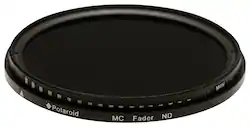
Polaroid - Optics 72mm HD Multicoated Variable-Range Neutral Density Fader Filter
Model: PLFILFDND72
SKU: 5209146
This item is no longer available in new condition. See similar items below
The vast majority of our reviews come from verified purchases. Reviews from customers may include My Best Buy members, employees, and Tech Insider Network members (as tagged). Select reviewers may receive discounted products, promotional considerations or entries into drawings for honest, helpful reviews.
Probably the most usual use for a neutral-density filter is to blur the motion of water, such as a water fall, which can produce a very pleasing result. Blurring the motion requires long exposures, ranging from two or three seconds to minutes. In bright light, these long exposures are not possible because (1) the camera’s ISO cannot be set low enough and/or (2) its lens opening (aperture) cannot be set small enough (high f number, e.g., f/16) to allow the long exposures without overexposing the image. The Polaroid variable neutral-density filter is convenient because it contains, in one filter, five steps of light reduction. These steps are rated in “ND numbers,” specifically including ND2, ND4, ND8, ND16 and ND400, accessed by rotating the filter in its mount. In terms of f-stops, this series corresponds to reductions of 1, 2, 3, 4 and 8.67, a range broad enough to accommodate most requirements. I cannot actually comment on the durability of this item because I have not used my filter for a long time. However, it appears to be well constructed.
Posted by Jim3345