
Red Panda - Context 2 Reverb Pedal
About This Item
- General
- Brand: Red Panda
- Model Number: RPL-102V2
- Product Name: Context 2 Reverb Pedal
- Dimensions
- Product Width: 3.5 inches (The out of box width of the item. Width is measured as the horizontal distance from one side of the item to the other as it would be primarily used or placed.)
- Product Height: 2.87 inches (The out of box height of the item. Height is measured as the vertical distance from the bottom of the item to the top as it would be primarily used or placed.)
- Product Length: 5 inches (The out of box length of the item. Length is measured as the longest dimension of the item.)
- Product Weight: 0.9 pounds (The out of box weight of the item.)
- Features
- Instrument Compatibility: Guitar
- Effect Type(s): Reverb
- Power Source: Plug-in/Battery-powered
- Warranty
- Warranty - Parts: 1 year
- Warranty - Labor: None
- Other
- UPC: 665760908463
The Context is a reverb pedal inspired by 1980's rack mount reverbs. It has 8 algorithms, including room, hall, cathedral, gated reverb, reverse reverb, plate, spring, and a granular reverb. Each algorithm features separate high and low frequency damping controls, pre-delay, modulation, dynamics (duck/expand), and infinite hold. In addition, delay is always available, along with tremolo in spring mode. The modulation knob changes the amount and character of the internal reverb modulation, specific to each algorithm. It gives you a mix of different modulation types from 1980's and early 90's reverbs, including chorus modulation, random modulation that keeps the pitch stable, and deep modulated reverbs. Holding down the shift button adjusts the modulation rate. Reverse reverb fades in louder and brighter over time, giving the impression of playing backwards. Modulation adds a wash of normal reverb. The spring reverb was designed using the techniques and algorithms that were used in 1980's reverbs, but with enough DSP power to drip and feel like a spring tank. You can adjust the length of the decay, high and low frequency damping. The modulation is tremolo with adjustable intensity and speed. Grain mode is a granular reverb inspired by the Ursa Major SST-282 Space Station. The SST-282 was released in 1978 and used multiple delay taps with modulation to create reverb effects. The Context can create ghostly reverb effects, slowly sweeping resonances, and at higher modulation settings is a multi-voice granular processor that creates clouds of detuned sound fragments for entirely new reverb sounds. When the shift button is held down, the top row of knobs adjust delay parameters. The low and high damping knobs adjust dynamics for ducking reverb or an expander for more reverb on louder notes, with adjustable threshold and recovery time. Holding down the foot switches gives you two different types of infinite sustain. One preset available on the left footswitch, 4 using a remote footswitch, and 127 via MIDI. The expression pedal can be assigned to any combination of parameters. We also have a web-based editor for tweaking and managing your presets. Designed and assembled in USA. The Context 2 requires a 9 V 250 mA center negative power supply (not included).
- DSP Wizards for Experimental Sound: Red Panda designs and produces DSP-focused guitar and effects pedals that push creative boundaries. Their pedals—such as the Bitmap, Particle, Raster, and Tensor—are built for sonic explorers who demand flexibility, depth, and control. The company emphasizes in-house design with assemblage in the U.S., targeting musicians who want pedals that are both innovative and performance-ready.
- DSP Wizards for Experimental Sound: Red Panda designs and produces DSP-focused guitar and effects pedals that push creative boundaries. Their pedals—such as the Bitmap, Particle, Raster, and Tensor—are built for sonic explorers who demand flexibility, depth, and control. The company emphasizes in-house design with assemblage in the U.S., targeting musicians who want pedals that are both innovative and performance-ready.
Reviews
This product doesn't have any reviews yet.
Compare similar products

The Context is a reverb pedal inspired by 1980's rack mount reverbs. It has 8 algorithms, including room, hall, cathedral, gated reverb, reverse reverb, plate, spring, and a granular reverb. Each algorithm features separate high and low frequency damping controls, pre-delay, modulation, dynamics (duck/expand), and infinite hold. In addition, delay is always available, along with tremolo in spring mode. The modulation knob changes the amount and character of the internal reverb modulation, specific to each algorithm. It gives you a mix of different modulation types from 1980's and early 90's reverbs, including chorus modulation, random modulation that keeps the pitch stable, and deep modulated reverbs. Holding down the shift button adjusts the modulation rate. Reverse reverb fades in louder and brighter over time, giving the impression of playing backwards. Modulation adds a wash of normal reverb. The spring reverb was designed using the techniques and algorithms that were used in 1980's reverbs, but with enough DSP power to drip and feel like a spring tank. You can adjust the length of the decay, high and low frequency damping. The modulation is tremolo with adjustable intensity and speed. Grain mode is a granular reverb inspired by the Ursa Major SST-282 Space Station. The SST-282 was released in 1978 and used multiple delay taps with modulation to create reverb effects. The Context can create ghostly reverb effects, slowly sweeping resonances, and at higher modulation settings is a multi-voice granular processor that creates clouds of detuned sound fragments for entirely new reverb sounds. When the shift button is held down, the top row of knobs adjust delay parameters. The low and high damping knobs adjust dynamics for ducking reverb or an expander for more reverb on louder notes, with adjustable threshold and recovery time. Holding down the foot switches gives you two different types of infinite sustain. One preset available on the left footswitch, 4 using a remote footswitch, and 127 via MIDI. The expression pedal can be assigned to any combination of parameters. We also have a web-based editor for tweaking and managing your presets. Designed and assembled in USA. The Context 2 requires a 9 V 250 mA center negative power supply (not included).
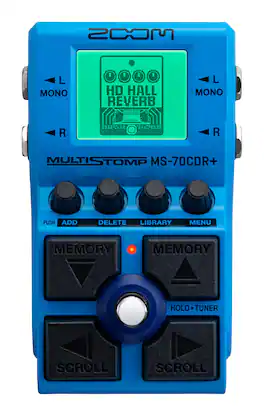
The Zoom MS-70CDR+ Multi-FX Pedal is a powerful, versatile effects processor offering 149 spatial effects, including 43 modulation effects like chorus, phaser, and flanger, 29 delays, 33 studio-quality reverbs, and 44 dynamics and filter effects such as EQs, compression, and noise reduction. Designed for guitars, synths, and line-level instruments, it features stereo input/output, flat-phase circuitry for precise attack and clean lows, and robust construction for touring. Up to six effects can be combined simultaneously, with 100 patch slots and 80 presets for easy tone creation. The pedal includes a built-in chromatic tuner, color-coded LCD screen, four multifunction encoders, and cross-key switches for intuitive control. USB-MIDI connectivity allows remote patch changes, and integration with the Handy Guitar Lab app expands your effect library. Flexible power options include USB bus power, two AA batteries, or a 9V adapter, making the MS-70CDR+ an ideal solution for live performance and studio recording, delivering rich, spacious, and customizable tones.
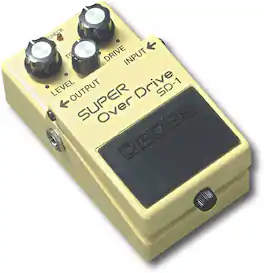
The SD-1 Super OverDrive pedal produces the warm, natural distortion of an overdriven tube amplifier while maintaining the subtle nuances of a player's picking technique. This is one of BOSS' more subtle and smooth overdrive pedals, perfect for blues and rock.

The classic DS-1 Distortion pedal provides a harder distortion effect for guitar and keyboard sounds. Instead of toneless, fuzzy distortion, the DS-1 faithfully reproduces all the subtle nuances of playing dynamics--at any volume.