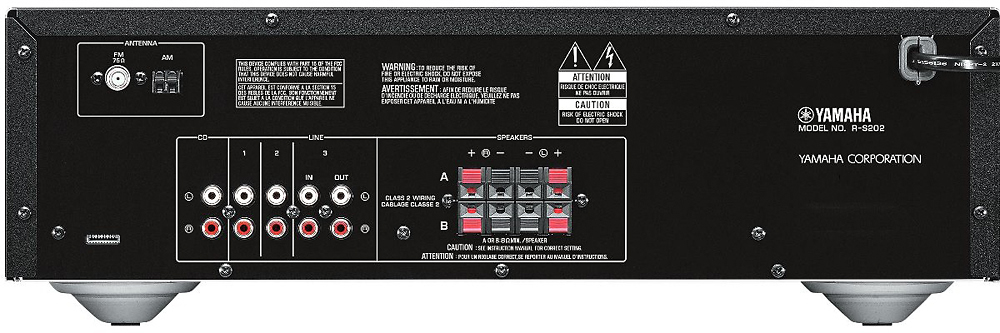
A:AnswerI haven't done this (with this particular receiver) but line 3 (on the rear of the receiver) appears to have both an "in" and "out" set of analog (RCA) jacks. This may provide you with a connection option. This receiver may or may not be compatible with an equalizer. Since an equalizer is typically used to process all input sources, compatibility may be an issue. If your intention is to process only one source with the equalizer, you may be able to connect that source to the input jacks on the equalizer and then connect the equalizer to an available analog input in the receiver.
The design of equalizer's can vary.
Since I'm not using it for this purpose, these are just possibilities. You should check the user's manual for the equalizer for connection options.
A:AnswerI paired this receiver with Klipsch speakers:
Klipsch - Reference Series 5-1/4" 340-Watt Passive 2-Way Bookshelf Speakers (Pair) - Black
Model: 1065839R51M
SKU: 6241808
Great match and the sound is terrific.
A:AnswerThis can be tricky!
It could be related to your speakers. They may need more wattage to power them to a higher volume, due to the way that they're designed (generally an impedence/ohms issue). It could also be an issue with your speaker cables. They deteriorate as they get older. They may need to be replaced.
It could also be a problem with the source device not providing enough volume to the receiver. Check to see if there's an output volume control on your source device
Lastly, you may have a defective receiver. Although it's unlikely, it's still a possibility. Good luck!
A:AnswerIf your TV has an analog audio output you can connect to the rear. Or if your tv has a Blue tooth output you may be able to connect with the receiver. otherwise no .
A:AnswerPutting two 8 ohm speakers in series will give you 16 ohms. If you use both the A and B output, this will essentially put the two 16 ohm circuits back in parallel, bringing the total load back to the amp back down to 8 ohms (depending on how the internals of the receiver handle the A/B switching). This should be ok, but keep two things in mind.
1, the total power of the amp will be shared across all the speakers (thus a lower overall volume at each).
2, if using the same speakers the volume should be the same at all the speakers. It will get more complicated with mismatched speakers, impedance, etc.
Avoid lower impedance speakers (i.e. 4 ohm). There are other solutions to what you want, but what you have in mind should be ok given the above criteria.
A:AnswerI use Boston Acoustic speakers which I purchased many years ago. They are fantastic. I had a Kenwood receiver which died after 40 years, which is why I purchased this Yamaha. I don't know if Boston speakers still exists or have been bought out. But I highly recommend them. The bass carries through our house, sometimes inconveniently to others but great for me. Good luck.
A:AnswerYes. The spring clip speaker outputs will only take bare wire or small pins though. If your current speaker cables have spade or banana connectors, just cut them off and strip the insulation back about 1/2". Hope this helps.
A:AnswerIf you have High Level Inputs on your sub, just use channel B and keep your Receiver in A/B Speaker mode. If you sub only has low level input, RCA jack, buy a line level RCA converter. https://soundcertified.com/how-to-connect-subwoofer-to-receiver-without-subwoofer-output/
A:AnswerThey play at the same level as the Speakers, so they should sound very similar in volume. you may still want to lower the volume and the bass (if you typically listen at high bass levels) to prevent possible ear damage. Another tip: make sure to turn off both Speaker zones before connecting headphones, that way it doesn't play through both.
A:AnswerHave some vintage Klipsch floor speakers that im using this receiver for , it does sound good , especially for some of my vinyls , im sure this can do the job as as long as your not expecting a whole bunch of bass,
A:AnswerI own this unit. It has a CD input and 3 line inputs. It does NOT have a phono pre-amp built in. Most modern turntables do, but mine is from 1974 (a Dual). I have an external phono pre-amp and it works great in 1 of the 3 line inputs. Turntables must have a pre-amp to work, be it built-in to the receiver, the turntable, or as in my case, an external 1.
A chromecast audio dongle is in my Line 2 input. Line 3 for me is empty. But, suffice to say, anything analog (RCA) left/right could be input into the receiver. There is also built-in Bluetooth. So, in total you can have 5 devices input to the receiver at 1 time, assuming one of those is Bluetooth, and the other 4 (CD, and Lines 1-3) are all analog (RCA).
The short answer to your question is yes.
See included photo for receiver i/o
A:AnswerIn order to connect a turntable to this receiver you will need either an external phono preamp or a turntable with one built in. Very cheap and easy to hook up. It will sound excellent with a turntable.
A:AnswerSpeakers are all about personal preference, I prefer and bought the Bose 301s, the Klipsch R-15M sounded a little too bright. Listen for yourself to decide.