Early Black Friday DealsNew Doorbusters through SundayShop now

Main Content
product image

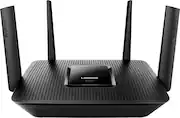
Linksys - Max-Stream™ AC2200 Tri-Band Wi-Fi Router - Black

Model: EA8300
SKU: 5788100
This item is no longer available in new condition. See similar items below
  • Key Specs
    • Wi-Fi Mesh System: false (A single wireless network consisting of a main router (connected directly to a modem) that connects to a series of satellite modules or nodes placed around the home. Routers with this capability promote stronger, faster wireless signals as well as increase Wi-Fi coverage by reducing interference and eliminating dead zones.)
    • Wi-Fi Speed: 2134 gigabits per second (The maximum rate at which data is transferred between a network device and wireless router.)
  • General
    • Brand: Linksys
    • Model Number: EA8300
    • Product Name: Max-Stream™ AC2200 Tri-Band Wi-Fi Router
    • Color: Black
  • Security
    • Data Encryption: true
    • Encryption Type: WPA, WPA2, WPA2-Enterprise (The security protocols or certification programs that protect the Wi-Fi network.)
    • Firewall Type: Other, SPI (The method the firewall uses to filter and process data to increase network security, primarily by blocking malicious traffic requests while allowing legitimate traffic through.)
    • Security Features: true
    • Parental Controls: true (Allows user to block unwanted content, signals, channels, networks, etc. from being received or accessed.)
  • Network
    • Band Technology: Tri (Refers to the number of frequency bands used to wirelessly transmit an internet signal. For example, dual-band devices may use one 2.4 and one 5 GHz band, while tri-band devices may use one 2.4 and two 5 GHz bands. Multiple bands also provide more flexibility for designating connected devices to specific band use.)
    • Ethernet Standard: 10/100/1000 (Each standard is a variation of the IEEE 802.3 set of computer networking technologies known as Ethernet. New versions evolved to include higher bandwidth, different physical media, and other new and improved features. Standards are often denoted by speeds (in Megabits per second). For example, a 10/100/1000 Ethernet port transmits at 10 Mbps, 100 Mbps, and 1000 Mbps (1 Gbps).)
    • Number Of Connected Devices: 50
    • Number of Antennas: 4
    • Frequency Band: 2.4 GHz, 5.0 GHz (Bands may be grouped into categories such as low- and high-band VHF (Very High Frequency), low- and high-band UHF (Ultra High Frequency), or certain frequency channels (measured in MHz or GHz). Generally, higher frequencies transmit information faster but have shorter range than lower frequencies.)
    • Wireless Networking Standard: Wi-Fi 5 (The wireless networking standard used by the device. Each iteration of the standard developed by the Wi-Fi Alliance corresponds to an existing IEEE 802.11 protocol; for example, standard 802.11ac (or AC) is termed Wi-Fi 5. Refers specifically to the standard the device is designed to use, but ultimately determines product interoperability and backward compatibility including previous versions.)
    • Wireless Standard: AC, N (The wireless networking protocol used by the device. Each iteration of the protocol is based on the 802.11 standard developed by the Institute of Electrical and Electronics Engineers (IEEE) Standards Association. Denoted by letters following 802.11 (802.11a, 802.11ac, etc.), each version, published in alphabetical order, encompasses all previous versions.)
    • Number of 2.4Ghz Streams: 1 (A router's streams are like lanes on a highway. The more streams a router has, the less traffic congestion. Because the 2.4 GHz band is used to transmit wireless signals to a wide variety of devices, there is often high amounts of traffic on that stream. But with multiple streams, each can be designated to a specific device for optimal performance. For example, if one 2.4 GHz stream is assigned to one device, such as a desktop computer, it leaves the remaining streams open for guest users, devices that use more data, or devices with specific band compatibility.)
    • Number of 5.0Ghz Streams: 2 (A router's streams are like lanes on a highway. The more streams a router has, the less traffic congestion. The 5.0 GHz band provides high speed, short-range data transmission and typically has less traffic than the 2.4 GHz band. With multiple streams, each can be designated to a specific device for optimal performance. For example, if one 5.0 GHz stream is assigned to one device, such as a streaming media player, it leaves the remaining streams open for guest users, devices that need less data, or devices with specific band compatibility.)
    • Wi-Fi Mesh System: false (A single wireless network consisting of a main router (connected directly to a modem) that connects to a series of satellite modules or nodes placed around the home. Routers with this capability promote stronger, faster wireless signals as well as increase Wi-Fi coverage by reducing interference and eliminating dead zones.)
    • Ethernet Switch: true (Connects multiple devices to expand the Local Area Network (LAN).)
  • Certifications Listings & Approvals
    • ENERGY STAR Certified: false (Devices carrying the ENERGY STAR service mark, such as computer products and peripherals, kitchen appliances, and other products, generally use 20% to 30% less energy than required by federal standards.)
  • Features
    • Beamforming: true (A signal processing technique that enables a router to focus a Wi-Fi signal in a specific direction. The router determines where a connected device in the network is located and projects a stronger signal in that specific direction. This can result in faster and higher quality data transfer as well as reduced signal interference.)
    • Integrated Modem: true
    • Auto Connect: true
    • Auto Detecting: true
    • Wireless: true
  • Ports
    • Number Of WAN Ports: 1 (Number of devices able to be connected to the Wide Area Network (WAN). This type of port may simply be labeled "Internet," and it allows the device to share its internet connection with all devices connected to it via LAN ports.)
    • Port Type(s): RJ-45, USB (USB 2.0 connects external drives, gaming controllers, smartphones, MP3 players and other accessories.USB 3.0 transfers data faster than USB 2.0, but only when used with USB 3.0 devices.USB Type-C provides fast speeds and versatile power, featuring connectors with identical ends that plug in upside down or right side up. Adapters allow for video as well as backward compatibility.Thunderbolt provides ultra-high bandwidth for fast data transfer between devices featuring a Thunderbolt or MiniDisplayPort connection.HDMI allows you to connect a projector or display HD media on your HDTV or monitor.Media card slots allow you to transfer photos from your digital camera or camcorder.)
  • Speed
    • Wi-Fi Speed: 2134 gigabits per second (The maximum rate at which data is transferred between a network device and wireless router.)
    • Gigabit Ethernet Speed: true (Supports the gigabit Ethernet networking standard, which has a data rate of at least one gigabit per second, or 1,000 Mbps.)
    • Auto Speed Sensing: true
  • Compatibility
    • System Requirements: Latest versions of Google ChromeTM, Firefox®, Safari® (for Mac® and iPad®), Microsoft Edge and Internet Explorer® version 8 and newer (The software that a product must have for it to be able to integrate with another product.)
  • Dimensions
    • Product Height: 2.2 inches (The out of box height of the item. Height is measured as the vertical distance from the bottom of the item to the top as it would be primarily used or placed.)
    • Product Length: 6.4 inches (The out of box length of the item. Length is measured as the longest dimension of the item.)
    • Product Width: 8.4 inches (The out of box width of the item. Width is measured as the horizontal distance from one side of the item to the other as it would be primarily used or placed.)
    • Product Weight: 1.3 pounds (The out of box weight of the item.)
  • Warranty
    • Warranty - Parts: Not available
    • Warranty - Labor: Not available
  • Other
    • UPC: 745883731916

Satisfy bandwidth-hungry gaming and streaming demands with this Linksys Max-Stream Wi-Fi router. Its next-generation multiuser MIMO technology works four times faster than conventional routers, letting multiple users enjoy low-latency VR gaming and glitch-free 4K simulcasting. This tri-band Linksys Max-Stream Wi-Fi router provides wired network sharing with its four Gigabit Ethernet ports and a USB 3.0 connector.

Find the perfect Wi-Fi solution

  • Compatible with 802.11ac: Backward compatible with 802.11a/b/g/n networks, so you can easily upgrade.
  • Up to 2.2 Gbps data transfer speed: For fast, efficient operation.
  • 256MB flash memory: Plus 256MB RAM promotes optimal performance.
  • MU-MIMO technology: MU-MIMO gives every compatible device its own dedicated full-speed Wi-Fi connection, so that multiple devices can connect at the same time without slowing down the network.
  • 1 USB 3.0 port: Allows you to connect a printer and enjoy 3G and 4G file sharing.
  • Parental control: Lets you automatically block specific content on connected devices.
  • Complies with a variety of standards: Including FCC.
  • Gigabit Ethernet connectivity: Offers a high-speed wired network connection.
  • Auto detecting and auto sensing: To simplify device connectivity.
  • LED indicators: Make it easy to monitor the status of your network.
  • Encryption: Includes 128-bit WEP, 64-bit WEP, WPA, WPA2, 128-bit AES and WPA2-enterprise to keep your network secure.
Whats Included
  • Linksys EA8300 Max-Stream™ AC2200 Tri-Band Wi-Fi Router
  • Network cable

Q: What is the distance you can get wifi from?

A: I have it in a closet and get coverage throughout my 2700 square feet single story house and part of backyard. Speed is less in far corners.

Q: Is this router compatible with Comcast?

A: this is just a router not a router modem combo so yes it will work with comcast but you need a modem as well

Q: Can this be mounted flat against the wall with the antennas point upward parallel to the wall?

A: yes it has two slots it can be mounted vertical antennas up or 180 degrees down

Q: I am getting horrible speeds downstairs in an 1800 square foot house. I was told this router would not have a problem reaching. Why am I having slow speeds with an extender?

A: There could be a number of reasons. Things to look at would be: - where is the router located in your house? Is it at one end, in the center? etc. Try to get it as close to center as possible. - what style house do you have? If you have a ranch, 1800 sq. ft. on the main level is a lot, and that usually means a large basement. A colonial or tri/quad level is more boxy so you won't have as far to reach. Again, try to get the router near the middle. - what is near the router, the extender or your end device? Do you have any other wireless devices nearby such as a printer with wireless, a 2.4 GHz cordless phone, a microwave, or anything else similar that may be emitting interference? - is there anything in between it and where you are having issues? such as structural beams or heating/cooling duct work between the router and the problem area? If so, move the router. - how do you have the antennas oriented? If the router is on a flat surface they should be straight up and down. The usual pattern for these types of antenna is a doughnut shape around the antenna. - you mention an extender in your question. What kind of extender is it? Is it 2.4 GHz only or dual band (2.4 and 5) and what is its max speed for each band? If you use an extender, you will greatly impact the speed at which an end device will communicate as it basically cuts your overall throughput to the router in half for each extender between you and router, in this case probably one quarter the max speed. On average your device connected to the router or the extender connected to the router will get about half the throughput that it says it's connected at. A budget extender will connect at 150 mbps which is shared up and down so about 75 up and 75 down. This doesn't factor in any performance decrease from interference, range, etc. When you connect to the extender you're going to get about half of that available throughput so now you're looking at 30'ish up and 30'ish down, again not factoring any performance decrease from other factors. Placement of the router is key. Place it so your high demand devices have the best chance to connect to it directly and use extenders where needed for low demand devices. I hope that helps.