A:AnswerHi Hihowareyou,
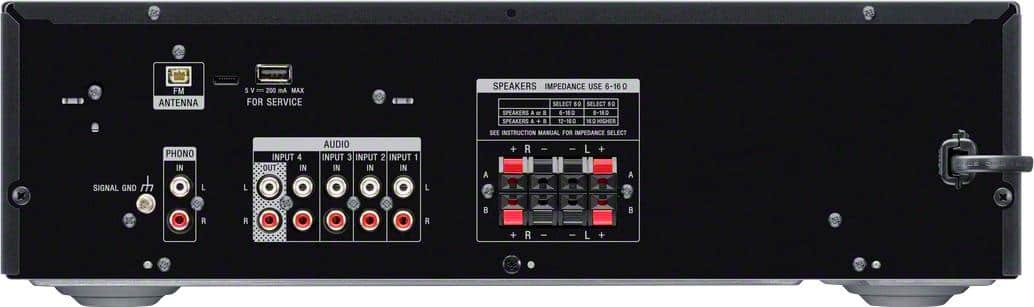
If your rokit 8 speakers speaker impedance is within 6-16ohms, you can connect the speakers directly to this AV Receiver. Check these link for more information.
https://www.sony.com/electronics/support/articles/00023429
https://docs.sony.com/release//SPECS/STRDH190_mksp.pdf
Regards,
-David
A:AnswerThe Bluetooth has an approximate range of 30 m or about 98 feet. Other paired devices can interfere with the connection, like microwaves, a wireless LAN and obstacles can also affect the connection.
A:AnswerHi WVMan, No, the unit is not designed for an external equalizer. You may refer to this link for more information:
https://www.sony.com/electronics/support/articles/00025111
~Ralph
A:AnswerCannot use 2 pairs (4 speakers) at 8 ohms. This receiver has a minimum of 6 ohms. Using 2 speaker pairs of 8 ohms, the receiver will "see" a total of 4 ohms. This will send the receiver into protective mode - or possibly damage the receiver.
A:AnswerHi rjpatty,
Channels are actually the number of speakers you can connect with the unit. So 5.2 meaning you can connect 5 speakers and 2 subwoofers.
Regards,
David
A:AnswerHi Hippy, Thanks for your inquiry. The current line of Sony® receivers do not have a tape monitor loop. For this reason, it is not possible to connect an add-on equalizer/amplifier to current Sony® AV receivers.
NOTES:
Most Sony® receivers feature a built-in Digital Signal Processing (DSP) Equalizer. The addition of an equalizer is not needed and would provide no additional benefit to the overall sound output of the receiver.
Regards,
Sam
A:AnswerHi ByAngelwings, Thank you for your interest in the STRDH190. With 8 ohm loads, both channels driven, from 20 Hz – 20,000 Hz; rated 90 watts per channel minimum RMS power at stereo
mode. Also make sure that the speakers are within the impedance rating of 6-16 ohms. Hope this helps! -Sam
A:AnswerHi there, Yes, you can delete and change a preset station on this unit. You can also store up to 30 FM stations as your favorite stations as preset stations. Please refer to this link for more information. Thanks! https://www.sony.com/electronics/support/res/manuals/4726/f63b8edb2b154409daa55875111f95e4/47269071M.pdf (page 25). -Sam
A:AnswerHi, cdome!
Yes, it will work on the A and B setup. Please take note that matching speakers and subwoofer with lower impedance (ohms) and watts than what the A/V receiver is rated may cause damage to the receiver and is not recommended
~Earl
A:AnswerThere maybe many reasons that may occur, but it appears the receiver is protecting itself. If there is a severe problem, I don’t think the protection light has to engage. Check the wiring of your speakers to see if any are crossed. It’s also an good idea to check all wiring including the power line.
Finally, there might be an internal issue.
If you cannot find any wiring issue and this continues you should give Sony a call.
A:AnswerShort answer, yes. According to the description, both pairs of speakers can be used at once, but this is two stereo setups, not surround sound. And my experience has shown that 8 ohm speakers work with most amps. It's the lower impediences that get you in trouble.;-)
A:AnswerNO. I leave mine powered on 24x7 to drive speakers connected to my Amazon Echo Dot. It's always ready to play any music I ask for from my streaming service.
A:AnswerYes, you can operate all four speakers at the same time. It has plenty of power to drive all four at a high volume level.
You can also mix speakers of different Ohm specifications (from 6 Ohm to 16 Ohm), as long as the speakers on A are the same and the B speakers are the same.
A:AnswerHi RGB3,
Thank you for the inquiry! Speaker wires that are anywhere between 12 to 16 gauge are most commonly used for connecting speakers to an amplifier or an Audio/Video (A/V) receiver. A lower-gauge number indicates a thicker wire, while a higher-gauge number indicates a thinner wire. Speaker wires with lower-gauge numbers are better at carrying an amplified audio signal. When determining which wire gauge to use, consider how far away the speakers are from your amplifier or A/V receiver. Generally, for short speaker wire runs, a 16-gauge wire is sufficient. However, for longer speaker wire runs (to another room, for example), it is better to use a thicker, lower-gauge wire.
Hope this helps!
-David