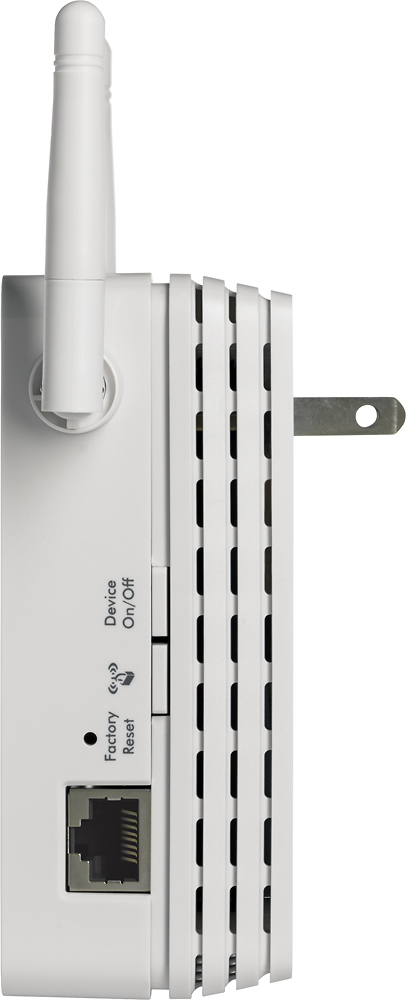
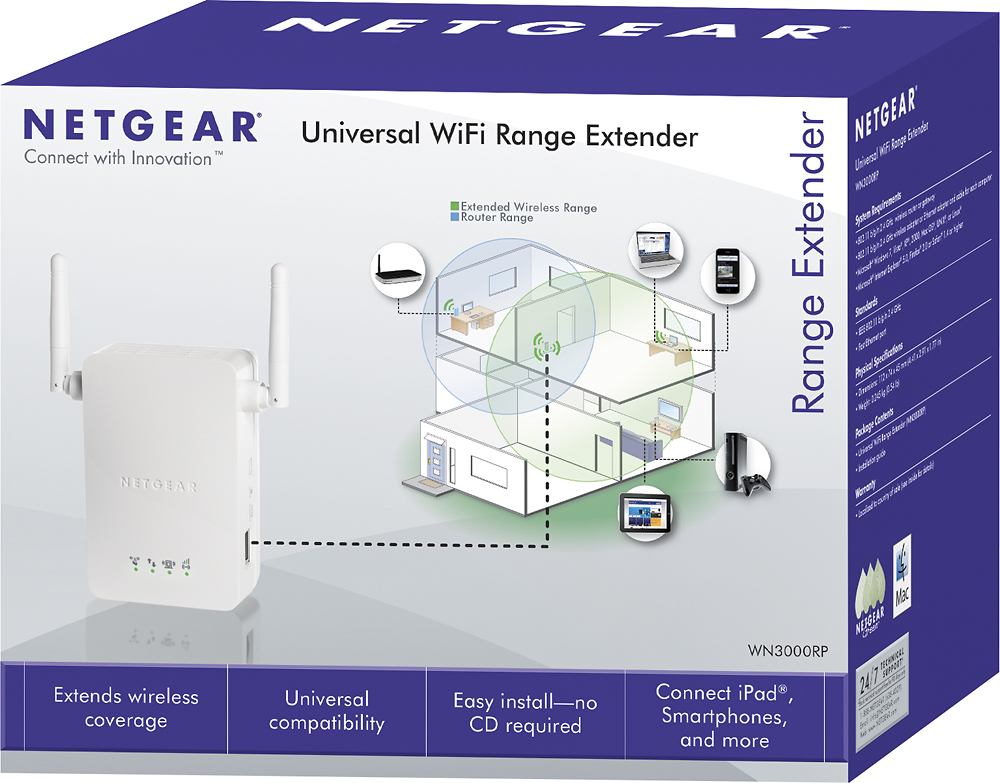
A:AnswerThe device setup next to your router is redundant and pointless. Your main router is already there. You want the extension, so yes, plug in after setup any room in center of the home or opposite side of the house. Try different outlets until you get the desired results. You will! This device is phenomenal. Works all day long with same signal strength strength presently supplied from your ISP provider.
Hope that helps!
God Bless
Woody
A:AnswerThere are quite a few. The AC750 uses a different wireless standard then the Universal one (802.11ac vs 802.11n). Also, the AC750 has dual band 2.4 GHz and 5.0 GHz, while the Universal only uses 2.4. For the average home user the AC750 is overkill as most computers coming from Dell, Toshiba and other big box suppliers aren't coming equipped with networking cards that support the extra speed and range of wireless 802.11ac. I'd go with the Universal if you are an average home user. If you are above average there are other dual band range extenders that may be cheaper or the same price that isn't using the 802.11ac standard. Likewise, if you are a power user, on the cutting edge of technology and know that your card is capable of 802.11ac and would like the new technology, then the 750 is great!
Any questions about wireless standards can be found by searching about it on Google or Wikipedia.
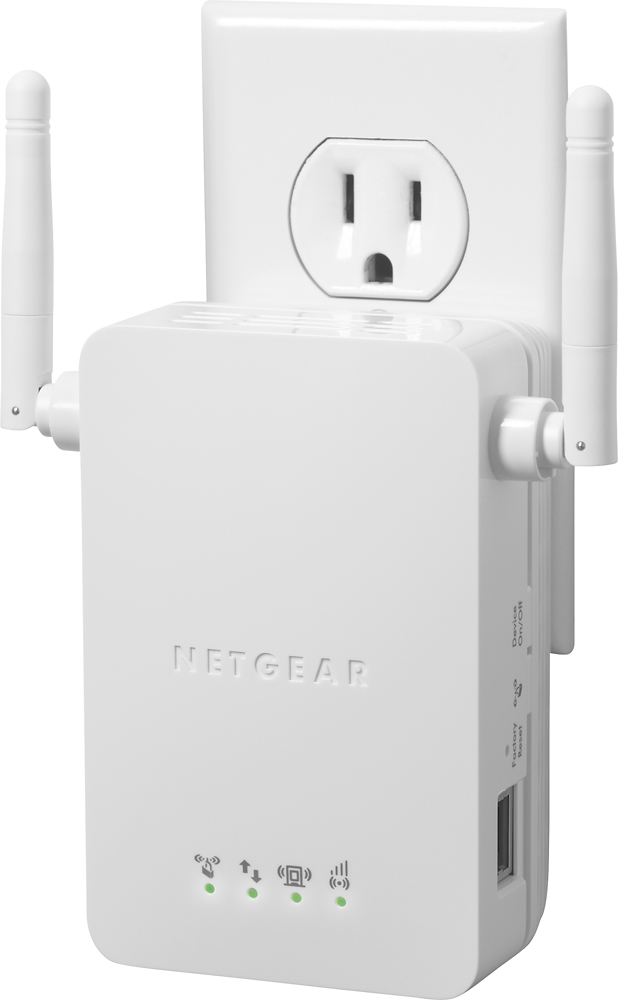
A:AnswerYour speed is determined by your plan through your ISP provider. It will not increase speed therefore, but will increase the signal from your main router anywhere in your home. You can simply plug it in anywhere and if you have more rooms than we had, buy a second or a third. For the price, it's unmatched and works like a champ 100% reliable.
Hope this helped as well.
God Bless
Woody
A:AnswerYes and hope you can see my other posts as well. Pairing not an issue. They all work the same way. Just a quick setup next to your router and the device picks up all necessary info and then just go plug it in any outlet, anywhere.
Hope this helped!
Best 49 bucks I've ever spent to solve similar problem.
Regards,
God Bless
Woody
A:AnswerEthernet cable not necessary unless you desire a direct connect. Back bedroom is router, 1000 ft. away is this device. I now have wifi in garage and backyard.
A:AnswerThis device worked well to extend signal inside a metal walled office, (with door open), where signal had been poor, or none. I was quite pleased to note that this Netgear device worked with two laptops running Linux Mint operating systems, which i switched to recently. No configuration necessary to run in Linux.
A:AnswerThe Netgear Extender will work perfect for you as well. I have a 2 story house (2200 SF), my cable modem and wireless router are all located in one room downstairs, and my second workstation office is upstairs on the opposite side of the house. I placed the extender in the same room as my second office. Works great and my PC receives 5 bars; it is as fast if not faster.
A:AnswerGenerally, the best place to install an extender is halfway between the devices needing a connection and the router. If that would be outdoors between two homes as in your case, pick an inside wall that is closest to the halfway point.
However, if the signal path passes through a wall or floor at a shallow angle, that can be worse than any distance problem. In that case you can get better results by installing an extender away from the direct line-of-sight between computer and router, so that the signal zigzags through walls and floors as perpendicular as possible.
I had horrible problems with only 50 feet between my computer and my router because my office is under concrete stairs supported by a concrete wall. I got excellent results with an inexpensive Netgear WN3000RP right outside my office, with a zigzag 90 degree path to dodge past the concrete.
A:AnswerYou don’t put it in the room where the signal is weak. You put it within the range of the router with decent strength that will reach the room you want to cover. To answer your question specifically, no. It will give you the strength of signal that the extender gets. If the signal the extender gets is no better than your device it does not “boost” the signal. I had a similar WiFi problem and I placed the extender in a hallway near the room that I wanted to cover. Now I get full house coverage. The only issue is that it is technically another network with its own login. My devices won’t jump networks until the signal becomes unusable.
A:AnswerSure. If you bridge the router and the extender via Ethernet, the extender will automatically act as an AP and only 1 SSID will be shown. But if you set the extender as WiFi repeater, 2 SSIDs will appear.
A:AnswerIt should help.
You do not connect via wire to your router or computer.
You plug into AC power, then it connects to your current WiFi network, then offers its own signal as an extension to your current WiFi network.
You can then connect to your current WiFi network if you're on that end of the house, or to the extender if you're working in the other end of the house(for instance).
A:AnswerIt should work. My internet box is in the basement and I placed the little box in my dining room so I could get WiFi on my deck. If you buy it and it doesn’t work you can return it to the store. I hope this helps
A:AnswerI have a Ring door bell that I am totally satisfied with, , but my wifi connection right outside the door would sometimes not be good enough to connect this device. After installing this extender, no more problems. The ring door bell has a camera similar to the Nest product, and I would try this extender to help, it should work fine.
A:AnswerNo. It extends the range of your Wifi. Especially important if your Modem is on one corner of the house and you need it to extend on the other side other of the house with adequate strength.