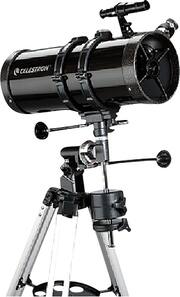
View the night sky with this telescope that features a 3x Barlow lens for enhanced magnification and high-transmission optical coatings for bright, clear images. Slow-motion controls allow smooth tracking.
Q: I'm a first time telescope buyer,I don't have a clue! Advise please!
A: The PowerSeeker 127EQ is a fine beginner's telescope to see celestial objects. Why? Because it features a 5" primary mirror which gathers a lot of light that helps bring out plenty of detail, so you'll have no problem seeing Jupiter's cloud bands and four of its brightest moons, Saturn's magnificent rings, and even Mars' polar ice caps during its close opposition to Earth. Our moon will appear bright and crisp with many craters, mountain ranges and valleys visible. You can also see bright nebulae, galaxies and star clusters, but the darker the sky, the more you will see. If you have any further questions, our product experts in Technical Support are always willing to assist you. They can be reached by emailing them at [email protected]. Good luck on your decision! Sincerely, Garrett at Celestron
Q: Is their a smartphone adapter available
A: Yes, Celestron offers a Basic Smartphone Adapter, 1.25" #81035 and also a NexYZ 3-Axis Universal Smartphone Adapter #81055 which are both compatible with the PowerSeeker 127EQ Newtonian Reflector Telescope. Sincerely, Garrett at Celestron
Q: will the view be upside down, or right side up?
A: Using the included 25mm erect image eyepiece with the PowerSeeker 127EQ telescope, the image will be right side up image and corrected right to left. Sincerely, Garrett at Celestron
Q: What can you see with this telescope and how well can you see it?
A: The PowerSeeker 127EQ's primary mirror gathers plenty of light to reveal countless lunar features including craters, maria, valleys, and mountain ranges. The telescope will also reveal Saturn's rings, Jupiter's four brightest moons, double stars, bright open star clusters, and more. From a dark sky site, you will be able to observe globular clusters, galaxies, and nebulae.
Q: Can you hook a phone/computer up to it to get pictures through the eye?
A: You can attach a smartphone adapter to the PowerSeeker 127EQ telescope's eyepiece to take cell phone photos of the Moon or planets. It can be used for terrestrial photography during the daytime too.
A: The PowerSeeker 127EQ uses an equatorial mount with slow motion control knobs and is not a Dobsonian-style mount which can be manually moved up-down-left-right. The optical tube is 5" and not 10" in aperture.
Q: Is the primary mirror parabolic?
A: The PowerSeeker 127EQ Newtonian Reflector Telescope's primary mirror is spherical and not parabolic.

View the night sky with this telescope that features a 3x Barlow lens for enhanced magnification and high-transmission optical coatings for bright, clear images. Slow-motion controls allow smooth tracking.

Celestron has reinvented the manual telescope with StarSense Explorer—the first telescope that uses your smartphone to analyze the night sky and calculate its position in real time. StarSense Explorer is ideal for beginners thanks to the app’s user-friendly interface and detailed tutorials. It’s like having your own personal tour guide of the night sky. Dock, Launch, Explore. Leave complicated star charts, imprecise planetarium apps, and computerized mounts behind. With StarSense Explorer, locating objects has never been easier, faster, or more accurate. Within minutes of setting up the telescope, you’ll be navigating the sky with confidence. Simply place your phone in the unique StarSense dock and launch the StarSense Explorer app. After aligning your phone to the telescope’s optics (a quick, 2-minute procedure), StarSense Explorer generates a list of celestial objects currently visible. Make your selection and arrows appear onscreen, guiding you as you to move the telescope. When the object is ready to view, the bullseye turns green. Smartphone Compatibility-StarSense Explorer works with most modern smartphones; it is compatible with Android 12 and later, as well as iOS 18 and newer, including iPhone XR and newer models. Users with older phones can still use this app, but will not be able to reinstall the app if they uninstall it. Patented StarSense Sky Recognition Technology-StarSense Explorer uses patented technology and your smartphone to determine exactly where the telescope is pointed in the night sky. A Lost in Space Algorithm (LISA), like the ones satellites use in orbit to correctly orient themselves, helps the app match star patterns it detects overhead to its internal database. While other astronomy apps may claim that they can help you find objects, they rely exclusively on the phone’s gyros and accelerometers, which aren’t as accurate as LISA technology. No other app can accurately tell you when your target is visible in the eyepiece. Sturdy Altazimuth Mount, StarSense Explorer LT’s simple altazimuth mount makes it easy to move the telescope to find your target. An altitude slow motion adjustment with a sliding rod helps you fine tune the telescope’s pointing position and follow targets as they appear to drift across the night sky. It’s all anchored by an adjustable, full-height tripod.Dazzling Views with High Quality Optics. With a large 114mm (4.5”) objective lens, this telescope has enough light gathering ability to bring out detail in celestial objects. You can expect sharp, bright views of Jupiter’s four Galilean moons, its cloud bands and Great Red Spot, the rings of Saturn, the trapezium in the Orion Nebula, and beautiful Pleiades Open Star Cluster. Perfect for the City or Dark Sky Sites. Even if you live in a light polluted city location, StarSense Explorer is advanced enough to be able to pick out Jupiter, Saturn, Venus, the Orion Nebula, double stars, and a few more of the most famous celestial objects. But if you can take the telescope to an even slightly darker location, more objects will become visible. With this 4.5” Newtonian and relatively dark skies, the Andromeda Galaxy, Hercules Open Star Cluster, and so many more are easily within your reach. The entire telescope kit weighs just 10.4 pounds, so it’s perfectly portable and easy to bring on your next camping trip or to a remote observing site.Everything You Need to Observe Immediately. When you unbox your new StarSense Explorer LT, you’ll find:114mm Newtonian reflector optical tube, StarSense dock for your smartphone, Low powered (25mm) and high powered (10mm) Eyepiece, 2x Barlow lens to double the power of each eyepiece, StarPointer red dot finderscope, perfect for using the telescope during the day or without the StarSense Explorer app, Altazimuth mount with slow motion control rod, Full-height tripod with an accessory tray to keep you organized

Celestron has reinvented the manual telescope with StarSense Explorer—the first telescope that uses your smartphone to analyze the night sky and calculate its position in real time. StarSense Explorer is ideal for beginners thanks to the app’s user-friendly interface and detailed tutorials. It’s like having your own personal tour guide of the night sky. Dock, Launch, Explore-Leave complicated star charts, imprecise planetarium apps, and computerized mounts behind. With StarSense Explorer, locating objects has never been easier, faster, or more accurate. Within minutes of setting up the telescope, you’ll be navigating the sky with confidence. Simply place your phone in the unique StarSense dock and launch the StarSense Explorer app. After aligning your phone to the telescope’s optics (a quick, 2-minute procedure), StarSense Explorer generates a list of celestial objects currently visible. Make your selection and arrows appear onscreen, guiding you as you to move the telescope. When the object is ready to view, the bullseye turns green. Smartphone Compatibility. StarSense Explorer works with most modern smartphones; it is compatible with Android 12 and later, as well as iOS 18 and newer, including iPhone XR and newer models. Users with older phones can still use this app, but will not be able to reinstall the app if they uninstall it. Patented StarSense Sky Recognition Technology-StarSense Explorer uses patented technology and your smartphone to determine exactly where the telescope is pointed in the night sky. A Lost in Space Algorithm (LISA), like the ones satellites use in orbit to correctly orient themselves, helps the app match star patterns it detects overhead to its internal database. While other astronomy apps may claim that they can help you find objects, they rely exclusively on the phone’s gyros and accelerometers, which aren’t as accurate as LISA technology. No other app can accurately tell you when your target is visible in the eyepiece.High Quality Altazimuth Mount with Slow Motion Control An ultra-stable altazimuth mount provides a sturdy foundation for StarSense Explorer DX. Slip clutches and geared slow motion controls in both axes help you move the telescope smoothly and zero in your target. As celestial objects appear to drift across the night sky, you’ll be able to follow them with just a few turns of the knobs. It’s all anchored by an adjustable, full-height tripod. Dazzling Views with High Quality Optics. With a large 102mm (4”) objective lens, this telescope has enough light gathering ability to bring out impressive detail in celestial objects. You can expect sharp, bright views of Jupiter’s four Galilean moons, its cloud bands and Great Red Spot, the rings of Saturn, the trapezium in the Orion Nebula, and beautiful Pleiades Open Star Cluster. Celestron’s XLT optical coatings improve light transmission, enhancing the views even more. The telescope also includes a 90-degree erect image diagonal, so you can use it during the day to view birds, wildlife, landscapes, and more. Perfect for the City or Dark Sky Sites. Even if you live in a light polluted city location, StarSense Explorer is advanced enough to be able to pick out Jupiter, Saturn, Venus, the Orion Nebula, double stars, and a few more of the most famous celestial objects.But if you can take the telescope to an even slightly darker location, more objects will become visible. With this 4” refractor and relatively dark skies, the Andromeda Galaxy, Hercules Open Star Cluster, and so many more are easily within your reach. The entire telescope kit weighs just 14.2 pounds, so it’s perfectly portable and easy to bring on your next camping trip or to a remote observing site. Everything You Need to Observe Immediately. When you unbox your new StarSense Explorer DX, you’ll find: 102mm refractor optical tube, StarSense dock for your smartphone, Low powered (25mm) and high powered (10mm) eyepiece, 90-degree erect image diagonal, StarPointer red dot finderscope, perfect for using the telescope during the day or without the StarSense Explorer app, Altazimuth mount with slow motion controls, Full-height tripod with an accessory tray to keep you organized.

Explore space with this Celestron Inspire refractor telescope. Its fully coated glass optics prevent glare and provide a wide field of view, while the altazimuth mount sits on top of a rugged steel foldable tripod. This Celestron Inspire refractor telescope has a rubberized smartphone adapter so you can easily take pictures of telescopic images.
| Pros for Celestron - PowerSeeker 127EQ Newtonian Reflector Telescope - Black | |||
|---|---|---|---|
| There were no pros for this product— | Ease of use, Image Quality, Price, Clarity, Setup | Overall Performance, Ease of Use | There were no pros for this product— |
| Cons for Celestron - PowerSeeker 127EQ Newtonian Reflector Telescope - Black | |||
| There were no cons for this product— | Magnification, App Functionality, Tripod Stability, Alignment, Instructions | There were no cons for this product— | There were no cons for this product— |
The vast majority of our reviews come from verified purchases. Reviews from customers may include My Best Buy members, employees, and Tech Insider Network members (as tagged). Select reviewers may receive discounted products, promotional considerations or entries into drawings for honest, helpful reviews.
Easy to assemble. Great looking piece. Sturdy tripod which is a plus. But the up-and-down level and adjustment screws could be better they tend to slip and once you get the telescope calibrated or set to the right position you really don't want it to move.
This review is from Celestron - PowerSeeker 127EQ Newtonian Reflector Telescope - Black
Lostinthawt Posted
48 year old beginner here with looking into the sky. For a first telescope I found it pretty easy to calibrate the finder scope with the main scope (follow directions). Using a "smart" phone with Google Sky app to first locate planets to seek out with the telescope is a great combination! I hold my phone towards the sky and the gps points out the spot. I have been using less than a month and take it outside most clear evenings to look at Jupiter (see its four main moons too) ,Neptune (glows like a blue jem!), The Moon ( bright and clear!,can see texture details!) I am sure there are more powerful and computer gps guided telescopes for prices up into thousand dollars +. This one I have is portable to take to other locations,quick setup. Still learning and having a blast looking into the sky! It amazes me! Someday will probably upgrade! This scope has me hooked! This summer will be better than after Christmas winter night looking. I plan on taking the scope out to better open locations away from city and suburban lights. Will be looking out over Cedar Lake Indiana skies all summer!
This review is from Celestron - PowerSeeker 127EQ Newtonian Reflector Telescope - Black
northdrummer Posted
We've seen some great views of the craters on the moon, though at top magnification the view passes quickly. However, the fine tuning worked great to help keep the portions we were watching in our sight after a little practice. First time I had seen Jupiter with 4 moons in view. It was great.
This review is from Celestron - PowerSeeker 127EQ Newtonian Reflector Telescope - Black
Superstrait Posted