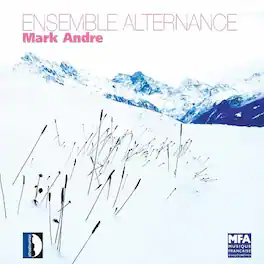
Ensemble Alternance - Fall from the Perfect Ground - COMPACT DISCS [CD]
Reviews coming soon
About this product
Album Tracks 1. A Fall from the Perfect Ground 2. Deux Sonnets de Borges 3. Mirages 4. Moonlit 5. Prã‰Lude - Voyage - Jotunheim
Specifications
- GenreClassicalDescriptionAlbum Tracks 1. A Fall from the Perfect Ground 2. Deux Sonnets de Borges 3. Mirages 4. Moonlit 5. Prã‰Lude - Voyage - JotunheimArtistEnsemble AlternanceTitleFall from the Perfect GroundFormatCDLabelDa Capo Open Spaces
Reviews
This product doesn't have any reviews yet.
Compare similar products
![Ensemble Alternance - Fall from the Perfect Ground - COMPACT DISCS [CD]](https://pisces.bbystatic.com/image2/BestBuy_US/images/products/1cb31ba3-5ebf-4bd0-b711-699c6a3c90f0.jpg;maxHeight=422;maxWidth=264?format=webp)
Album Tracks 1. A Fall from the Perfect Ground 2. Deux Sonnets de Borges 3. Mirages 4. Moonlit 5. Prã‰Lude - Voyage - Jotunheim
Album Tracks 1. IV 4, for Ensemble Iv4-1 2. IV 4, for Ensemble Iv4-2 3. IV 4, for Ensemble Iv4-3 4. IV 4, for Ensemble Iv4-4 5. IV 4, for Ensemble Iv4-5 6. Contrapunctus, for Piano & Ensemble 7. '... Zum Staub Sollst Du Zurückkehren... ', for Ensemble 8. IV 3, for Clarinet & Ensemble 9. IV 2, for Cello & Ensemble
![Rest Ensemble - Chamber Music - COMPACT DISCS [CD]](https://pisces.bbystatic.com/image2/BestBuy_US/images/products/23cd1ed7-1414-4b21-a044-febdc9996d34.jpg;maxHeight=422;maxWidth=264?format=webp)
The Milanese composer Riccardo Malipiero was born in Milan in 1914 and took lessons with his uncle, Gian Francesco Malipiero in the late 30s. Malipiero disowned all that he wrote up until 1938 and saved only a small amount of that written before 1945 the surviving early pieces show the influence of his uncle's teaching and the neo-classicism of Casella and Stravinsky. However, influenced by Luigi Dallapiccola, he came to embrace a personal, lyrical language of 12-tone composition which ultimately traces it's roots back to the music of Berg. The four-movement Violin Sonata from 1956 makes an ideal introduction to Riccardo Malipiero's music, with a nervous, waltz-like Scherzo and a frozen slow movement leading into the finale's extensive violin cadenza, beautifully written for the instrument and played here by Rebecca Raimondi with burning conviction as well as ferocious accuracy (she included the sonata within her Master's recital at the Guildhall School of Music and Drama, from which she graduated in 2017). At her graduation recital she was accompanied by Alessandro Viale, and together with the other members of the Rest Ensemble they have given concerts of Malipiero's music in both the UK and Italy, lending to these studio recordings the ring of intimacy and impassioned authenticity that is rare in recordings of unfamiliar modernist music. The Piano Trio of 1969 sets a tougher challenge to both performers and listeners, more angular and explosive, yet still imbued with a strain of wit and grace that runs through his output. Album Tracks 1. Sonata (1956) for Violin and Piano 2. Ciaccona Di Davide (1970) for Viola and Piano 3. Mosaico II (Hommage to Rodolfo Lipizer) (1987) for Violin Solo 4. Trio (1968) for Piano, Violin and Cello
![Ensemble Alternance - Surface - COMPACT DISCS [CD]](https://pisces.bbystatic.com/image2/BestBuy_US/images/products/44dee7e6-78db-4283-b3f0-b4da71ee289f.jpg;maxHeight=422;maxWidth=264?format=webp)
I am very interested in the approach of Dan Flavin, Sol Lewitt, François Morellet, Ellsworth Kelly, Doug Wheeler... I am touched by the purity of the forms of their works, by their false pure appearance. In detail, there is chaos, a false symmetry, a disorganization. My music has not a function to represent these works. It is just their geometrical aspect which I incorporate, a vibratory geometry. Unstable edges give this vibration as that of a cell moving in the space. It is the vibration which gives this unstable shape but it moves in a fixed structure it is a simple metaphor of the organic cell. It is not completely a coincidence if I am attracted by visual forms proposing courses. The labyrinthic shape is a musical source of inspiration for me as well as the kaleidoscopic shape and moreover my way of writing the music brings me towards labyrinthic forms. (Ricardo Nillni) Born in 1960 in Buenos Aires, Argentina, Ricardo Nillni studied composition at the Faculty of Arts and Musical Sciences in Buenos Aires where he obtained in 1985 the license and the higher diploma of composition. At the same time, he studied contemporary techniques with Francisco Kropfl and worked at the Electroacoustic Music Center of Buenos Aires (LIPM).
Specs
Be the first to ask a question.
We’ll try to get your question answered within 24 hours by a Best Buy customer or brand representative.