Julian Perkins - MacDowell, Beach & Barber: Summer Dreams - American Piano Duets - COMPACT DISCS
Reviews coming soon
About this product
Both Beach and MacDowell were formidably accomplished pianists who wrote concertos in barnstorming virtuoso style, for themselves and their contemporaries to play, but they could also turn their hand to the lucrative domestic market for piano-duet music. In doing so they also tapped into the 19th-century, Romantic preoccupation with childhood which Schumann had encapsulated in his Kinderszenen of 1838.MacDowell wrote his Moon-Pictures Op.21 in the winter of 1884-5 and subtitled them 'after H.C. Andersen's Picture-Book without Pictures', referring to an 1848 collection of short bedtime stories. Published in 1901 and dedicated to the composer's niece, the six duets of the album's title collection, Summer Dreams by Beach, are shorter and technically simpler than the Moon-Pictures, but they are prefaced by literary quotations which once more indicate that this is not music for children so much as music for adults to play to children, and for adults to play at being children. In any case, simpler means and fewer notes need hardly imply naivety of expression, and Beach's self-taught technique was too rigorous to allow anything less than the most deftly fashioned work to escape her desk. Composed in 1883, Beach's brief 3 Movements for piano duet are the work of a prodigiously talented teenager who knows her early-Romantic piano literature - including Kinderszenen - inside out, but who also understands at this stage how to emulate rather than merely copy her models. In the following year of 1884, the 23-year-old MacDowell wrote his 3 Poems Op.20. Strictly speaking, Hamlet and Ophelia is the outlier in this collection, since MacDowell composed it in 1894 as a tone-poem for orchestra in the Lisztian manner, and then made this two-piano transcription rather than leaving the work to the kind of professional arranger habitually commissioned by publishers for such work. Nevertheles
Specifications
- GenreClassicalDescriptionBoth Beach and MacDowell were formidably accomplished pianists who wrote concertos in barnstorming virtuoso style, for themselves and their contemporaries to play, but they could also turn their hand to the lucrative domestic market for piano-duet music. In doing so they also tapped into the 19th-century, Romantic preoccupation with childhood which Schumann had encapsulated in his Kinderszenen of 1838.MacDowell wrote his Moon-Pictures Op.21 in the winter of 1884-5 and subtitled them 'after H.C. Andersen's Picture-Book without Pictures', referring to an 1848 collection of short bedtime stories. Published in 1901 and dedicated to the composer's niece, the six duets of the album's title collection, Summer Dreams by Beach, are shorter and technically simpler than the Moon-Pictures, but they are prefaced by literary quotations which once more indicate that this is not music for children so much as music for adults to play to children, and for adults to play at being children. In any case, simpler means and fewer notes need hardly imply naivety of expression, and Beach's self-taught technique was too rigorous to allow anything less than the most deftly fashioned work to escape her desk. Composed in 1883, Beach's brief 3 Movements for piano duet are the work of a prodigiously talented teenager who knows her early-Romantic piano literature - including Kinderszenen - inside out, but who also understands at this stage how to emulate rather than merely copy her models. In the following year of 1884, the 23-year-old MacDowell wrote his 3 Poems Op.20. Strictly speaking, Hamlet and Ophelia is the outlier in this collection, since MacDowell composed it in 1894 as a tone-poem for orchestra in the Lisztian manner, and then made this two-piano transcription rather than leaving the work to the kind of professional arranger habitually commissioned by publishers for such work. NeverthelesArtistJulian PerkinsTitleMacDowell, Beach & Barber: Summer Dreams - American Piano DuetsFormatCDLabelBrilliant Classics
Reviews
This product doesn't have any reviews yet.
Compare similar products
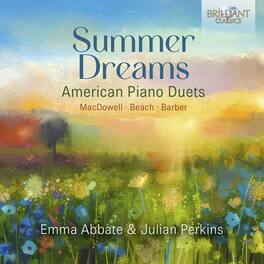
Both Beach and MacDowell were formidably accomplished pianists who wrote concertos in barnstorming virtuoso style, for themselves and their contemporaries to play, but they could also turn their hand to the lucrative domestic market for piano-duet music. In doing so they also tapped into the 19th-century, Romantic preoccupation with childhood which Schumann had encapsulated in his Kinderszenen of 1838.MacDowell wrote his Moon-Pictures Op.21 in the winter of 1884-5 and subtitled them 'after H.C. Andersen's Picture-Book without Pictures', referring to an 1848 collection of short bedtime stories. Published in 1901 and dedicated to the composer's niece, the six duets of the album's title collection, Summer Dreams by Beach, are shorter and technically simpler than the Moon-Pictures, but they are prefaced by literary quotations which once more indicate that this is not music for children so much as music for adults to play to children, and for adults to play at being children. In any case, simpler means and fewer notes need hardly imply naivety of expression, and Beach's self-taught technique was too rigorous to allow anything less than the most deftly fashioned work to escape her desk. Composed in 1883, Beach's brief 3 Movements for piano duet are the work of a prodigiously talented teenager who knows her early-Romantic piano literature - including Kinderszenen - inside out, but who also understands at this stage how to emulate rather than merely copy her models. In the following year of 1884, the 23-year-old MacDowell wrote his 3 Poems Op.20. Strictly speaking, Hamlet and Ophelia is the outlier in this collection, since MacDowell composed it in 1894 as a tone-poem for orchestra in the Lisztian manner, and then made this two-piano transcription rather than leaving the work to the kind of professional arranger habitually commissioned by publishers for such work. Nevertheles
![American Piano Duo - Two Pianos Eight Hands - COMPACT DISCS [CD]](https://pisces.bbystatic.com/image2/BestBuy_US/images/products/febe0c32-32f3-4695-8110-8b9e24716aed.jpg;maxHeight=422;maxWidth=264?format=webp)
Album Tracks 1. Stars and Stripes Forever (John Philip Sousa) 2. Waltz-Suite, Op. 8 Allegro Moderato (Moritz Moszkowski) 3. Waltz-Suite, Op. 8 Pesante E Lugubre (Moritz Moszkowski) 4. Waltz-Suite, Op. 8 Allegro Grazioso (Moritz Moszkowski) 5. Waltz-Suite, Op. 8 Vivace Assai (Moritz Moszkowski) 6. Waltz-Suite, Op. 8 Pomposo Ed Energico, Ma Non Troppo Allegro (Moritz Moszkowski) 7. Petite Suite en Bateau (Claude Debussy) 8. Petite Suite Cortege (Claude Debussy) 9. Petite Suite Menuet (Claude Debussy) 10. Petite Suite Ballet (Claude Debussy) 11. Sonata in One Movement in E Minor (Bedrich Smetana) 12. Spanish Dances, Op. 12 Allegro BR Ioso (Moritz Moszkowski) 13. Spanish Dances, Op. 12 Moderato (Moritz Moszkowski) 14. Spanish Dances, Op. 12 Con Moto (Moritz Moszkowski) 15. Spanish Dances, Op. 12 Allegro Comodo (Moritz Moszkowski) 16. Spanish Dances, Op. 12 Bolero; Con Spir Ito (Moritz Moszkowski) 17. Les Preludes (Franz Liszt)
![American Piano Duo - Rachmaninoff - COMPACT DISCS [CD]](https://pisces.bbystatic.com/image2/BestBuy_US/images/products/8300bf35-865f-47ab-af9d-01c4517d7bbb.jpg;maxHeight=422;maxWidth=264?format=webp)
Album Tracks 1. Gondola Song Allegretto (8 56) [Fantasy (Suite No. 1), Op. 5 (1893)] 2. The Night, and Love Adagio Sostenuto (5 26) [Fantasy (Suite No. 1), Op. 5 (1893)] 3. Tears Largo Di Molto (5 33) [Fantasy (Suite No. 1), Op. 5 (1893)] 4. Russian Easter Allegro Maestoso (2 30) [Fantasy (Suite No. 1), Op. 5 (1893)] 5. Introduction Alla Marcia (3 44) [Suite No. 2, Op. 17 (1900-01)] 6. Waltz Presto (6 04) [Suite No. 2, Op. 17 (1900-01)] 7. Romance Andantino (6 34) [Suite No. 2, Op. 17 (1900-01)] 8. Tarantella Presto (6 16) [Suite No. 2, Op. 17 (1900-01)] 9. Non Allegro - Lento - Tempo I (9 56) [Symphonic Dances, Op. 45 (1940)] 10. Andante Con Moto (Tempo Di Valse) (7 17) [Symphonic Dances, Op. 45 (1940)] 11. Lento Assai - Allegro Vivace (12 40) [Symphonic Dances, Op. 45 (1940)]
![Various Artists - Portuguese Music for Piano Duo - COMPACT DISCS [CD]](https://pisces.bbystatic.com/image2/BestBuy_US/images/products/e6df33c1-f9e6-4063-ad7f-2b34b98673ea.jpg;maxHeight=422;maxWidth=264?format=webp)
This precious collection of piano-four-hands works from the foremost musical minds of Portugal in the 20th and 21st centuries can serve as a welcome introduction to the classical music of Portugal for those who may not know it. But there is a greater significance and added value to this thoughtful recital programme, in that it traces back the genealogy of modern Portuguese classical composition - and pianism! - to roots firmly planted in German Romantic soil. It links the living composers to their teacher and inspiration, the great composer-ethnographer Fernando Lopes-Graça who undertook research into Portuguese folk music on a par with what Vaughan Williams and Bartók & Kodály did in their own nations, and then links Lopes-Graça back to his piano professor, the great virtuoso and music educator José Viana da Mota, himself a pupil and disciple of Liszt. The album opens fittingly with a set of Portuguese Folk Melody treatments by Lopes-Graça, the third in his three-volume set being dedicated exclusively to piano four hands. Immediately, the national colour welcomes listeners to the distinct ethnicity of Europe's far southwestern corner, a historic and pre-historic crossroads for Celtic, Roman, Gothic and Moorish cultures. This is followed by the Sonatina of his student, Sérgio Azevedo, bristling with the Neoclassicism he inherited from Lopes-Grac¸a. Then to the wellspring, Viana da Mota's Opus 7 singing with a Mendelssohnian lyricism, yet nonetheless tinged with the innate longing of the Portuguese soul. The expressionistic, effusive atonality of Lapa's Storyboard returns the listener to the modern era, and to finish, Victorino d'Almeida's heartfelt Ballad (for a child about to be born) embraces melody and tonality once again, from a post-modern vantagepoint. Album Tracks 1. Melodias Rústicas Portuguesas (Book 3) 2. Sonatina for Piano 4 Hands 3. Erinnerungen
Specs
Be the first to ask a question.
We’ll try to get your question answered within 24 hours by a Best Buy customer or brand representative.