Rating 4.7 out of 5 stars with 20 reviews
4.7- Audio Quality (17)
- Connectivity (8)
- Setup Ease (6)
- App Usability (4)
Customer Images
The vast majority of our reviews come from verified purchases. Reviews from customers may include My Best Buy members, employees, and Tech Insider Network members (as tagged). Select reviewers may receive discounted products, promotional considerations or entries into drawings for honest, helpful reviews.
- Rated 5 out of 5 stars
BlueSound Node Nano Updates Your Stereo to 2025!
BlueSound is a Canadian manufacturer of ultra high end audio gear. famous for their award winning streamers, BlueSound continues to innovate and release cutting edge audio products. I started with BlueSound Node Nano & was hooked with 24 bit, 192 K pure audio. I connected it to a premium quality amplifier & speaker system, and the results are amazing!! This brought my stereo system to 2025 standards; I can stream all of my favorite audio! I recommend the RC1 IR Remote, allowing 10 of your favorite streaming sources with the press of a button, as well as volume control. You can see this remote in the photos attached with this review. The sound of BlueSound 24Bit 192K must be heard to be believed!! It earns my highest recommendation!
Posted by gadgetguy11
- Rated 5 out of 5 stars
An absolutely fantastic network streamer
I’ve had the Nano for several days and can say that it is an extremely capable streamer. The Nano is AirPlay 2 compatible, has Spotify Connect, Tidal Connect, and can serve as an endpoint for Roon (although I could only get it to work via AirPlay). In addition, the Nano can unfold MQA and has Bluetooth input and output. It is controlled via iOS or Android apps and the BluOS app. On the backside of the unit, you have RCA outputs (which can be set at variable or fixed), coax and optical outs for an external DAC, an Ethernet and a USB connection. The USB-A connection can be used two different ways: Either to pull data from an external drive OR to send data to an external DAC with a USB input. The Nano resides in a small but nice stereo system that sits in my family room. I have the Nano plugged into a small integrated amp that drives a pair of ML floor speakers. The Nano has been set at fixed output, pushing sound through its internal DAC and out through the RCA outputs. The result? Amazing sound. I had planned on using an external DAC and the digital out of the Nano to drive it, but after comparing the two through my humble system, I see no need to utilize an external DAC. Set up was easy. Download the BluOS app, install it on my smartphone, log in (I had owned a Bluesound device prior), and it found the Nano immediately. After a 15-minute update, I was ready to go. Air Play streaming worked great, Spotify Connect worked well (had some issues with it not always connecting, sometimes it took several tries, and issue I didn’t have with other components at the time), and I was able to connect a Bluetooth turntable to the Nano (I thought that was pretty awesome!) and could stream records to the family room, something I had not been able to do before. The Nano sounded excellent. A sparkly, non-fatiguing treble matched up with firm, defined bass is the character I would describe the Nano as bringing to the table through its internal DAC. Very pleasant to listen to. I moved over to Roon. This is where I met my first and only challenge: The Nano was showing up as Roon Tested only, not Roon Ready in my Roon desktop. The Nano was only accepting AirPlay streams, which was annoying me a little (limited to 16/44.1). Fortunately, that little problem was easily resolved by rebooting the Nano. As soon as I did that, it showed up as Roon Ready, and I was streaming a 24/96 file of Pink Floyd’s ‘One of These Days’ in glorious high resolution. I moved through an assortment of music, streaming everything from standard 16/44.1 streams to 24/192 hi-res streams via the wireless connection. Everything sounded great, and I didn’t encounter any glitches or issues. I wanted to stream DSD files, and the Nano does support DSD, but apparently that is only via an attached USB drive. Regardless, Roon is more than capable of converting DSD to PCM that can be played by the Nano. I am very impressed by the Node Nano. It comes in a sleek, attractive package, has tons of streaming capability, a solid two-way AptX connection, and excellent internal DAC. I highly recommend this unit. If you are a Roon owner, this is the way to go. Super high cost to value ratio and highly recommended.
Posted by Derek
- Rated 5 out of 5 stars
Well Worth the Price of Admission
TLDR Audio products are always subjective. What appeals to one person, may or may not appeal to another. In my opinion, the BlueSound Node Nano is one of the best sounding streaming devices on the market. Superior in nearly every way to my current system. CONNECTIVITY RCA Analog Out RCA Coaxial Digital Out Optical Digital Out RJ-45 Ethernet / Wi-Fi USB-A Input IR Input 12V Trigger Out INTRODUCTION I was extremely interested in trying the BlueSound offering. My current home streaming system is composed of devices from the most popular household name in wireless streaming devices. These devices have served me well for many years. They have been easy to use and most importantly, the spousal acceptance factor has been high. Unfortunately, my love for the above devices has waned in the past couple of years. A recent home addition, equipped with these devices, left me wanting. Teaming their famous amp with a pair of 8” Sonance in-ceiling speakers sounded substandard. Worst yet, the speakers being installed in a 12ft ceiling left them next to impossible to change out. Add to that a recent app re-write made the app buggy and extremely difficult to use. The app has been much maligned on the interwebs and for good reason. Having no experience with a BlueSound product, I wasn’t sure what to expect. They are a smaller player in the overall market but have offerings that compete with the name brand in nearly every category. My experience with another major player in the market, who makes a full range of devices, including home theater receivers, also left me unimpressed. I felt their contributions were half-hearted and were not fully baked into their infrastructure. They were no competition to the major player and have never gained much of a foothold. Was the BlueSound Node Nano going to following in the runner-ups footsteps? SET-UP Having come from the newly redesigned app from the competition, I thought the BlueOS app couldn’t be any worse, and it isn’t. There is a learning curve to figure out the adjustments and settings of the Node Nano, but it isn’t extremely difficult. I would say that the BlueOS app isn’t as easy and intuitive as the Blue’s primary competitor’s app in the good ol’ days but is better than the current offering after the app redesign. Using my Android phone for set-up, device discovery and set-up went issue-free. One thing that was annoying / concerning is that, as expected, there was a firmware update pending after device set-up. The firmware update took an incredibly long time to complete. Upwards of 10 minutes or more. However, the update went without issue and once restarted, the Node Nano has functioned flawlessly. But anytime an update takes that long to complete, it always makes me a bit antsy. USE So, how does the Node Nano stack up against my current system? Does it have anything to offer that my extensive, current set-up does not? YES! The Node Nano has the goods. Like I said earlier, my home addition left me feeling lackluster about my current line of streaming devices. The audio is just not natural. It sounds overly compressed with awkward bass response and a lack of mid-range openness. This is something I haven’t been able to tune out of the system. I’ve tried. The mid-range frequencies just aren’t airy and open enough for my tastes. Regardless of my choice of streaming services, the audio quality wasn’t and isn’t there. The bass is uneven and artificial sounding. The low and mid-range audio just sounds muddied, even with lossless audio tracks. Hooking the Node Nano via a set of shielded RCA cables to the inputs of my current streaming app changed the game. An immediate and noticeable difference. The DAC in the Node Nano is far superior to the DACs in my current system. My annoyances with the mids and highs are gone. There is a sense of openness and spaciousness to the mid-range that has never been present in my existing system. The unnatural bass response now sounds cohesive and perfectly tuned to the mids. This is before doing any tweaking or optimizations. It may sound hard to believe, but the differences in the audio quality are strikingly better. Better than they have ever been. Once thinking there was an issue with the speakers, installation, or the wiring, those concerns are gone. I can’t give enough praise for the improvements in the audio quality. NEGATIVES First. The BlueOS app isn’t without issue. While it works mostly well, it isn’t flawless. For instance, the Amazon Alexa integration does not work. This is something that works correctly in my current app. Alexa integration shows it goes through, but it does not complete, and you cannot queue songs via voice. Second. Along with the Alexa issue is that the app doesn’t properly index and present your audio track options. Whether it be using Amazon Music or a local NAS for streaming, the tracks aren’t accessible via the All-Tracks option under the artist. While I can access a track via an album under the artist tab, you cannot just select all tracks and view multiple tracks via multiple albums from the same artist. This is something BlueSound’s competition does much better. Or at least they did much better. Third. There isn’t a great deal of audio customization available via the BlueOS app. Just basic Bass and Treble controls. There is no parametric equalizer or sound settings built in. Maybe this is by design, and to be fair, and I’m not sure it is needed, and in reality, may just add unnecessary processing artifacts to the digital signal. FINAL THOUGHTS Anyone shopping for a whole-home streaming infrastructure should give the BlueSound products a serious look. I find the audio quality and processing superior to the current big-name in the industry. BlueSound has a very robust product catalog with many offerings to outfit your home with nearly every streaming scenario available. If you are looking for a stereo streamer, soundbar, or a whole home theater solution, BlueSound has an offering. Whether it be in the form of their speakers or adding a streamer / amp to your existing speakers, the options are there and worth exploring. HIGHLY RECOMMENDED
Posted by NAMO
- Rated 4 out of 5 stars
Premium DAC and Streaming Music Player
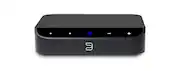
I've been testing the Bluesound Node Nano for about a week. Overall, I think it's a great premium DAC and streaming music player that's easy to set up and sounds fantastic. I just wish it included a remote control, a better power plug, and Chromecast compatibility. Look and Feel: The Bluesound Node Nano features a sleek, simple design that's very inconspicuous. There are 5 capacitive buttons on the front: 2 presets, play/pause, and volume up/down. On the back, it has 3 outputs: RCA, coaxial, and optical. It feels substantial and well-constructed, with the exception of the cheap cables and wall-wart power plug. The power plug comes with multiple international plug connectors, which is convenient for global use. However, a smaller power supply would have been preferable. Setup: Setup was quick and painless. I connected the Node Nano to my receiver using the included RCA cable and a separate, higher-quality power plug. Downloading the BluOS app from the Play Store and following the instructions was straightforward. My phone quickly discovered the Node Nano and connected it to the internet. After the initial connection, the device automatically began a firmware update, which took a bit longer than expected. However, the updateable firmware is a welcome feature. Once the update finished, the device was ready to use. Performance: The Node Nano works seamlessly with Tidal, Spotify, Deezer, and a multitude of other streaming services. Unfortunately, it doesn't support Chromecast, which is a bit disappointing. Hopefully, Bluesound will add this feature in a future update. With that said, I only tested it with Spotify and Tidal. With either app, the Nano performed flawlessly. Music quality was outstanding, song changes were instantaneous, and the Wi-Fi connection was rock-solid. The only downside was the reliance on my phone for track skipping. A separate remote control would have been a nice addition. Overall, I really like the Node Nano. I highly recommend it for anyone who wants to add high-quality streaming capabilities to a standard receiver or amplifier.
Posted by buckbabes
- Rated 5 out of 5 stars
Regarding music, it will suffer no hurt or damage.
Bluesound is practicing great musical medicine. In all its devices, including the Node Nano, Bluesound seems to operate on the principle that there should be a Hippocratic Oath for music reproduction equipment. Every effort is made to avoid distorting, compressing, filtering or diminishing the music streamed from our chosen sources. High Resolution streaming sources as well as my own network music servers offering FLAC (Tidal,etc), MQA (Tidal Masters), WAV (all CDs), AIFF (Apple hi-res), MPEG-4 SLS, DSD256 (SuperAudioCD) are supported, but so are compressed files types MP3, AAC (Apple), WMA, WMA-L, OGG (Spotify), ALAC (Apple), and OPUS. (Yep, even my older, awful files are accessible, although not improved.) Bluesound’s NODE NANO Wireless Streaming Media Player accesses many of the most popular and highest quality streaming services. The “tuning” is managed with the multi-room BluOS Controller App which can be downloaded for multiple device OS or directly from its front touch panel. This is a Hi-Res Digital to Analog converter (DAC) offering Jitter-free, 32-bit depth /384kHz response using a state-of-the-art ESS Sabre 9039Q2M chip for hi-res audio up to 24bit/192kHz (sometimes referred to as “Studio Masters” because they may represent what the sound engineers created in the studio) with a SN Ratio of -118dB. Today’s music streaming providers offer access to immense music collections and compete for our subscription dollars by offering best available selections and very high quality: Pandora, Spotify, Qobuz, Tidal, AirPlay2 (limited to 16bit/44.1kHz)(Apple Music), Amazon Music HD, iHeart Radio, SiriusXM and anything else in your private libraries connected to your Wi-Fi network. Of course the quality varies and some of you will have higher standards that I do. No matter, the Bluesound Node Nano has us covered. The BluOS CONTROLLER APP: I counted a total of 26 Music services, from Amazon Music to Deezer, Pandora, Qobuz, Spotify, Tidal, Tunify, and others plus a number of radio stations. They took a surprising amount of time to initially load using my iPhone14 (iOS 18.1.1) and fill the BluOS screen. I had enough time to search online to find out why it was taking so long or if I had a problem. I only needed some patience. You’ll need some more patience to sign into each service to be authorized to access it. The process was successful but there were random delays and I was directed to try again before the process completed on some services. Once a service (Amazon Music, Pandora, AirPlay2) was playing, I had no issues at all. As discussed below, the music experience was outstanding. I had no dropouts in my listening sessions. Bluesound provides a deep library of support materials but it’s not especially easy to appreciate because it’s not bound in a traditional operating manual. I could have used a web map of support links covering all those App features and settings. In the same way, a user supported help service is needed. I felt that the very esoteric, advanced issues were often better addressed than the very basic, new user questions. EQUIPMENT USED: I reviewed and compared music from a lengthy and varied selection of performers over this past week from various streaming services, including Amazon, Apple, Spotify, Pandora, and my local network. I prefer a mix of popular, alternative, classic rock and folk from 1960 to today’s newest releases, with “popular” classical and jazz added in. I also used AirPlay2 to send my Apple Music library to my connected system. I sent the output of the BlueSound NODE NANO to my home-made “portable” Class D stereo amp and its modest speakers. I did the same using a favorite, older Sony AV amp and its attached, newer B&W bookshelf speakers, and finally to my larger Parasound Amp and Martin Logan floor standing speakers. Listening varied from a smaller intimate setting to a massive living space. WHAT I’M HEARING: I can only speak for myself when I declare that the stunning detail, the breath of response, the wide stereo separation, background silence and dynamic range that I’m enjoying meets my expectations for the best possible musical performances from my recordings. I hear exactly what I remember from the somewhat more compressed, slight limited dynamics and frequency response of my 1960s-80s music favorites. Newer music from post-2000 musical performances leap out with stunning bass lines, sometimes rising out of the floor boards, and lifted into the musical stratosphere by thrilling songbirds. The Bluesound Node Nano makes a powerful defense on behalf of digitized music with the end user invited to find a music library that they prefer and that meets their technical requirements. The BluOS Controller makes managing sources easy, fun and flexible. It contributed significantly to the entire experience although there are many features that I’ve found only after some experience. Strongly recommended.
Posted by TECHBEENGOOD