Rating 4.4 out of 5 stars with 265 reviews
4.4- Overall Performance (66)
- Power (44)
- Ease of Use (33)
- Noise Level (26)
- Storage (8)
- Hose Quality (9)
Customer Images
The vast majority of our reviews come from verified purchases. Reviews from customers may include My Best Buy members, employees, and Tech Insider Network members (as tagged). Select reviewers may receive discounted products, promotional considerations or entries into drawings for honest, helpful reviews.
- Rated 4 out of 5 stars
Works as expected and seems well made.
Seems well made and works well. Nice having variety of nozzles. Will look into getting a longer hose to make roof cleaning easier. Not sure if they offer this or if I can get adapters to use with other hoses. Much quieter than gas powered. A good buy.
Posted by EnriqueM
- Rated 5 out of 5 stars
Money well spent
A little hesitant with electric being my last three were gas. I figured I would go a new route and it has not disappointed yet and has the same power. If not a little more than my 3200 psi craftsman it is a lot quieter. I am pleased I do not have to worry about gas And oil ..
Posted by Kicker
- Rated 3 out of 5 stars
Just another electric pressure washer
Definitely not 3000 psi. And it's a 1.2 GPM. It says that in super tiny print on the box in one location. The 2.0 GPM is for when you're spraying soap water, which is definitely nowhere near even a thousand PSI, more like 100 maybe if that. I will say it looks cool. It works, but no better than any other 1900 PSI electric pressure washer. The turbo nozzle has failed on me in less than a month, I had to buy another one. I'm not too happy with the purchase even though I did buy it when it was on sale. I feel I paid too much money for a pressure washer that is just as weak as any other electric pressure washer. Had I paid full price I'd be really upset. I wonder why all these new electric pressure washers are boasting power that they don't have. There used to be a thing called false advertising, I don't know how that went out the window all the sudden.
Posted by Miles
- Rated 5 out of 5 stars
Powerful power Washer
I am very satisfied with my purchase! This product is powerful, delivers superb performance, easy to assemble, and is user-friendly! Just a friendly reminder to turn off the machine when changing nozzles for safety! The product meets my expectations!
Posted by SonyOLED
- Rated 4 out of 5 stars
Does a great job cleaning with a few quirks
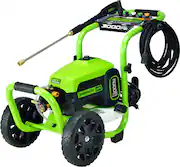
The Greenworks - 3000 PSI Pro Electric Pressure Washer has plenty of power and flexibility to handle a number of jobs. My primary use for pressure washing is vinyl siding, walkways, concrete surfaces, my small deck, and my vehicles. The unit ships with five nozzles. Each nozzle provides a different amount of pressure and spray width. Unfortunately, the user’s guide will only tell me the angle of each nozzle and what job the nozzle was designed for. So, I cannot give you an exact PSI output rating for each nozzle. I’m assuming the full 3000 PSI is present but the nozzle width dampens that pressure so as not to overpower the project. What I can tell you is that the Turbo nozzle will provide the maximum pressure possible. More on that later. The pressure washer is easy to assemble, hoses are easy to connect, the motor is quiet for a compressor motor, and the unit is easy to move around and store. Setup: Setup took about half an hour. Unpacking the box was like unpacking a puzzle. The parts were well packed and protected. They just won’t go back into the box the way they came out. The main body ships as a single piece. The easiest way to unpack the main body is to open the bottom of the box and then lift the box up over the part. Some assembly is required. See photos for a layout of all the parts. The only tool you will need is a Philips screwdriver. The handle slides into two pipes on the end of the Greenworks Pro Jetflow’s frame. There are two bolts and knobs that secure the handle. The deck that holds the five nozzles, hose, and gun connect to the handle via four screws. There are four threaded housings counter sunk into the handle. This gives the deck a solid, flat surface to mount to. It also allowed me to make a good tight fit. I prefer this much better than the normal through hole designs that tend to loosen over time or add additional rattle to the frame. There are two handles at the back of the frame that allow for the power cord to wrap around for easy storage. The handles attach to the frame using the same counter sunk threads as the deck. These two screws come with a washer and lock washer to unsure these screws don’t loosen up as the pressure washer vibrates. First use: First, read the directions from end to end. They are not long but they are important to the proper operation of this unit. It took me about 10 minutes to connect all the hoses, check for leaks, power it on, and clear the lines of air. I played around with the different nozzles until I found the one I wanted. The provided nozzles are 15º, 25º, 40º, Soap Soaker, and turbo. The degrees correspond with the measure of the cone or flat fan that the nozzle produces. The degree corresponds with the overall power output of the nozzle. For example, my very first project was my cement tile walkway. The cement tiles are one foot by one foot and make up a walkway that is three tiles wide by 20 tiles long. The path fills with debris and sand all winter long. I figured this would be a good place to start. I started with the 15º nozzle since this was rated for foliage and debris. Well, this turned the dirt to mud super-fast and threw mud through the air away from the water stream. Any lichen or moss that was on the tiles simply flew away. Any piles of mud or small rocks that had built up over the winter took a few passes to liquefy before flying away. Did the Greenworks Pro Jetflow do a good job? Yes and no. It is late winter/early spring where I live. So the water tends to pool instead of being absorbed into the ground. The muddy water pooled and flowed back onto my nice clean tiles. Before that happened, the tiles did look nicer than they did before. It was still fun blowing dirt, pine needles, and moss around. I changed up my game and focused on a single tile that was away from the pooled water. I did manage to capture a before and after photo of one of the tiles spared the dirty water overrun. And yes, the tile went from dullish grey to it’s original color. My second job was an 8-foot by 8-foot concrete slab that the previous owners used for a hot tub. Today, I use it as a small patio. I started with the 25º and then followed up with the 15º nozzles. The 25º nozzle did a good job of pushing away the loose debris. The 15º nozzle did a good job of blowing away the built up soil, grass, and plants along the edges. I had to turn to the Turbo nozzle to clean away the stains. The turbo removed 15 years of built-up stains. It looks almost new. I attached a photo of before and during to illustrate my point. The difference between clean and deep clean is stark. Also, be careful with the turbo if you are working along an edge. It will decimate any soil, lawn, or plants you have along your cleaning path. My third project was my truck. I used the 45º nozzle with the truck. This removed any loose debris and dirt. The 45º nozzle does not produce enough pressure to remove the hard stuck on grime like dead bug goop and stuck on brake dust. There were issues with this project that I noted below under “Issues.” My wife chose to spend the day pressure washing the front of the house. Unfortunately, I was not able to get any before and after images to share. I have white siding that turns shades of grey, black, and green over the winter months due to chimney smoke, car exhaust, and algae. My wife tells me she used the 15º nozzle for the siding to clean everything off. No cleaner was used. The manual does not list vinyl siding as safe for the 15º nozzle. It did a good job cleaning away the winter grime. Her next step is to add a cleaner to the reservoir and do another pass on the house next month when we will have consistent warmer days. I just hope she can use a wider nozzle while using a detergent. Issues: I chose to wash off my truck. I added a small amount of car soap to the reservoir and then filled the reservoir with water. This is where things got a bit wonky for me. First, the compressor seemed to have a very difficult time getting up to pressure or keeping pressure. The compressor would start at full power, the pitch would change indicating I had full pressure, I would pull the trigger for 10 seconds, and then the motor would go into some kind of idle mode. Idle mode got me maybe 1/3 normal pressure. Then it would suddenly kick back on. After about five minutes of this back and forth I was able to maintain full pressure for the remaining 20 minutes it took me to clean the truck. I did notice a small amount of water leaking from my garden hose around the nozzle. I wrapped it in silicon tape to stop the leak, but it did not immediately solve the problem. I do know that there was a lot of popping and hissing from the spray wand right before the power was regained. This may indicate air is getting into the system from somewhere else. The next day, as noted above, my wife pressure washed our home’s vinyl siding. She had zero issues. So, I am unsure what happened the previous day. Second issue. The garden hose connect is located just beneath the front handle. This makes it difficult to tighten and loosen the nut that secures the hose. A few times I scrapped my knuckles on the mixing assembly. The tight space also forces my twisting leverage around my wrist instead of allowing me to use my full arm. More than once I have had to use both hands to turn the nut. And even then, it was difficult to get the correct leverage. See included photo for a sense of what I am talking about. Operations: First, attaching the spray wand to the spray gun took more force than I expected. I had to brace the spray gun against the ground while attaching the spray wand and changing out nozzles. Be sure to turn off the pressure washer and lock the trigger safety before making any changes to the spray gun. Use the safety! It may save an eye or two. Second, be sure the water is running and passing through the spray gun for about 30 seconds before turning on the motor. It is possible to damage the motor if run with air in the line. Allow the motor to build pressure for about five to ten seconds before pulling the trigger. I did experience some moments of power loose when pulling and releasing the trigger in quick succession. I did this when getting too close to an edge or when trying to be delicate. I waited for about 10 seconds for the motor to stabilize before starting up again. This time, I was able to pull the trigger multiple times in a row without losing power. In hindsight, this may be a symptom of air getting into the line somewhere along the way. Powering the motor on and off was a snap. One button-press and the motor was running. About 5 seconds later the Greenworks Pro Jetflow was up to full pressure. I turned off the washer between nozzle change outs, moving between project locations, and anytime I left the unit unattended. My foreman, A.K.A, my wife, kept asking me questions and making comments while I was using the pressure washer. She had to raise her voice a little to be heard over the compressor but was easily heard. There are two ways to store this pressure washer. It can be stored horizontally aligning with the wheels and the feet at the bottom of the frame. My small shed holds a full-size snow blower, lawn mower, a grill, propane tanks, and is used for seasonal storage. I do not have a lot of horizontal space left for much of anything. The Greenworks Pro Jetflow’s frame allows for vertical storage. Flip the unit on its front roll bar/handle and the unit will stand stable in a vertical position. Overall, I am happy with the GreenWorks Pro Jetflow Pressure washer. I am concerned that air may be getting into the system and robbing me of performance. Since I cannot find an absolute culprit, at this time, I cannot give this a full four stars. If it was not for this one issue I would have award the Greenworks Pro Jetflow five stars.
Posted by ITJim