Rating 4 out of 5 stars with 79 reviews
4.0- Sound Quality (33)
- Battery Life (26)
- Size (26)
- Ease of use (17)
- Charging Case (7)
- Bluetooth (3)
Customer Images
The vast majority of our reviews come from verified purchases. Reviews from customers may include My Best Buy members, employees, and Tech Insider Network members (as tagged). Select reviewers may receive discounted products, promotional considerations or entries into drawings for honest, helpful reviews.
- Rated 5 out of 5 stars
Much Better Than C10"s!!
For me there's a massive improvement over the C10's (have been wearing for 8 months). Once properly set up the C20's clarity, volume and speech intelligibility are far better than Lexie B2's or Sennheiser Everyday Clear by a country mile!! The non-vented domes or sleeves that come with the C20 are not optimal as they can cause your own voice and bass sounds to be exaggerated (occlusion effect). Order the vented sleeves or use a pair of cuticle scissors cut two small openings to vent (see my pic). Hearing things that I have been missing out on for years, so happy!!
Posted by BenjaminB
- Rated 4 out of 5 stars
Impossibly small, unique operation, great results!
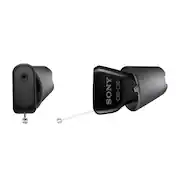
As my wife and I continue to pass through middle-age, I’ve developed mild hearing impairments while my wife is showing signs of moderate to high-moderate hearing loss. However, like many people without unlimited means (I would imagine), we have shied away from getting a set of prescription aids because they usually clock in close to $5-$6K. Our first attempt at OTC hearing restoration was simply a mid-priced pair of “hearing amplifiers” that did amplify ambient or directional sounds, but did so with so much artificial-sounding processing and echo that it ultimately became more distracting to use than not. Recently, we tried two different pairs of much higher-priced “premium” OTC aids ($1300-$1600), both of which produced markedly better results, but obviously those results came at greater cost. Fortunately, in terms of performance and comfort, the new Sony CRE-C20s comfortably rank right up there with those pricier OTC aids--and in a few ways they even outclass them. In fact, the CRE-20s would be an almost unequivocal blind-buy recommendation for those with mild to moderate hearing loss were it not for the omission of one glaringly large feature in particular that may or may not be a deal-breaker for you. The box comes with all you need to get started—4 sets of eartip sleeves (extra small, small, medium, and large), cleaning kit, replacement wax guards, charging case, and USB-C charging cable. The aids themselves are incredibly small, much more so than most BT earbuds you may be used to. This allows you to get them much further into your ear canals than most BT earbuds enabling a tighter and more secure seal which is critical to eliminating screeching during fitment or handling. In fact, these aids are so small they basically disappear into your ears—if they were available in colorways other than shiny black, people might be even more hard-pressed to tell you were wearing anything at all. In a similar vein, the charging case is equally svelte and more on the smallish side than the larger cases that accompany our other OTC aids. There is a small transparent tether attached to the back of each aid to grasp when removing them from your ear canals--a necessity given the fact that even in my wife’s ultra-tiny ears, the assembly is simply too small and too far inside the canal to get a hold of for removal. The tether is short with a small bulb on the end to aid in grasping with a fingertip or even a fingernail; however, if you have particularly long nails (artificial or otherwise), you may experience some difficulty at first as my wife was constantly reaching much further into her ear than was necessary to grab the end of the tether and experienced quite a bit of difficulty grabbing it. Setup requires a companion app from Sony...and sadly it also requires a Sony account to be created if you don’t have one already. This isn’t unexpected as all our other OTC hearing aids (and virtually any other kind of connected technology these days) have account-linked companion apps, but it would be nice not to have to surrender my personal information yet again just to get the aids activated and configured for use. You need to set aside a good 10-20 minutes in a quiet environment to get the hearing aids ready for use and customized with your own hearing profile. Fortunately, setup is very straightforward with simple and easy-to-follow instructions, graphics, and accompanying how-to demonstration videos. The setup procedure includes a hearing test which runs through a series of tones that helps create a personalized response profile for each hearing aid of different sound frequency boosts, cuts, and signal processing that cater to your unique hearing needs. Once the customization routine is complete, however, the app has very few capabilities remaining. For example, the “remote control” feature only gives you adjustments for volume and clarity...there are no options or selections to accommodate different listening environments or scenarios or selective amplification for voice or reduction of background noise. You do have the option to refine your hearing profile or use the app to help give you an audible reading of remaining battery power, but otherwise, there isn’t anything else in the way of functionality you can adjust or change to affect the functioning of your hearing aids. Confusingly, the setup procedures include an option to set “Loudness,” but afterwards you are only given a “Volume” control. The difference between the two is not made entirely clear, but from what I could divine from several trips into the app help and FAQ sections, adjusting the “Loudness” sets the default levels of the hearing aids while “Volume” adjustments then make changes from that baseline as necessary. The volume deviations from that loudness baseline are a bit subtle at times, and both my wife and I expressed some difficulty noting any appreciable increases or decreases in volume levels unless the volume adjustments were set to the extremes. In some ways, we found this preferable to the myriad adjustments available (even necessary?) in the companion apps of our other OTC aids because it provides just a simple set-it-and-forget-it use case...especially when you’re not in the mood to go spelunking in and out of an app every time you change venues. In action, the aids did exactly what they needed to, and they did it very well. For my case of minimal hearing loss, the CRE-20s provided additional depth and clarity to the soundscape, especially for movies and TV, with a shocking amount of oomph and clarity in the lower registers left behind to help achieve some of that visceral rush you can get from a really active soundtrack. I didn’t expect this kind of bass performance as the other aids we’ve tried usually make the soundfield thinner in exchange for better clarity of voices and other quiet sounds. Speaking of voices, the CRE-20s did a great job of enhancing voice clarity for me with only a hint of extra sizzle and trailing echo—I suspect that with additional use/acclimation and sound profile refinement, I could get rid of virtually all the remaining artificiality in amplified voices. But for my wife’s more pronounced hearing loss, the results she achieved were simply amazing. She was able to make out conversations in TV shows and movies at far lower volume levels without any difficulty, and more importantly, she could finally hear me speaking to her from a room away at normal volume. And thanks to the tiny profile of the aids themselves, the CRE-20s allowed my wife to enjoy high quality music via headphones, something that wasn’t possible due to her other aids’ larger earbud-style form factor or behind-the-ear construction. She reported virtually imperceptible signal processing artifacts when using headphones over the hearing aids--this was a real bonus because the musical quality/performance she’s used to from her other OTC aids hovers around passable to just okay. So, what’s not to like? First, it’s important to note that these hearing aids are NOT Bluetooth-enabled, nor are they compatible with the suite of Apple iPhone’s “Hearing Devices” accessibility functions (I suspect it is the same for Android devices). Instead, the phone is entirely configured/controlled by inaudible sound frequencies emitted by the phone’s speakers while using the Sony companion app. This means these aids provide no audio streaming or in-the-ear phone calls from any connected devices—it is strictly a hearing aid for dealing with everything going on OUTSIDE your head. Second, the aids themselves have no external controls of any kind—no switch to turn them on/off for battery conservation, no on-ear volume or speech quality adjustments; there’s not even a way to check the battery level without using the companion app. In the end, the limited signal processing adjustments to match varying use cases or environments, the lack of on-ear controls, and the lack of Bluetooth connectivity especially, are all most unfortunate--but those issues and omissions are also probably forgivable if you’re looking for a very discreet, very high-performing, and very simple-to-use set of OTC hearing aids that don’t require constant tweaking and adjustment to get great results. Highly recommended!
Posted by WyldeBlue
- Rated 5 out of 5 stars
Tiny but Impressive
The Sony CRE-C20 is one of the tiniest OTC hearing aids I have used. While they may be tiny, they provide surprisingly good comfort for prolonged use and they sound very good. Another positive thanks to their size is that they are discrete. I am not a fan of the pullout cord but with these hearing aids they are not noticeable. Setting them up is simple. Download the Sony hearing control app and follow the instructions to pair them. During the initial setup you have to create a profile of your hearing. Basically the hearing aids will perform a tone base test to evaluate your hearing level. It is very similar to the exam you get at the ENT audiologist but much simpler. These CRE-C20 are very simple and they sound really good when it comes to voice clarity. This is where they actually focus on, instead of more environmental sound. For example I was in a conference room and I was able to hear the speaker perfectly. It's like the device just focuses on vocals. During a noisy environment like a warehouse is the same thing but this time it felt like it masked the surrounding noises. Not completely, and it is really hard to explain as the noise just didn’t bother me at all. However, it was kind of hard listening to the speaker sometimes. I even tried adjusting the volume and the sharpness, it worked to some extent. It was like I had to find a good listening spot to hear the speaker properly. These hearing aids work very differently from other OTC hearing aidsI tried in the past. I mean it in a good way because the others pretty much just amplify the sound. With the app you can control the volume and the sharpness of the sound. Something I really liked is the fine tuning feature. A good example, after the initial setup, I could hear my breathing. However, the fine tuning feature offered several options to adjust the sound, and it worked!. The fine tuning is not only limited to just that, but you can pretty much correct most of the common sound issues using it. When it comes to battery life I honestly would like to know where it holds the charge? I was able to use them for over 14 hours. I took them off to sleep and left them outside of the charging case just to see how long they could last. To my surprise they still have less than 50% of the charge. That was more than 20 hours, that's impressive for their size. Manufacturer claims they can last up to 28 hrs. To know the battery level of the device is something I personally dislike. It doesn’t tell you exactly how much battery you have, instead it gives you an approximate % base on the tones. 1 beep is below 50%, 2 beeps is for 50-80% and 3 beeps is 80% or more. I don’t know why they chose to do that when it was simpler just to add the exact battery percentage. As for portability, they don’t fall behind. The charging case is very small too. It will fit in any pocket and it will not feel bulky at all. The hearing aids attach to the case magnetically and it holds very well. The case can be charged via USB-C or wirelessly. In the front there are three charging indicator lights. I was not able to find how much charge the actual case holds, not on their CRE website nor the manual. However, I was able to find in their press release that you can charge the CRE-C20 three times with it. These OTC hearing aids are exactly that, you cannot do audio streaming or take phone calls. Comparing these CR20 with my CRE-E10, the CR20 has much better voice quality. However, the E10 sounds better overall. The thing is the E10 lacks the tiny size and battery power of the C20. Overall these are impressive OTC hearing aids, coming from someone with moderate hearing loss. They are extremely discrete, they sound good with an impressive battery life. When it comes to vocal focus, I haven't heard anything better than this. They are also IP68 rated, giving your investment some protection against water, dust and moisture. In the box you get the OTC CRE-20, charging case, charging cable, cleaning cloth, 4 pairs of sleeves, wax guard, cleaning brush and manuals.
Posted by Wishkid
- Rated 5 out of 5 stars
Sony CRE-C20 Hearing Aids - A Great Choice
Self-fitting OTC Hearing Aids - Black (Sony CRE-C20) Over the past few years, I have tried a half-dozen or more OTC hearing aids and none of them were better than the Sony CRE-C20 aids that I have had the opportunity to evaluate. I have tried less costly and more expensive OTC's - doesn't matter - these were the answer to my inability to hear in many situations. Family conversations, TV volume at a normal loudness level, my preacher's sermons and other situations makes life much more pleasurable. I was pleasantly surprised at how clear the sound was coming out of them in almost all circumstances. The other night I was in a meeting in which there were three different groups in the same room. The two other groups were talking loudly but I was still able to hear in the group I was in pretty well. The Fit These hearing aids fit inside the ear which is my preference. I wear glasses and some hearing aids fit behind the ear. I find the behind the ear an uncomfortable fit with my glasses. The CRE-20 aids are very comfortable. I insert them in my ear in the morning and wear them all day. One night I forgot to take them out and wore them overnight for I did not realize they were still in my ears. The CRE-C20 aids do NOT use replaceable batteries. Charging overnight is so convenient and the charge lasts all day with a decent amount of left over. Even the case can be charged which adds portability without a cable or finding a place to plug them in. All in all, with the impressive sound quality, the comfortable fit, and the rechargeable battery system, I think anyone who does not have serious hearing impairment but needs hearing aids, can't go wrong with the Sony CRE-C20 OTC Hearing Aids.
Posted by ERN52
- Rated 4 out of 5 stars
Tiny Over The Counter Hearing Devices
I’m pretty new to hearing aids, having been diagnosed with moderate hearing loss in my left ear and minor loss in my right. I was lucky enough to get a pair covered by my insurance but the doctor gave me no options about what brand, model, features, etc. I wanted from my first hearing aid. Basically this means that I was left wondering if I was getting a good set or not, and when I got the chance to test out the Sony CRE-C20 “self fitting” hearing aids I figured there’s no better consumer electronics company than Sony! The box is a slip case so you can slide out the box with all the accessories, documentation, and the case with the hearing aids which is really nice since there’s small stuff that could get lost/misplaced. The hearing aids themselves were very exciting just to see them since I knew they’d be more discreet than what I had already, the Sony ear pieces are small like an earbud without the “handle” on the bottom and use a little wire on the back instead. I say wire but it’s actually a plastic or flexible nylon which isn’t irritating to the ear, in my opinion. That wire is incredibly small, maybe too small (possibly a quarter inch?), and barely sticks out so it doesn’t go past the edge of your ear, making them virtually invisible! The default rubber cone that comes on them is probably fine for most people but there’s also a pack of Small, Medium, and Large pairs to swap out with (I’m pretty sure the medium is the ones on there already, so you have a spare). You will need to download a Sony app to configure these as well as fine tune and troubleshoot, but I think almost everyone has a smartphone by now so that shouldn’t be an obstacle. Setup takes some time, you can’t open the box and go. Start by removing the charging case (which has the hearing aids inside) and plug the enclosed charging cable into the back, there is no adapter so you’ll have to supply that on your own. Once again, everyone should have one but this is a pet peeve of mine because if you don’t then you’re in a pickle. Let the hearing aids charge fully, the LEDs will turn green, and you need to download and install the app while you wait. Once you have the app and fully charged devices you can start the app and follow the instructions which is essentially a self diagnosis like you’ve already gotten from the doctor’s office: it plays a series of various frequency tones in each ear and you say how many you heard. This calibrates each side to your hearing needs and then you’re good to go. In the app main menu you’ll also find a fine tuning sequence you can run where you pick what issue you have and it gives some pre-programmed adjustments you can try. For my issue I found that I could hear people and sound around me “normally” but my own voice sounded muffled like I had cotton in my ear and I was talking too loud to compensate. It gave me four adjustment options and you click a button to try it out, it asks if you want to keep the settings or not. If the adjustment fixed your issue then you’re good to exit the app but otherwise it attempts a few more times. There’s also volume and “sharpness” slider so you can personally fine tune some of the extra “white noise” of the environment and make it easier to hear to your tastes. What I love about these is just how tiny they are while performing at the same level as my doctor prescribed hearing aids. As I mentioned the discrete size is both a blessing and a curse as I’ve found myself fumbling to locate the little wire on the end to pull them out at night. They’re FDA approved medical devices and I can’t find it in the paperwork but somewhere, maybe the app, I saw that some insurance MAY cover the cost of these, which would be awesome to have another option insurance will cover. You can’t beat a battery that lasts almost the entire day as well, I don’t stay up 18 hours so I can’t say for sure but they go at least 15 hours. Having a carrying case that’s also a charger is a huge benefit, so you’d be able to take them camping without running out of power. These are so small you won’t have to feel self conscious, that’s the biggest sales point in my book. One drawback I would maybe consider is they do not function as bluetooth earbuds as well, which other companies’ models do. It's a minor thing but makes a huge difference if you’re someone who likes to listen to music or podcasts on the bus or at work without having to constantly swap back and forth. The troubleshooting is really handy and simple, but I never fully satisfied myself with the solution to my muffled voice issue…hopefully it's something that just adjusts away with time once I get used to them, but otherwise there’s a customer support number (although they’re open East coast business hours which wasn’t convenient for me). Overall, if you’re having hearing issues this is a SOLID consideration you can use to return close to your natural hearing without advertising to the world that you have a device in your ear.
Posted by NinjaTard