“I just purchased the Sony a7iii and a friend that’s a professional photographer told me to get any lens that is constant F2.8. Not one that has a range like f/3.5 - 5.6. Can someone tell me which lens that would be? Thank you! :)”
Answer This Question![Sony - Alpha 7 III Mirrorless [Video] Camera with FE 28-70 mm F3.5-5.6 OSS Lens - Black-Front_Standard](https://pisces.bbystatic.com/prescaled/500/500/image2/BestBuy_US/images/products/6213/6213100_sd.jpg;maxHeight=100;maxWidth=60)
1-4 of 4 Answers
There are two main categories of lenses: zoom lenses and prime lenses. Prime lenses have a fixed focal length and of course zoom lenses have variable focal length. For some zoom lenses, the maximum aperture will decrease (as in your example from f/3.5 to f/5.6) as you zoom to larger focal lengths. A zoom lens with a constant maximum aperture will generally cost more than one that doesn't. Every lens will specify its focal length (either a single number for prime lenses, or a range for zoom lenses). The lens will also specify its maximum aperture. All prime lenses will have constant maximum aperture, so buying a prime lens you automatically follow your friend's advice. Zoom lenses that have a constant maximum aperture over their focal length range will specify only a single f number, whereas those that don't will specify a range. Rather than blindly listen to your professional photographer friend's advice, learn and understand what maximum aperture means for a lens' performance and buy the lenses that are suited to your needs. If you don't understand basics of how aperture affects exposure and depth of field, then following your friend's advice will generally result in you buying better lenses, but not necessarily getting better images.
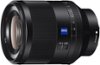
Sorry, there was a problem. Please try again later.Your friend is advising you to get what it called a "normal" lens, one used for a lot of general purposes and which gives about the same perspective on the scene as a human eye (in other words, no zooming in closer, and no "wide angle" type of effects). These lenses have a fixed max aperture. The other alternative is an adjustable focal length lens, a.k.a. a "zoom" lens. These lenses offer the versatility of an adjustable focal length (and thus changeable "perspective" without the need to swap lenses), but in doing so, the optical design of the lens makes some compromises with regard to sharpness and shallowest depth of field. In the end, you have to decide if you're going to be shooting for pleasure, like walking around a city or a country-scape, and wanting to capture both near scenes, far away landscape vistas, people, and maybe close-up objects. In that case, the zoom lens might be best for you. However, if you want to get into photographyy seriously, you might want to just purchase the camera body first, then rent some lenses and try them out before you decide. A good "piece of glass" is going to set you back some serious cheddar, so knowing what you want -- and why -- is probably quite important. The "normal" lens at a reasonable price could be the Sony FE 50mm F/1.8 SEL50F18F for around $250, but there is also the Sony Planar T* FE 50mm f/1.4 ZA with Carl Zeiss optics, basically a higher end version of a "normal" lens, and one that a professional might buy, for a whopping $1450! Good luck and enjoy your camera!
I would recommend:
Sorry, there was a problem. Please try again later.The Tamron 28-75 is a good general use lens. Otherwise look for the prime that you use most. 24mm, 50mm, or 135mm and look for reviews about that focal length.
Sorry, there was a problem. Please try again later.Hi Am81c, Sony has a wide range of products with constant aperture blade such as F4 or F2.8 throughout the zoom range. Since there are many lenses to choose from please follow the link to see what kind of photography work best suited for you. You can use the filter to select the type of photography work and the lenses that is best suited will be listed below. https://www.sony.com/electronics/interchangeable-lens-camera-products/t/camera-lenses?sensor-lens=35mm-full-frame&cameramount=e-mount
Sorry, there was a problem. Please try again later.