Customer Ratings & Reviews
 See more images
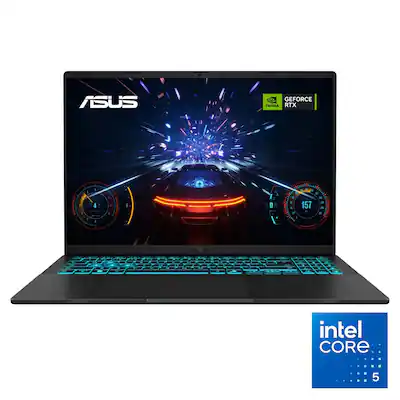
ASUS - V16 16" 2K Gaming Laptop - Intel Core 5 Processor 210H with NVIDIA GeForce RTX 3050 - 8GB Memory - 512GB SSD - Black
- Model:
- V3607VJ-VS/V16_55
- SKU:
- 6683981
Customer reviews
Rating 3.9 out of 5 stars with 23 reviews
would recommend to a friend
- Rated 4 out of 5 stars
More of a 'Casual' Gaming Laptop
CKent Posted
This ASUS V16 may be considered a gaming laptop, which it is, but it's more of an entry-level laptop. With PC gaming systems you generally get what you pay for. This makes it tougher to compare because you can't pit a machine like this against the top of the line machines that have the best of everything. So I have to look at it more from a cost perspective, and how it might compare to other systems at the same price level. Overall, it has the minimal specs you need for a lot of games, with one big exception, which I'll get to later. Depending on your monitor and other variables, you will need to make some adjustments. For example, I got a game that was just recently released. It's more of a casual action rpg, not anywhere near the level of some of the big triple-A releases, and even with that, I had to lower some game settings to better match the capabilities of this ASUS. Again, not necessarily a negative since this isn't meant to be a high-end machine. Then there's the one exception, the bottleneck, the thing that needs to be addressed before anything else, memory. Not only does it need to be addressed, just plan on upgrading it immediately. I know RAM costs have skyrocketed in recent years, but having only 8 GB of RAM is almost laughable. Honestly, I feel like at this point, a computer should have minimum 16GB to be labeled as a gaming system. Anything less should be made for casual users who maybe only play older or lighter games. Personally, I do like to game with newer and heavier titles, I work with software, and I'm a video content creator. Each one of those 3 things struggles with only 8GB of RAM. At least with this ASUS, the RAM is very easily upgradeable. As for everything else you would use a laptop for, this ASUS gets the job done. Everything works and I didn't run into any issues outside of gaming where it struggled. It has some great positives though too. The keyboard is actually really nice and comfortable to use. I especially love the backlighting and how the primary keys used in gaming has a different look to them. The touchpad has a good feel to it and it's always a huge plus when the webcam has a physical shutter you can close on it for privacy. The battery is ok. It lasts about as long as most pc laptops running Windows, which is to say it won't outlast some of the first party laptops out there, but it won't immediately die out either. Although unlike other laptops, this one did seem to arrive with no charge at all. When I first plugged the charger in, it took so long for even just the charging light to come on that I thought it might have been broken. So if you're just a casual gamer who needs a simple system that lets you perform the basic functions of a computer, this ASUS could be a good fit, and I have no problem recommending it to someone like that. However, if you do care about running games at higher settings for smoother gameplay and improved graphical quality, or if you develop software, or if you want to run an AI locally, you might want to look elsewhere, or at the very least, upgrade the RAM literally the moment you unbox it.
I would recommend this to a friend - Rated 4 out of 5 stars
Balanced for Work & Mid-Tier Gaming
TheDuke Posted
This ASUS Vivobook does a good job balancing work functionality with moderate level gaming. High in functionality, but low in flash. The laptop doesn't have any unnecessary RGB lights, wild logos splashed across the lid, or crazy textures pressed into the plastic - but, ASUS was thoughtful in its simple design. I like the imbedded webcam - which is practically a necessity for Zoom calls these days. And while I appreciate the built-in shutter that can block the camera when not in use, I am disappointed that it is not capable of Facial Recognition (Windows Hello). Not only can the computer not log you in with your face, it also does not feature any fingerprint sensor, leaving me in the ancient past typing in a password to log-in (which is the slowest possible option). The extra-large trackpad is quite useful for navigating with gestures, but occasionally it seems to sense my palm which sends the cursor instantly to a random location causing me to type overtop of existing text. It hasn't happened too often, but it is wildly annoying when it does happen. There is no touchscreen, but thankfully the keyboard which does have a 10-keypad. The keyboard is backlit and easy to use with a moderate tactile feel to the keys. I don't particularly like that the WASD & directional keys are translucent, but this choice is the one tangible feature that feels like a gaming laptop. The 8 GB of RAM is a bit of a weakness when it comes to current AAA games like GTA IV. Thankfully I have had good luck playing my library of Steam Games along with less intensive new games such as Gravhounds (which is still in pre-release). The refresh rate has been great, and the screen does look good - even though it is not OLED (which I would prefer). Fans run reasonably quiet and do a good job of keeping the laptop from overheating...helped by the rubber feet which hold the laptop up off of the surface it rests upon. I would prefer more than one USB-C input, but thankfully many of my peripherals still use USB-A for which there are two inputs. I also prefer to charge using USB-C (as it is the most common cable in my house), but I understand that gaming performance requires more power. USB-C does work, but it will charge slowly (and not keep up with the drain experienced during gaming). If you consider yourself a gamer, make sure to use AI to verify that your computer can play your favorite games. You no longer need to guess or speculate on how well a game will run. Upload a screenshot of the computer's specs into CoPilot, ChatGPT, Muse, etc and ask if it can play a specific game. AI does a great job of explaining how well a specific title will run on a particular system. If you enjoy playing Steam Games or using XBOX Cloud Gaming, this laptop should be a decent match. But, again, ask AI how well it will run your favorite games. Do not guess. Overall, I am quite pleased with this laptop. I am thrilled that I can actually open the lid with one finger (without the base tipping upwards). Decent weight, good performance, quick to boot-up, good battery life, and thank God that it has an obvious Print Screen button. An easy recommend for the casual gamer on the go.
I would recommend this to a friend - Rated 4 out of 5 stars
A value-packed performer
phoenixfta Posted
I have an embarrassment of laptops. My job and life has a wide range of interests and intensities so I'm constantly looking for a very good all-around/near desktop, a very good portable with lots of power and a really attractive and light "just in case" travel unit. Long ago I found the gaming laptops are very good, and often less expensive solutions for my architectural and design life. I need lots of power, large screen and strong video card with vibrant color, an ample track pad and a good battery. I picked up the ASUS V16 16" hoping for it to be my all-arounder. First, it was an easy set-up and, in cahoots with Windows, I was able to largely have this laptop replicate my prior power machine in no time. I like the matte screen which is a little less vibrant, but actually renders color better and minimizes glare. Good for the variety of locations at which I work. The track pad is wonderfully large and properly responsive. The keyboard is mixed. I like the key-press feel and spacing, but I found myself often one key over from the QWERTY position and when the backlights are on, it's distracting for standard use...and really good for gaming use. I also was flustered by the number keypad because it lacks the 4th column and the keys are narrower than the others on the keyboard. Connectivity is keeping up with contemporary needs: two USB-A 3.2, one USB-C 3.2, one HMDI 2.1, and a mini headphone. It uses a proprietary power port. It's slightly annoying because you have to carry that propriety power block with you, but at least it's 150W. Too bad that block doesn't have supplemental ports to power other devices. It has a 63Wh battery that provides several hours of work and play. Manufacturer highlights are dual fans with dual vents. I never noticed them, so they are super quiet, and I found my lap didn't get scorched and the processors kept churning. Also, dual memory slots are great, but I'm going to have to upgrade immediately. The 8GB isn't inadequate for some of the memory hogs in architecture. The NVidia GEFORCE RTX card is great, providing 144Hz of refresh. WiFi 6 does the job you expect. Just works. I like and don't like the all-plastic case. It's matte, but still shows fingerprints. However, it's noticeably lighter than my other metal machines (of course). Good for travel though. My gripes? The number keypad, the far off-center QWERTY bear repeating. The final one is the camera is good, but lacks infrared so you cannot use it for Windows Hello login. Insane in 2026. Still, this is a very nice machine, performs well, looks nice and has a very nice price.
I would recommend this to a friend - Rated 4 out of 5 stars
Capable Hybrid Gaming laptop but 8gb RAM limits
KKCNIck Posted
Setup: Unboxing was straightforward, though the initial Windows out-of-box setup took roughly an hour. After reaching the desktop, I ran all pending Asus and Windows updates. A BIOS update applied during this process and reset my Windows Hello PIN, though reconfiguring it took only a minute. The included 150W power adapter is reasonably sized and uses a secure, proprietary plug. While it locks into place firmly and feels durable, it is not USB-C. Because of this, standard third-party chargers cannot be used as backups if the original adapter is misplaced. Use: The chassis and keyboard deck have a solid, premium feel. Instead of aggressive styling or bright RGB lighting, the clean exterior and subtle blue backlighting allow the laptop to fit naturally into an office or classroom setting. Typing is comfortable, with translucent WASD keycaps that make finger positioning quick during gaming, as well as a dedicated function key for bringing up the Windows emoji menu. However, the number pad is tight, and the shrunken Enter key requires some adjustment. The 1080p IPS display is sharp, adequately bright, and color-accurate, with a 144Hz refresh rate that pairs well with the internal graphics card. The oversized trackpad handles multi-touch navigation and gestures smoothly for productivity work, but the physical left-click was hit-or-miss during daily use. A standard-sized, more tactile mechanism would have been preferable. Port selection covers everyday essentials with a USB-C port, two USB-A ports, an HDMI output, and a microphone/audio jack. The webcam also features a physical slider switch, which is an excellent privacy touch for remote work or classes. Built-in audio quality was an unexpected highlight, delivering much fuller and louder sound than typical laptops in this tier. Thermal performance varies significantly by workload. In silent mode, the laptop remains quiet and cool for productivity tasks. Once gaming starts, the cooling fans become loud and the bottom panel generates noticeable lap heat. The 8GB of system memory is the main bottleneck. In Forza on low settings, the benchmark recorded 73 FPS, but live gameplay repeatedly triggered low-memory warnings and threats of game lockups, making it unplayable. In Fortnite at native 1200p on low settings, performance held steady at 130 FPS on the internal screen. However, connecting to an external 27-inch 1440p monitor caused frame rates to struggle below 30 FPS. Fortunately, the memory is user-upgradeable, which is essential to unlock the machine's full capability. The battery provided 55 min of life when gaming and 3.75hrs when using for mixed productivity. It is ok but there are better options if your trying to get thru a work day or school day without charging. Pros: • Crisp 144Hz high refresh display • Surprisingly strong built-in audio quality • Understated styling fits professional settings • Built-in webcam physical privacy slider • Memory is easily user upgradeable Cons: • Base 8GB memory bottlenecks gaming • Proprietary non-USB-C power plug • Trackpad left click feels inconsistent • Fans run loud under load • Cramped number pad and enter key Summary: This laptop provides a dependable balance of work productivity, subtle styling, and casual 1080p gaming, but the single 8GB stick of RAM restricts gaming stability. It is an easy recommendation only if you factor the cost of an immediate memory upgrade into the overall purchase. Also, the 16 x 10 display is another bonus if using for work or school since more is able to be displayed.
I would recommend this to a friend - Rated 4 out of 5 stars
Good Entry Gaming Laptop on a Budget Upgradeable
James K Posted
ASUS - V16 16 2K Gaming Laptop - Intel Core 5 Processor 210H with NVIDIA GeForce RTX 3050 - 8GB Memory - 512GB SSD - Black Overall - A Budget minded entry into gaming laptops with a generous screen that suports a high refresh rate. Very capable laptop for everyday tasks. This specific 8GB RAM / RTX 3050 configuration has one considerable limit - its memory is tight for modern games and multitasking. Everyday tasks - Browsing the web, using office, playing content from Netflix and you tube works fine. Multitasking is possible and works surprisingly well given the limited memory. The CPU is quick as is the storage so I did not encounter any issues or slowdowns. The battery life was reasonably good when just surfing or watching a movie. The rated "5-6" hours was achievable easily when using for daily tasks. Gaming pulled the battery life for me down to about 1.5 hours. Gaming ! - I had no issues running a huge range of older titles. The 144hz panel keeps things smooth and framerates were acceptable for most indy and older titles I played. The 6GB GPU and limited memory did struggle a bit with a few of the latest games that I own however I was able to play some of them after adjusting performance settings. If you have a massive steam library and want to play a lot of less demanding games - this easily runs every 3d FPS game that is more than 3-4 years old that I tried to run at acceptable and high frame rates. Adding Memory - This laptop has two memory slots and on my unit, one slot is open and upgrades are supported. It took about 20 minutes total to add an additional 8gb stick. Given the current memory prices, I only added 8gb of DDR5 SODIMM - this was instantly recognized and it helped performance significantly when gaming on a few of the newer titles I tried to run. What I love: Good display and Keyboard ! Medium weight for a large screen portable Room for improvement: Advertised as "2k" resolution - But - It's simply or arguably not ? The native resolution is 1920 × 1200 (WUXGA). (I have no actual issue with this as the 16:10 aspect is perfect for games however I feel that is misleading) 8GB of ram is not enough and it holds back performance on this laptop.
I would recommend this to a friend - Rated 4 out of 5 stars
Great laptop for the majority of needs
nautec Posted
The ASUS V16 2K Gaming Laptop performs very well for the majority of games most people play. Most titles on the popular gaming platforms run on it with no problem. Games that lean heavily on ray tracing or path tracing may not run well at the highest settings, since the laptop has an NVIDIA RTX 3050 with 6GB of VRAM and 8GB of onboard memory, which is not the latest and greatest. Those top-tier games were designed with desktops in mind, where much more premium video cards and higher amounts of RAM are available. Still, the average person playing popular games will be just fine. As a laptop for content creation or design work, the V16 is an excellent machine. It takes on CAD work, video editing, music recording, 3D design, and general office tasks like a champ. I have observed absolutely no lag or stutter during professional level work. Surprisingly, even though this laptop has only 8GB of DDR5 memory and runs Windows 11, I have not seen much degradation in performance with multiple apps open at once. Given today’s ridiculous RAM prices, Asus must have done some optimization to keep the 8GB from becoming a limitation. The laptop also has an extra slot for future RAM expansion once prices drop a bit. The size and weight make it great for travel, thanks to its thinness and minimal weight. The battery is ample and lasts a long time during professional work. The laptop is also very quiet and is tuned not to get loud when graphics intensive apps are running. The screen is super clear and reproduces amazingly accurate colors. There are a couple of things this laptop lacks. First, it has no IR webcam, so there is no facial recognition for Windows Hello. I had to use one of the USB ports for a thumbprint reader to get biometrics for my password manager. Second, it has no built-in LAN port for native wired networking, so it relies on WiFi unless you use a USB expansion hub with a network port to take full advantage of Gigabit internet speeds. All in all, this is a great laptop for someone on the move. The 8GB of RAM seems fine at the moment, but as time goes on, a RAM upgrade will probably be needed. Until RAM costs as much as a new laptop, though, the ASUS V16 should meet most people’s needs for the near future.
I would recommend this to a friend - Rated 3 out of 5 stars
Sleek/quiet 16" mid-range trapped by 8GB chokehold
WyldeBlue Posted
At a glance, the ASUS V16 presents with a modern, sensible mid-tier design. It’s relatively svelte, carries a gorgeous 16:10 matte/non-glare and non-reflective display, runs surprisingly quiet under load, and doesn't scream "RGB carnival" when you set it down on a desk. But then you boot into Windows 11 and fire up a single browser tab, you’ll quickly learn why virtually no gaming rig ships with a criminally underpowered 8GB of system RAM. While the chassis and screen punch above their weight class, the out-of-the-box memory bottleneck turns modern multitasking into an exercise in patience. BUT, this is a gaming laptop after all. So, how does it perform in its primary capacity? Well, if your gaming library leans heavily into well-optimized classics, esports titles, or games released closer to the premier of the first Guardians of the Galaxy movie, the ASUS V16 delivers a remarkably quiet, sharp-looking experience. However, for modern AAA gaming, that 8GB DDR5 stick and postage-stamp of a 512GB SSD mean immediate hardware upgrades aren’t just recommended—they are essentially mandatory before you do anything else. PROS: - Sharp, Vibrant 16:10 Display: Excellent matte coating, minimal backlight bleed, and great bright-light performance near windows almost completely eliminated reflections and glare. - Acoustics Under Control: Even under heavy gaming loads, the fans remain audible without devolving into a high-pitched jet engine whine. - Exceptional Keyboard Backlighting: High-contrast, mostly full-sized keycaps, on the chicklet keyboard deliver a crisp and easy-on-the-eyes "Turbo Blue" LED backlight. Fully illuminated WASD keys drive home the gaming DNA under the hood. - Upgrade-Friendly Architecture: refreshingly, not everything is soldered to the motherboard. There are dual DDR5 slots (supporting up to 64GB), a replaceable M.2 WiFi card, and a standard 2280 NVMe SSD slot that make user servicing simple. - Quietly Upgraded I/O: USB-C port natively supports both Power Delivery and DisplayPort-Alt mode–definitely a nice touch. CONS: - Crippling 8GB Out-of-the-Box RAM: Idle Steam usage hits 70–80% memory allocation; opening a single browser tab on top of that spiked utilization to 95%+ and caused system-wide stutters and severe slowdowns. - No mainstream Variable Refresh Rate: The cardinal sin of a high refresh-rate screen: the 144Hz screen lacks G-Sync or FreeSync which really hurt when framerates fluctuated wildly (which they will). - Anemic 512GB SSD: Installing only five modern titles left roughly 10% of free disk space remaining! Yes, that’s a sad commentary on the shipping size of modern PC games, but it’s still a logical constraint you need to deal with. - Port Shortage & Proprietary Power connector: Lacks a unified high-power USB-C power option, relying instead on a dedicated square jack. Only one usable USB-C and two USB-A ports. - Cramped Numpad Layout: Half-width keys and no persistent NumLock indicator light make long-term data entry awkward. DESIGN & ERGONOMICS The all-plastic construction is a bit of a double-edged sword: it keeps the 16-inch machine impressively lightweight and easy to tote around in a backpack or messenger bag, but the keyboard deck does suffer from noticeable flex if you type with a heavy hand, and the outer shell will be quick to show you just how much it LOVES your fingerprints. The chicklet keyboard itself is a highlight for visibility. The white-on-black keycaps are crisp, and the "Turbo Blue" LED backlighting is a welcome departure from standard white or obnoxious rainbow waves. Gamers will appreciate the fully backlit WASD keys, though the half-height backlit arrow keys feel too cramped for actual directional gameplay. The trackpad offers massive real estate—almost too much, as my palm occasionally fought with the lower edges during intense sessions. I/O selection is functional but tight: you get two USB-A ports, one USB-C (with DP-Alt mode and PD), HDMI, and an audio jack. Relying on a proprietary square connector for power feels like a missed opportunity for full USB-C charging parity (and giving you an extra USB-C port when not under wall power), especially when port real estate is already at a premium. DISPLAY & AUDIO For an IPS panel, the 1200p 16:10 screen is genuinely, even surprisingly, pleasant. No, it’s not flashlight-in-your-face bright, but colors looked balanced right out of the box without requiring manual calibration, and the anti-reflective matte coating held up admirably when gaming directly next to a sunlit window. On the audio front, the onboard speakers are also surprisingly decent, providing clean, non-distorted sound that gets comfortably loud for casual media consumption. The primary travesty here is the omission of G-Sync or FreeSync. If there is adaptive sync buried in there somewhere, I couldn’t find it and neither could the updated NVIDIA app or a fresh installation of the NVIDIA control panel. Without that frame synchronization to fall back on, framerate drops below native refresh or wild fluctuations around serviceable average framerates were immediately and distractingly noticeable. PERFORMANCE & BENCHMARKS The Intel Core 5 210H and RTX 3050 combo perform predictably well on older titles or with brilliantly optimized game engines, but the 8GB RAM chokepoint and only 6GB of VRAM heavily handicap modern AAA framerates. Even with DLSS attempting to lift heavy weights with lower-resolution scaling, 8GB of system RAM led to numerous micro-(and macro!)-stutters as Windows desperately swapped memory around behind the scenes. Here is how the machine handled some real-world testing: Doom (Ultra Settings): 105 – 140 FPS (Flawless, hyper-optimized performance) Fortnite: 160 – 200 FPS (Avg: 180 FPS) (Smooth, highly responsive esport experience) Tomb Raider GOTY (Ultimate Settings): Min 82 / Max 124 (Avg: 106.7 FPS) Dying Light 2 (DX12, High Quality, native resolution): Min 21.32 / Max 38.0 (Median 28.25 FPS) Dying Light 2 (DX12 High Quality, DLSS ON): Min 31.9 / Max 53.2 (Median: 41.3 FPS) (Passable, but required DLSS upscaling) Shadow of the Tomb Raider: Min 37 / Max 83 (Avg: 54 FPS) Doom: The Dark Ages: 45 – 52 FPS (Serviceable, but visual compromises are required to achieve anything close to its 10 year-old sibling) Horizon Zero Dawn (High Settings): Severe stuttering due to RAM limits. (Dropping to Medium resolved memory thrashing: Min 2 / Max 109 / Avg 48 FPS) Horizon Forbidden West: An unplayable slideshow that fluctuated wildly under 20 FPS, even with DLSS active. Bundling a free month of Xbox Game Pass alongside free copies of 1996’s Quake and Quake 2 feels almost poetically honest: this machine will make 30-year-old classics run like an absolute dream, but modern titles will demand a great deal of mercy and sacrifices on the graphics sliders before they start feeling legitimately playable. UPGRADABILITY & MAINTENANCE Thankfully, ASUS didn't solder down the memory or storage. Removing the 14 bottom screws (including one captive screw designed to pop the edge seam) gives quick access to the internals. Inside, you'll find a standard 2280 M.2 SSD slot, a swappable M.2 WiFi card (currently Wi-Fi 6 but without 6GHz band support), and two DDR5 SODIMM slots (one open). Because DDR5 natively operates in dual-channel mode on a single stick, you can easily pop a second stick of even non-matched capacity RAM into the empty slot to bring this machine up to a mandatory 16GB, 24GB or 32GB (with a theoretical ceiling of 64GB according to the spec sheet). VERDICT Honestly, the ASUS V16 has great bones: a solid display, quiet thermals, a reasonably comfortable keyboard, and an easier-than-most upgrade path. But out of the box, this “modern” gaming laptop is hamstrung by its own memory specs. In today’s market, assuming you have designs on playing today’s titles at even compromised graphics settings, you will need to budget at least an extra $120-$140 for an immediate RAM upgrade unless you have some (laptop DDR5 lying around). Do it, and you'll have a capable, attractive, mid-tier workhorse. Leave it at 8GB, and you'll be tearing your hair out before your second browser tab finishes loading.
No, I would not recommend this to a friend - Rated 3 out of 5 stars
A Good Laptop Held Back by its RAM
CatCity Posted
I’ve been using this Asus V16 for the past week and overall have been happy with it., despite how critical my review may sound. Asus products generally hold their weight, and I’ve consistently had great experiences with their laptops. It’s a balanced computer, and one I would put at entry level gaming, but nothing beyond that. Starting with the positives, the 16-inch IPS display is surprisingly good. Colors and overall picture quality exceeded my expectations, and the 144Hz refresh rate is a welcome addition. The anti-glare screen also performs reasonably well in bright environments when viewed directly, but viewing angles become more restrictive in strong sunlight. I have some photos in this review taken from side angles in direct sunlight, and the screen is very difficult to see. The laptop itself looks nice and feels reasonably well constructed, although it lacks the premium feel because of the plastic chassis. It weighs a little over 4 lbs, which sounds heavy, but given the 16” screen, that’s actually a pretty favorable weight. The backlit keyboard is comfortable and attractive, but I really wish they would had included customizable RGB lighting rather than a single backlight color. It would have definitely helped create the gaming laptop feel. One of the more surprising features though is the sound quality.. it’s remarkably good! My biggest complaint is the memory configuration. This model ships with only 8GB of DDR5 RAM in a single-channel configuration. With Microsoft Edge open and only seven or eight browser tabs, I’m seeing approximately 80–85% memory utilization. That’s not much headroom for gaming. I made a peculiar observation when researching the memory to see how much the firmware allows. Asus advertises the memory is advertised at 5600 MT/s, but Intel’s Core 5 210H processor officially supports DDR5 speeds only up to 5200 MT/s. So while the model ships with 5600mhz capable RAM, the i5 CPU caps it at 5200mhz. There is no realistic work-around for this cap either given the hardware and firmware. The saving grace here is this laptop has two accessible memory slots, so upgrading is possible, and this particular firmware can support up to 32gb. The RTX 3050 with 6GB of dedicated video memory is powerful for less demanding titles and casual gaming. However, graphics-intensive games will need to make significant reductions in the settings to work properly. Even with the 144Hz display is nice, you’ll struggle to consistently take full advantage of it in demanding games. Asus includes a 150W charging adapter using their proprietary port. You can charge from the USB-C port, but it’s limited to only 100 watts. I tested USB-C charging myself, and it works well during lighter workloads, but the laptop constantly warns me I am not using a fast enough charger. I measured the incoming wattage on light loads and my USB-C was actually supplying 40 watts to charge the battery while fully supporting the laptop with the other 50-60 watts. This doesn’t hold up when gaming though, you’ll need to use the included charging adapter. Overall battery life is nothing to get excited about. I like my screen bright, but anytime I go over 50% I’m seeing approximately three to four hours of use, even with relatively ordinary activities. This also gets hot in my lap pretty quickly as well. Overall, it’s a decent laptop, but only for the right population. I can see this as being a great college laptop because of the large screen, the IPS anti-glare display, ability to game, decent weight for size and backlit keyboard. The 8GB of RAM is honestly the most disappointing piece, and it’s the single biggest bottleneck in the whole device. At 16 GB this would be a substantially different computer.
I would recommend this to a friendBrand response from ASUS Answers
Posted
Dear CatCity,
Thank you for sharing your experience with the ASUS V16 V3607VJ Gaming Laptop. While we're pleased to hear that you were satisfied with the display quality, audio performance, overall design, and portability of the system, we sincerely apologize that the memory configuration, battery life, thermal performance, and gaming capabilities did not fully meet your expectations.
Your feedback regarding the 8GB single-channel memory configuration, upgradeability considerations, battery performance, thermal behavior, and overall gaming experience is valuable to us. We will ensure that your comments are shared with our product team for further review.
We stand behind our products and continuously strive to improve our products and processes to achieve customer service excellence. If you require any further assistance, please email us at customerloyalty@asus.com and include the case number "N2610032020-0001" as a reference. We will do our best to resolve your case quickly. Your feedback is very important to us, and it enables us to improve our support channels. Thank you for choosing ASUS.
Best Regards,
Chantae
ASUS Customer Loyalty US Support
- Rated 4 out of 5 stars
Mid-range portable gaming machine
SUHD Posted
Got the ASUS - V16 16" 2K Gaming Laptop with Intel Core 5 Processor 210H and NVIDIA GeForce RTX 3050 about a week ago and have been using it for both play and work. Despite being a sizable laptop with a 16” display, it is still only 0.77” thin and 4.3 lbs, which makes it very portable. It came configured w/only 1x 8GB DDR5 memory stick, and a 512 GB SSD M.2 drive. Luckily there is another empty memory slot which I would strongly recommend using to add more memory. The Intel Core 5 Series 2 Model 210H offers solid 8-core/12-threads @ 2.2 GHz performance, boostable to 4.8 GHz that’s great for multi-tasking and all around gaming, productivity and photo/video processing apps as well. Other notable features are plenty of USB ports - 2x USB 3.2 Type A Ports and 1x USB 3.2 Type C Port. Also one HDMI 2.1 port as, classic headphone jack as well as Wi-Fi 6 AX and Bluetooth. The keyboard is tastefully backlit, not overdone with distracting RGB lights and has a nice, solid feel to it with just enough travel and resistance. Now what makes this laptop a gaming laptop is the NVIDIA GeForce RTX 3050 video card w/6 GB of dedicated GDDR6 video memory. It also supports DLSS 2 (Deep Learning Super Sampling) and Ray tracing that help provide a fluid gaming experience for many games with high quality settings turned on. I have tried a few older games such as Call of Duty, and Forza Motorsport with high visual settings @1080p resolution and easily got 60-99 fps. You’ll be able to play most modern AAA games at mid to high settings on the go while you’re away from your main high-end gaming desktop. The 16” LED WUXGA HD display offers 144 Hz refresh rate which is great for a fluid, flicker free gaming experience, but in my experience at 300 nits it’s not always bright enough to use in a well lit room, especially with lots of sun. I’ve been spoiled with super bright adaptive OLED displays on my Samsung phones and most recently on an ASUS OLED Gaming Monitor. The battery life is OK considering the power hungry video card and large display, especially when you’re playing games and the CPU and GPU fans kick-in as well, but that’s to be expected, so make sure you have a plug near-by or you’re fully charged before you need to get your gaming fix while waiting to board your plane at the airport. All in all, I would say this is an entry to mid-level gaming laptop that should have come with at least 16 GB of memory and could satisfy reasonable gamers on the go and also act as an affordable desktop replacement.
I would recommend this to a friend - Rated 4 out of 5 stars
Solid budget gaming laptop, not perfect
Daniel Posted
I think this is very solid laptop that will serve many varying use cases. The only negative I have here is similar to what many others have noted: RAM. Pros: - Build/ form factor: I have a lot of positive things to say about the design and build of this laptop. When you hear "gaming laptop" an initial worry might be an overly flashy design with RGB everywhere that would really stand out in many settings. Not this one. The understated black design paired with soft backlit key pad is right at home in a classroom or shared office (even if the WSAD are slightly brighter to aid with gaming. I also am a big fan of the screen which does a great job reducing glare while maininting sharpness and color accuracy. The physical webcam blocker is always a nice touch. Performance - When gauging performance here you need to set the right expectations. This is NOT a top of the line PC with top tier specs. That being said, it provided me with very respectable performance on non graphically intensive games and passable performance on lower settings on some AAAs. Cons: RAM - I don't know what needs to be said here. 8 GB is simply not enough. I know RAM is astronomically over priced right now and this decision was made to keep price manageable, but it doesn't take much pressure for you to feel the bottle neck. Upgradability is nice, I guess though. Minor: The keyboard layout, specifically the cramed number pad, takes some getting used to. I REALLY like the full keyboard but I just need more practice with the layout/ size to get it right The laptop also gets quite warm under load and the proprietary charger isnt my favorite. Also the battery life is enough to get from one side of the house to the other, don't expect long, unplugged gaming seasions here. All in all, I think this is a VERY solid laptop for someone looking for a little more umph than you would get from a straight productivity machine. I recommend it for most use cases.
I would recommend this to a friend - Rated 3 out of 5 stars
A budget gaming laptop-poor configuration hold bac
DJSmooth Posted
The ASUS V16 is a capable entry-level gaming laptop with sturdy construction, a comfortable keyboard, and a pleasing 16-inch display. Its Intel Core 7 240H processor and NVIDIA GeForce RTX 5050 provide a reasonable foundation for everyday productivity and gaming, but the included 8GB of system RAM makes the package feel unbalanced. This is not a bad laptop. The bigger question is whether the configuration justifies the asking price. With additional memory, it becomes considerably more appealing. Without it, the compromises show up sooner than they should. Key takeaways + Sturdy construction and manageable 4.3-pound weight + Comfortable keyboard and pleasing 144Hz display + Good everyday productivity performance + Two replaceable RAM slots + Substantial gaming improvement after upgrading to 16GB + Stock 8GB RAM configuration limits demanding games + Replaceable SSD, but no second storage slot + Mixed experiences with cooling and trackpad reliability + Value depends heavily on the sale price and upgrade costs DESIGN The plastic chassis feels solid, with no meaningful flex during normal use. The hinges hold the screen firmly without wobble and allow it to lie flat. At a reported 4.3 pounds, the V16 is also manageable for a 16-inch laptop that may need to travel between school, work, and home. Connectivity covers a basic setup: two USB-A ports, one USB-C port with display output and charging support, HDMI, and a headphone jack. Most connections sit on the left, with one USB-A port on the right. It gets the job done, although several accessories may require a hub. The included 160-watt adapter uses a reversible proprietary connector. USB-C charging is a welcome alternative, though another USB-C port would have added flexibility. The keyboard provides comfortable travel and three backlight levels. Its cool-blue lighting looks good in a dim room, but the translucent W, A, S, D, and arrow keys are more distracting than useful to me. Their symbols can be difficult to distinguish, and the half-height arrow keys and function row feel cramped. The oversized trackpad was smooth and reliable in my testing. The speakers are adequate for everyday listening, and the 1080p webcam includes a physical privacy shutter. DISPLAY The 16-inch IPS display offers a 1920 × 1200 resolution, 144Hz refresh rate, and rated brightness of 300 nits. Its matte finish helps control reflections, but there is no touchscreen. I found approximately 85% brightness comfortable in a lit room. Viewing angles were wide, colors looked pleasing, and text is crisp without distracting color fringing. MyASUS also includes splendid controls for adjusting the picture. It is a good fit for documents, browsing, and gaming. The display is not the part of this laptop that leaves me wanting an immediate upgrade. PERFORMANCE The Core 7 240H handles everyday applications well. Its older architecture is less concerning here than the limited system memory. For browsing, office work, streaming, and general productivity, the processor provides a capable foundation. The RTX 5050 includes 8GB of GDDR7 video memory, separate from the laptop’s 8GB of DDR5 system RAM. That distinction matters: the graphics hardware has its own memory, but it does not make up for a restricted system configuration. In my God of War testing at a mixture of medium and high settings, the stock configuration produced approximately 17–42 FPS with noticeable choppiness. Adding another 8GB of RAM raised the same scene to approximately 48–85 FPS, generally staying in the mid-60s to mid-70s. Gameplay became substantially smoother. One particular area that caught my eye is from other users. One reviewer reported repeated memory warnings and intermittent hangs in Forza Horizon 6, despite otherwise smooth performance at reduced settings. In Borderlands 4, they described lengthy shader compilation and severe brief frame-rate drops even near the lowest settings. None of which I was able to experience, nor additional tests I performed for it, but they highlight why average frame rates do not tell the whole story. A game can look playable much of the time and still become frustrating when performance repeatedly stalls. The RTX 5050 remains an entry-level GPU, and demanding games require realistic settings. Supported games also offer DLSS as another performance option, but that should not distract from the more immediate need for additional system RAM. ISSUES / QUIRKS My biggest complaint remains the stock memory configuration. Two replaceable RAM slots are a genuine advantage, but only one is populated. Upgradeability is welcome; needing to budget for it immediately is less appealing. Access can also be awkward. Although I installed additional RAM successfully, someone else reported a stubborn bottom panel that damaged a pry tool and the panel edge during removal. The 512GB PCIe 4.0 SSD is a less serious compromise than the RAM. It is workable for everyday use and a modest game library, but Windows and several large games can consume much of its capacity. The drive is replaceable, although there is no second slot for simply adding storage. A larger internal drive means replacing the original and handling the associated system migration or reinstallation. Cooling reports seem mixed. My fans became audible without being distracting, and the typing area stayed relatively cool. As I read other experiences, I noticed another reviewer reported CPU and GPU temperatures peaking in the 80s Celsius during gaming, with brief CPU throttling during Cinebench. Another reviewer experienced much louder fans and a gaming crash they attributed to overheating, although that cause was not independently established. These differing experiences make it difficult to describe cooling as an unqualified strength. Battery life also favors ordinary use rather than unplugged gaming. My results were just under four hours at fairly bright settings and approximately an hour and a half while gaming. This is a laptop I would expect to keep plugged in for longer gaming sessions. CONCLUSION The ASUS V16 has the makings of a useful everyday laptop and a respectable entry-level gaming machine. The build, keyboard, display, and replaceable memory give it practical appeal, and the improvement after adding RAM shows that the underlying hardware has more to offer. The problem is the balance between configuration and price. The 512GB SSD is manageable. The 8GB of system RAM is much harder to overlook in a machine marketed for gaming, particularly when it contributes to stuttering and makes an upgrade feel like part of the initial purchase. At a substantial discount, the V16 makes sense for school, productivity, and gaming with adjusted settings. At a price close to better-equipped alternatives, the recommendation becomes harder to defend. ASUS either needs to provide more memory or price the configuration accordingly. My experience supports 4 stars after the RAM upgrade — but out of the box, this is a conditional recommendation rather than an easy one. At the end of the day, this is a worth 3-stars
No, I would not recommend this to a friendBrand response from ASUS Answers
Posted
Hi Dj Smooth
Thank you for taking the time to share your review of the ASUS V16 V3607VJ Gaming Laptop. While we're pleased to hear you appreciated the build quality, display, and upgradeability, we sincerely apologize that the 8GB RAM configuration did not meet your expectations and affected your overall experience.
We value your feedback regarding performance, memory capacity, cooling, and overall value, and will share your comments with our product team for review and consideration.
We stand behind our products and continuously strive to improve our products and processes to achieve customer service excellence. For more information, email us at customerloyalty@asus.com and include the case number N2611008322-0003 as a reference. We will do our best to resolve your case quickly. Your feedback is important to us and enables us to improve our support channels. Thank you for choosing ASUS.
Best Regards,
Shrrelle
ASUS Customer Loyalty US Support
- Rated 4 out of 5 stars
Fast, sleek, some limitations
Ernesto Posted
Asus as we all know, makes quality PCs, laptops, and computer components. Their newest product the Asus v16 is a great budget gaming laptop that has some power and only one real negative. Read my review to find out. The 16 inch screen is large, thin, and a 2K resolution, it’s looks crisp, Vibrant and clear, no problems here. The Processor which is an Intel Core 5, is a very capable Processor that can run many programs and games. The Graphics Card or “GPU” is a Nvidia Geforce RTX 3050 is a budget GPU that is capable of playing most non graphical intensive games at good frame rates, or most other games but at lower settings and FPS. The games look good and run just fine but with limitations. One of the negatives of this particular laptop is the 8GB of RAM, right now RAM is at an all-time high price and so the fact that this is only 8 is kind of disappointing. From what I understand this is upgradable which is a good thing and may be mandatory down the line. If this had 16GB, I would give it 5 syars but as it stands, it will get 4. Misc: everything here works really well for a laptop this light and sleek. It feels premium to the touch, the battery last for a good long while, the speakers sound loud and clear for their size etc. Conclusion: I would consider this an entry-level gaming, laptop, you’ll be able to play most modern non-graphically taxing games like Fortnite, Apex Legends, Rocket League etc with no problems… you’ll be able to play other AAA games like Call of Duty as well but at low-medium settings if you want to have decent frame rates.
I would recommend this to a friend - Rated 4 out of 5 stars
A fast, sensible everyday gaming laptop.
bamfsig45 Posted
What Works Great Lightweight for a 16-Inch: Big gaming laptops are usually heavy bricks, but at around 4.3 lbs, this one easily slips into a standard backpack. Low-Key Design: The matte black finish looks normal in a classroom or coffee shop, while the subtle blue backlit keys give it just enough personality at night. The physical webcam privacy slider is a great bonus. Roomy, Smooth Display: The taller 16:10 screen gives you extra space for web pages and work stuff, and the high refresh rate keeps scrolling and fast games butter-smooth. Solid Everyday Gaming: With the Intel Core 5 chip and RTX 3050, popular games like Fortnite, Valorant, and Rocket League run crisp and snappy. It handles heavier games fine too if you keep settings around medium. Comfortable Thermals: Fans kick on when you’re gaming, but the palm rests stay cool and it runs very quiet during basic web browsing. Things to Keep in Mind 8GB RAM Limit: Perfectly fine for my work and light games, but if you love having dozens of browser tabs open while a game runs, it can bog down. Luckily, you can easily pop the bottom off and upgrade the RAM yourself later. 512GB Storage: Between Windows and a couple of modern 80GB+ games, storage fills fast. An inexpensive external drive is worth keeping handy. Bottom Line: A fast, sensible everyday gaming laptop. It nails the essentials—a big, fluid screen, reliable Intel power, and real dedicated graphics—without making you pay four figures.
I would recommend this to a friend - Rated 5 out of 5 stars
Solid Well Made Machine, 8GB RAM Can Cause Issues
MountainLiving Posted
The ASUS V16 is an entry to mid level gaming laptop that feels solid in the hand. The build is good, the screen is excellent, and the keyboard and touch pad are genuinely nice to use. Out of the box it’s a lovely everyday machine that handles all basic tasks as well as some gaming. However, limitations start to appear when trying to play modern games, especially with ASUS's proprietary software, Armoury Crate, installed. The good news? After a software adjustment, the machine becomes a lot more usable than the stock experience suggests. A more detailed experience follows. The physical build of this laptop is excellent overall. The touchpad is one of my favorite features of this laptop. It’s large, accurate, and comfortable enough that you don’t immediately miss a mouse for casual use. The 16:10 display is also a strong point. The extra vertical space makes it great for older 4:3 shows (which I watch a lot!) and just generally feels more useful than a standard 16:9 panel. I mean, if you're going to use the extra space anyway, why not make the screen a little taller? I play a lot of simulation type games and the extra space just allows you to view your map a little more fully. The keyboard has solid feedback and useful backlighting (especially the WASD and arrow key zones). Speakers sound good for a laptop (serious audiophiles will want external speakers or good headphones but that is pretty much standard with laptops) and the fans aren't too loud or annoying. One surprising thing that is missing is there’s no Ethernet port. For a laptop marketed as a gaming machine, that’s a surprising omission. I love having everything hard wired, things just tend to be a little more stable and faster overall in my experience. Other than the lack of an Ethernet port I love everything about the layout, the feel, and use of the keyboard and touch pad. I am also very happy it has a spare slot available to upgrade the RAM if I decide to in the future. Once I got a feel for the physical side of this computer I started testing and pushing its computing limits. Then after running my various benchmark and gaming tests with the out of the box set up I completely removed the ASUS software suite, disabled the automatic reinstall service in the BIOS, and switched to G-Helper for fan and lighting control. In some areas there wasn’t much difference but as expected anytime RAM was the limiting factor in performance there was a marked improvement. The software switch resulted in Idle RAM use dropping from 5.2GB (68%) to 4.3GB (55%), freeing up almost 900MB. Background processes dropped from 209 to 187. I tested it with a trio of my favorite games that stress a computer in different ways. First up was the theme park simulator Planet Coaster 2. This game is very memory intensive and I wasn’t sure what I would be able to do with 8GB RAM. On the stock install, medium sized parks with a couple thousand guests and a couple dozen rides ran fine but memory was already at 90-95%. Trying to load a huge mega park caused an immediate crash. After the software change everything ran moderately better. Small to medium parks were snappier in their response. I loaded up what I would call a large park and it was technically playable but noticeably a little slower than it should be when trying to build. The Mega Park actually opened, though I wouldn’t consider it playable as it was very choppy with a frame rate around 10. Next I tested Civilization VI. There are 2 built in bench mark tests you can do. One test focuses more on graphics, while the other focuses on the computer's AI. Frame rates were high in both cases. The clean install slightly improved the look (less micro-stutter), while AI turn times stayed almost identical. The CPU is the bottleneck here, not background software or the RAM. Ultimately this game is very much playable on this computer, even with larger maps. Last up was Dragon’s Dogma 2 which is fresh off its first huge DLC and general update. Stock install forced me to drop settings pretty hard to keep it playable. I would say graphics were about 25-30% of max overall. You can play it fine, I ran all over even killing a couple of huge boss enemies. After cleaning the system I could raise texture and quality settings noticeably while still keeping a smooth frame rate. So basically out of the box it ran well and lower settings while after the software change is ran well on more average settings. Finally I did some pretty common synthetic tests. 3DMark Steel Nomad Light scores were essentially identical between the two setups (around 3390 and 33 FPS). The cleanup doesn’t magically add GPU power; it just stops the system from choking on background processes. CrystalDiskMark showed the 512GB SSD drive operated consistently at 3,600 MB/s sequential read and 3,200 MB/s sequential write across both testing environments. Solid results here across the board. One real world test that was very different was opening multiple tabs on a browser. Depending on what the tabs were I could start to have some issues with 15 tabs or so. After the software switch it was getting more up to 35-40 before issues reared up. The ASUS V16 Gaming Laptop is a highly capable machine wrapped in excellent physical chassis, though its out-of-the-box configuration hamstrings its potential. An 8GB RAM layout in modern gaming is going to sometimes be a tightrope walk. When paired with resource-heavy proprietary factory software, that tightrope will break more often. However, now that I have altered the software and spend some decent time with this machine I am very happy with it. It's a highly responsive, quiet, and surprisingly capable machine that meets or, in some cases, exceeds my expectations. If I knew someone IRL who was a casual gamer looking for a good multipurpose well made laptop I would absolutely recommend this one to a friend.
I would recommend this to a friend - Rated 3 out of 5 stars
mmodler Posted
The ASUS V16 is an interesting laptop. It's touted to be a productivity focused computer that can also be used for gaming. Which is fine. I am a working adult who needs to work during the day to survive and to disassociate I play video games. While it functions just fine as a work machine I don't really feel like this meets my gaming needs. With that said, it isn't necessary a bad thing. The ASUS V16 is a good looking computer. It is very unassuming compared to other gaming laptops in its class. It isn't flashy. It feels mature. I am not wild about all the plastic touch points, but that isnt a deal breaker for me. It has a big enough screen that is 16 inches and a full sized keyboard that has the coveted 10-key for all your number punching desires. The fans were quiet during normal operation. The computer never got concerningly warm during my usage. Sound profile of the speakers was good for a laptop. Best thing for me about the computer was the buttery smooth screen that sat at a dreamy 144Hz. During my time gaming, I was able to play some light titles with ease. Triple A titles however began to slow down due to the internal hardware. This is where I mentioned earlier that this computer isnt necessarily bad but it didn't meet my needs. One thing I do like about this computer is that I am not confined by the hardware limitations. If I wanted to I could upgrade both the RAM and the SSD to larger capacities. It doesn't completely fix my FPS as that is GPU locked, it can make the computer feel and run more efficiently. Really the biggest cons about this computer are the screen quality and the battery performance. The screen is not the brightest in the world. I would not expect to be able to use it outside or sitting with a window behind me on a sunny day. The color the screen produces feels a bit muted which can be a hinderance if you are planning on using this computer for any media editing. Battery performance is only slightly better than a gaming laptop. I was able to get 4-6 hours on a charge. So who is this computer for. I think this computer would be great for high school or freshman in college whose parent is buying them their first laptop. It meets enough of the criteria for this to be a good purchase for productivity needs while being able to play some games here and there on the side. It can also grow with the person's needs by upgrading things like the RAM and SSD.
No, I would not recommend this to a friendBrand response from ASUS Answers
Posted
Dear Mmodler,
Thank you for sharing your experience with the ASUS V3607VJ Gaming Laptop. While we're pleased to hear that you appreciated the laptop's design, thermal performance, keyboard layout, upgradeability, and smooth 144Hz display, we sincerely apologize that the gaming performance, display brightness, color reproduction, and battery life did not fully meet your expectations. We understand your concerns regarding the system's suitability for more demanding gaming workloads and regret any disappointment this may have caused.
Your feedback regarding gaming performance, display quality, battery life, and overall product positioning is valuable to us. We will ensure that your comments are shared with our product team for further review.
We stand behind our products and continuously strive to improve our products and processes to achieve customer service excellence. If you require any further assistance, please email us at customerloyalty@asus.com and include the case number "N2611008322-0002" as a reference. We will do our best to resolve your case quickly. Your feedback is very important to us, and it enables us to improve our support channels. Thank you for choosing ASUS.
Best Regards,
Chantae
ASUS Customer Loyalty US Support
- Rated 3 out of 5 stars
Entry-level gaming laptop with an identity crisis.
Gadgeteer Posted
The ASUS V16 delivers a curious mix of high notes and baffling budget decisions. It runs cool, sounds better than expected, and gives users rare freedom to upgrade internal storage and memory down the road. Yet, hampered by a washed-out screen and an inexcusable 8GB RAM configuration on Windows 11, it is an entry-level machine that cannot quite decide whether it wants to be an everyday portable or a true budget battle station. + Pros + • Portability & footprint: genuinely thin and lightweight for a 16-inch gaming chassis, avoiding the typical heavy "brick" feel of older gaming rigs. • Exceptional upgradeability: opening the chassis revealed two full DDR5 SO-DIMM RAM slots, an upgradeable M.2 2280 NVMe SSD slot, and a swappable Wi-Fi card. • Solid 1080p/1200p gameplay: consistently held 45–60 FPS in moderately demanding games at native resolution without dropping every visual setting to the basement. • Acoustics & thermals: dual-fan cooling kept fan noise and surface thermals far lower than expected for an all-plastic housing. • Punchy audio: built-in speakers delivered surprising clarity and volume. • 144Hz smoothness: high-refresh panel provided fluid navigation and competitive frame pacing for fast-paced titles. - Cons - • Single-Channel 8GB RAM: shipping a Windows 11 gaming machine with a single 8GB stick creates an immediate performance bottleneck. Upgrading the RAM becomes virtually mandatory. • Dull display & limited Gamut: the screen caps at 300 nits and only covers 45% NTSC. Colors look washed out and flat; no amount of calibration will make this suitable for color-critical creative work. • Budget touch points: the body is entirely matte black plastic that flexes under pressure and acts as an aggressive fingerprint magnet. • Missing critical ports: lacks Thunderbolt/USB4, and more crucially for online gamers, it completely omits an Ethernet port. • Muted webcam feed: the camera lacks saturation and dynamic range, leaving skin tones and background lighting looking muddy and washed out. • Cramped 10-key layout: the 10-key layout feels compressed like an after thought rather than naturally integrated. • Modest Battery Life: averages roughly 5 to 6 hours on light productivity, meaning you will need to bring along the charger for full-day off-desk use. ** Who it is for ** Budget-conscious gamers playing esports titles (Counter-Strike 2, Valorant, Rocket League), students needing a single machine for light productivity and 1080p gaming, or users comfortable opening the bottom panel to drop in a second RAM stick on day one. ** Who should skip it ** Content creators requiring sRGB/DCI-P3 color accuracy for photo/video grading, competitive online gamers unwilling to use a USB-to-Ethernet adapter, or anyone expecting premium metal chassis materials.
No, I would not recommend this to a friend - Rated 5 out of 5 stars
Capable Gaming at Low Price and Easy Upgrades
RalphHenry Posted
This is a very well-designed gaming laptop with mid-range specs at a very affordable price. I have noticed the smooth performance for gaming as well as other apps. The ASUS IceCool thermal technology with dual fans and heat pipes cools very well through long sessions and is essentially silent. There are easily accessible dual memory slots that leave room to expand, and ASUS has designed this laptop such that you can remove the screws on the bottom and update components. I ran with the original memory of 8GB, but then I added another 8GB of memory which did improve multitasking speeds and made animations even smoother. It was a simple process to add the new chip, so I do recommend this relatively cheap upgrade. The way the memory will boost your speed can be important if you take advantage of things like: better multitasking where web browsers can use a lot of RAM by themselves if for instance you have many open tabs. With 16GB, you can run a browser with many tabs, office documents, communication apps, and background tools simultaneously and more smoothly. Tasks like video editing, 3D modeling or modern PC games run better with 16GB to prevent slowing down because of the heavier loads. Also with the 16GB you do get dual channel performance which means you send and receive data at same time to speed communications with the CPU. If these characteristics match your needs, then this laptop is a great buy with just a small cost delta to easily add more memory. If you don't need these heavier loads, then you are all set as is. The 'NVIDIA GeForce RTX 3050 graphics technology' has shown that it runs my games perfectly. Animation is fluid and colors are beautiful. Tip of the cap to the ASUS engineers for designing a gaming laptop at a lower price that performs superbly. In addition to gaming, my Office apps run well, and I do a lot of Powerpoint presentations and photo processing applications, so this work has been optimized by this mid-range priced device which is fine for all my needs. The weight is sufficient but not the lightest, but this is partly due to the outstanding cooling technology and a superior long-life battery. I did notice this machine ran without getting too warm in my lap like my previous laptop – nice. The 512GB PCIe 4.0 NVMe SSD provides a great storage technology. I now want only these newer SSD technologies that are more reliable and run much faster than the older SSD devices. This has helped with loading some of my larger files quickly. The backlit keyboard has a solid feel and is very rugged, especially for me as I don’t have the lightest touch on the keyboard. I loved the over-sized touchpad as well. I did take advantage of the included TWO MONTHS OF GAME PASS PREMIUM. I’ve already tried a couple dozen very nice and fun PC games. I highly recommend this sturdy laptop that is designed for easy upgrades and comes at a low to mid end gaming laptop price point.
I would recommend this to a friend - Rated 5 out of 5 stars
ASUS V16 Gaming Laptop has Excellent Performance
Frank Omelu Posted
I have been using the ASUS V16 16-inch 2K Gaming Laptop for a few days, and I am genuinely impressed with its overall performance, design, and features. For a gaming laptop in this price and performance tier, it offers excellent value. The setup was incredibly easy, and with Windows 11 Home preinstalled, I was up and running in no time. One of the first things I noticed was its sleek yet rugged build. It feels sturdy, looks stylish, and is surprisingly portable for a 16-inch gaming laptop. The 16-inch display is one of my favorite features. With its 144Hz refresh rate, 16:10 aspect ratio, and 100% sRGB color coverage, everything looks sharp, vibrant, and smooth. Whether I am gaming, watching videos, browsing the internet, or working on projects, the visuals are impressive. The anti-glare screen is another great addition, especially in brightly lit environments. Performance has also been excellent for a laptop in this category. The Intel Core 5 Processor 210H and NVIDIA GeForce RTX 3050 GPU with GDDR6 memory offer a strong combination of processing power and graphics capability. Games run smoothly at appropriate settings, and the laptop also handles everyday productivity and creative tasks. The 8GB of 5600MHz DDR5 RAM is a solid starting point for everyday multitasking, and I especially appreciate that ASUS included dual memory slots for future upgrades. Connectivity is another strong point. With Wi-Fi 6, HDMI 2.1, two USB Type-A ports, USB Type-C with display output and charging, and a 3.5mm audio jack, I have plenty of options for connecting external monitors, accessories, and other devices without constantly needing adapters. Overall, I am extremely impressed with the ASUS V16 Gaming Laptop. It strikes an excellent balance between performance, portability, build quality, and affordability. It is a great choice for casual gamers and anyone looking for a capable everyday computer.
I would recommend this to a friend - Rated 3 out of 5 stars
A laptop that’s stuck between two roads
Daniel Posted
I’ve been using the Asus V16 for abit and out of the box I will say it feels a lot my plasticy then I originally thought. But this was assuming it was metal. The screen on it is large it’s 16:10 aspect allows for easier split browser window. It’s also 2k and 144hz to it looks very crisp. When it comes to performance I will say this laptop is very much an entry level laptop. On straight battery. There was many times I was using it and it would choke up on basic things at time. Once I plugged it in the charger. It was able to open up alittle more especially during gaming. I was able to run around 80-100 fps on Fortnite Low. Also I’m sad that the power plug isn’t USB C. It’s a proprietary square plug. I will say this thing gets loud, and when it gets going and needs to cool it uses its dual fan to cool. I will say it blows that hot air on your lap and it gets very uncomfortable. So in short. It’s in a weird spot since it’s an entry level laptop. But it misses a lot of marks in my eyes. It wants to be in-between a regular laptop and a gaming laptop but it fails kinda in both. Its 8gb of ram only really is also holding it back. It’s a powerful laptop but is held back but itself.
No, I would not recommend this to a friendBrand response from ASUS Answers
Posted
Dear Daniel,
Thank you for sharing your experience with the ASUS V3607VJ Gaming Laptop. While we're pleased to hear that you appreciated the display quality, gaming capabilities, and overall performance when connected to power, we sincerely apologize that aspects such as the build materials, thermal comfort, memory configuration, and battery-powered performance did not fully meet your expectations.
Your feedback regarding the chassis design, cooling behavior, charging interface, memory configuration, and overall user experience is valuable to us. We will ensure that your comments are shared with our product team for further review.
We stand behind our products and continuously strive to improve our products and processes to achieve customer service excellence. If you require any further assistance, please email us at customerloyalty@asus.com and include the case number "N2611008322-0001" as a reference. We will do our best to resolve your case quickly. Your feedback is very important to us, and it enables us to improve our support channels. Thank you for choosing ASUS.
Best Regards,
Chantae
ASUS Customer Loyalty US Support
- Rated 5 out of 5 stars
Best for dedicated gaming
Wendal Weets Posted
As we all know, I’ll preface this by saying that everything with RAM in it is expensive right now. It’s unfortunately the way it is. That said, this delivers a lot of power for console gamers like myself who want something portable, but not a handheld. I am not hooking this up to my TV (despite the welcome inclusion of a full sized hdmi port). I’m more interested in plugging in my Xbox controller and playing with my lighter steam library along with Xbox play anywhere lightweight titles and emulation. I have to caveat that I upgraded to 16gb of ram before I did anything else. I pulled 16gb of ram from my big and heavy gaming laptop a year and an half ago and had it in a drawer. Back when 32gb sodimms pairs were $90… which brings me to the best thing about this laptop. It doesn’t feel as heavy or dense as my main gaming laptop, a ROG 16” with R9, 32gb, and a 5070. When I’m not playing the heavy hitters, this is what I’ve been reaching for. Overall, I would recommend getting this on sale. There are other similarly specced laptops on sale for less at the time I’m writing this. It’s not super thin and light as a daily driver for work but for the gaming power and large screen size, it’s relatively portable. Asus has been doing well the last handful of years in the gaming space and while this isn’t the latest technology, it gets the job done for everything but AAA gaming at high settings very well. It’ll do all the basics but not worth the premium if you’re only using it for productivity. It is absolutely an excellent AA and below 1080p gaming laptop.
I would recommend this to a friend