Antonio De Innocentis - Italian Harpsichordists on Guitar - COMPACT DISCS [CD]
Reviews coming soon
About this product
The guitar is an expressive harpsichord declared the composer Claude Debussy after a concert by the Catalan guitarist, Miguel Llobet. The classic guitar has benefited, more than most other instruments, from arrangements of music of many genres. Renaissance and Baroque music especially suit the timbre and range of the guitar and keyboard music is ideal for playing on the guitar, often direct from the original score. Debussy's comment may be unjust to harpsichordists, but the expressive limits of the guitar may be said to outweigh those of the harpsichord.Girolamo Frescobaldi was born in Ferrara, one of the most musically stimulating cities in Italy at the end of the 1500s. He was organist of St Peter's, Rome and is said to have also been a magnificent harpsichordist. His influence spread not just through Italy, but also north of the Alps. Gaetano Greco (also Grieco) was born and worked in Naples, notably as Maestro di cappella of the Basilica in Naples from 1704-1720. He was an influential figure, numbering Domenico Scarlatti and Nicola Porpora among his pupils.If we know the name Domenico Alberti nowadays it is probably only through the eponymous bass figuration heard in many classical and pre-classical keyboard pieces. The lively Giga, from his collection of Sonatas Op.1 gives way to a more elegant Allegro from a Sonata da camera.As well as being a composer and a pupil of Pasquini, Domenico Zipoli trained for the priesthood as a Jesuit. He emigrated to Paraguay, where he aimed to complete his training, but died before he could be ordained.With Bernardo Pasquini we bridge the gap between Frescobaldi and Domenico Scarlatti. Pasquini made a close study of Frescobaldi's work, especially his early Fantasie and employed some of these ideas in his variations.Moving forward 50 years from Pasquini, Benedetto Marcello proved to be a real polymath, with interests in politics, l
Specifications
- GenreClassicalDescriptionThe guitar is an expressive harpsichord declared the composer Claude Debussy after a concert by the Catalan guitarist, Miguel Llobet. The classic guitar has benefited, more than most other instruments, from arrangements of music of many genres. Renaissance and Baroque music especially suit the timbre and range of the guitar and keyboard music is ideal for playing on the guitar, often direct from the original score. Debussy's comment may be unjust to harpsichordists, but the expressive limits of the guitar may be said to outweigh those of the harpsichord.Girolamo Frescobaldi was born in Ferrara, one of the most musically stimulating cities in Italy at the end of the 1500s. He was organist of St Peter's, Rome and is said to have also been a magnificent harpsichordist. His influence spread not just through Italy, but also north of the Alps. Gaetano Greco (also Grieco) was born and worked in Naples, notably as Maestro di cappella of the Basilica in Naples from 1704-1720. He was an influential figure, numbering Domenico Scarlatti and Nicola Porpora among his pupils.If we know the name Domenico Alberti nowadays it is probably only through the eponymous bass figuration heard in many classical and pre-classical keyboard pieces. The lively Giga, from his collection of Sonatas Op.1 gives way to a more elegant Allegro from a Sonata da camera.As well as being a composer and a pupil of Pasquini, Domenico Zipoli trained for the priesthood as a Jesuit. He emigrated to Paraguay, where he aimed to complete his training, but died before he could be ordained.With Bernardo Pasquini we bridge the gap between Frescobaldi and Domenico Scarlatti. Pasquini made a close study of Frescobaldi's work, especially his early Fantasie and employed some of these ideas in his variations.Moving forward 50 years from Pasquini, Benedetto Marcello proved to be a real polymath, with interests in politics, lArtistAntonio De InnocentisTitleItalian Harpsichordists on GuitarFormatCDLabelBrilliant Classics
Reviews
This product doesn't have any reviews yet.
Compare similar products

The guitar is an expressive harpsichord declared the composer Claude Debussy after a concert by the Catalan guitarist, Miguel Llobet. The classic guitar has benefited, more than most other instruments, from arrangements of music of many genres. Renaissance and Baroque music especially suit the timbre and range of the guitar and keyboard music is ideal for playing on the guitar, often direct from the original score. Debussy's comment may be unjust to harpsichordists, but the expressive limits of the guitar may be said to outweigh those of the harpsichord.Girolamo Frescobaldi was born in Ferrara, one of the most musically stimulating cities in Italy at the end of the 1500s. He was organist of St Peter's, Rome and is said to have also been a magnificent harpsichordist. His influence spread not just through Italy, but also north of the Alps. Gaetano Greco (also Grieco) was born and worked in Naples, notably as Maestro di cappella of the Basilica in Naples from 1704-1720. He was an influential figure, numbering Domenico Scarlatti and Nicola Porpora among his pupils.If we know the name Domenico Alberti nowadays it is probably only through the eponymous bass figuration heard in many classical and pre-classical keyboard pieces. The lively Giga, from his collection of Sonatas Op.1 gives way to a more elegant Allegro from a Sonata da camera.As well as being a composer and a pupil of Pasquini, Domenico Zipoli trained for the priesthood as a Jesuit. He emigrated to Paraguay, where he aimed to complete his training, but died before he could be ordained.With Bernardo Pasquini we bridge the gap between Frescobaldi and Domenico Scarlatti. Pasquini made a close study of Frescobaldi's work, especially his early Fantasie and employed some of these ideas in his variations.Moving forward 50 years from Pasquini, Benedetto Marcello proved to be a real polymath, with interests in politics, l

The guitar became increasingly important to Castelnuovo-Tedesco through the course of his long career. 'My art tends progressively to simplify itself,' he wrote, 'and the guitar has become one of my favorite means of expression because it has led me towards the essential.' He was first drawn to the instrument after meeting Andres Segovia in Venice in 1932. The Variations á travers les siècles Op.71 followed almost immediately. Over the course of the next seven years, Castelnuovo-Tedesco produced a string of equally successful pieces for the instrument. Most substantial is the four movement Guitar Sonata subtitled as a 'Homage to Boccherini' an elegant essay in neoclassicism which evokes the courtly elegance of Boccherini's Guitar Quintets while sounding entirely true to Castelnuovo-Tedesco's own language. There followed a Capriccio Diabolico, which lives up to it's title as a homage to Paganini with fiendish figuration which delighted Segovia. Sharing the Capriccio's Opus number of 87 is a contrastingly restrained character-study of Sicilian flavor, 'Oranges in Bloom'. The last guitar piece written by Castelnuovo-Tedesco before leaving Europe for good was the Variations plaisantes sur un petit air populaire Op.95, which takes it's theme from a French folk melody after a Swiss critic had taken aim at the Sonata as merely a display piece for Segovia. Castelnuovo-Tedesco proved him wrong with another demonstration of his deep feeling for the guitar as an instrument of both display and reflection, ending with an elaborate fugue. This album is the latest in a series of new recordings documenting the output of Castenuovo-Tedesco. Rather than playing from the standard editions of these pieces by Segovia, Antonio Rugolo has gone back to the composer's manuscripts as well as consulting newer editions by Angelo Gilardino, resulting in performances which are truer to the compos

Henze / Dieci - Complete Music For Solo Guitar [COMPACT DISCS] date 06/24/2016
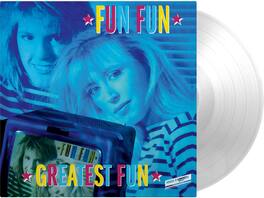
Fun Fun was an Italian Euro disco band produced by Dario Raimondi Cominesi and Alvaro Ugolini. The group was fronted by models, while the vocals were recorded by original singers Antonella Pepe, Angela Parisi, and Ivana Spagna. Spagna left after the of their first album in 1983. Their breakthrough came with the hit 'Happy Station (Scratch Remix),' by Ben Liebrand which climbed the charts in several European countries, including the Netherlands, Germany, and Belgium. The track became a staple in the hottest discos of the era. The Greatest Fun compilation album brings together their biggest hits, including 'Happy Station (Scratch Remix), Give Me Your Love, Baila Bolero,' and 'Living in Japan. ' Additionally, the album features the Fun Fun 'Mega Hit Mix,' a special mix by Dutch producer and DJ Martin Boer of 2 Brothers on the 4th Floor fame, along with many more Euro disco tracks. Fun Fun Greatest Fun is available on vinyl for the first time, as a limited edition of 1000 copies on crystal clear vinyl and includes an exclusive insert. LISTEN //youtu. Be/XNkFWnCwIz0 * 180 GRAM AUDIOPHILE VINYL * INCLUDES INSERT * FEATURING THE HITS 'HAPPY STATION (SCRATCH REMIX)', 'COLOR MY LOVE', 'GIVE ME YOUR LOVE', 'BAILA BOLERO', 'FUN FUN MEGA HIT MIX' & MANY MORE * FOR THE FIRST TIME AVAILABLE ON VINYL * LIMITED EDITION OF 1000 COPIES ON CRYSTAL CLEAR VINYLTrack listing SIDE A 1. Happy Station (Scratch Remix) by Ben Liebrand 2. Color My Love 3. Give Me Your Love 4. Baila Bolero (Remix) 5. One Day 6. Psychedelic Vision 7. Lonely Feeling 8. Give A Little Love AgainSIDE B 1. Fun Fun 'Mega Hit Mix' 2. Living In Japan 3. Gimme Some Loving (House Mix) 4. Could This Be Love (House Mix) 5. I'm Needing You 6. Sing Another Song 7. Tell Me