Skip to contentGo to Product Search
Main Content

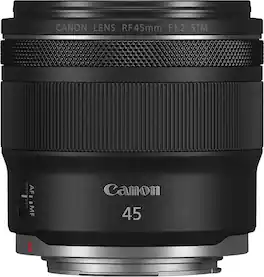
Canon - RF45mm F1.2 STM Standard Prime Lens for EOS R-Series Cameras - Black

Model: 7198C002
SKU: 6664535
Sold byBest Buy

Customers are saying

Customers appreciate the exceptional build quality that consistently delivers sharp photos, alongside the lens's impressive autofocus speed. Users also value its compact and lightweight design, which makes it an ideal choice for street photography, as well as its quiet operation. However, some users note the lack of built-in image stabilization and the absence of weather or dust sealing as potential drawbacks.

Generated by AI based on customer reviews.
Features
  • Compatible with Canon EOS R series cameras

    For use with your existing camera.

  • Light and affordable

    The RF45mm F1.2 STM combines a large RF mount with a short back focus and advanced digital correction. A compact, affordable lens that still delivers the stunning F1.2 performance you expect.

  • Fastest Wide Open

    The wide f/1.2 aperture creates stunning bokeh, making subjects pop with a three-dimensional effect. And thanks to the fast aperture, it shines in low light, allowing you to capture action at faster shutter speeds.

  • Tech, Meet Optics

    Canon’s first use of a PMo aspheric lens in an F1.2 design helps minimize aberrations for sharper, more accurate images. Combined with the RF mount’s large diameter and short back focus, this allows for a compact build without sacrificing optical performance.

  • Step in and Focus with Confidence

    The RF45mm F1.2 STM uses a gear-type STM motor paired with a magnetic detection system for smooth, precise autofocus. This keeps the lens compact and lightweight while ensuring your subject stays sharp, even in challenging lighting or fast-paced shooting.

  • What You See, I See

    The 45mm focal length is like seeing how you see with the naked eye, giving you a natural perspective and framing that feels just right.

  • Control at Your Fingertips

    A dedicated customizable control ring on the front of the lens lets you assign functions like ISO, White balance, etc. for quick adjustments during shooting.

  • 45mm focal length

    A versatile focal length for capturing crystal-clear shots throughout a variety of shooting situations.

  • f/1.2 maximum aperture

    Capture the action at indoor sporting events and other situations with less-than-ideal lighting conditions. It creates an exceptional background blur, which produces stunning images

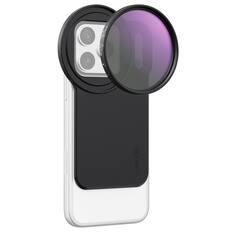
  • Accomodates 67mm filters

  • Minimum focusing distance of 1.5 ft or 17.7 inches

Specifications
  • Lens Mount Compatibility
    Canon RF
    Lens Type
    Standard Prime
    Minimum Focal Length
    45 millimeters
    Maximum Focal Length
    45 millimeters
    Maximum Aperture
    f/1.2
Sponsored

Reviews

Rating 4.8 out of 5 stars with 30 reviews

5 star rating. 23 reviews4 star rating. 7 reviews
100% would recommend to a friend
Customers are sayingCustomers appreciate the exceptional build quality that consistently delivers sharp photos, alongside the lens's impressive autofocus speed. Users also value its compact and lightweight design, which makes it an ideal choice for street photography, as well as its quiet operation. However, some users note the lack of built-in image stabilization and the absence of weather or dust sealing as potential drawbacks.
This summary was generated by AI based on customer reviews.
  • Build Quality (21)
  • Autofocus Speed (19)
  • Portability (11)
  • Noise Level (7)
  • Weight (4)
  • Image Stabilization (9)
  • Weather Resistance (4)

Customer Images

The vast majority of our reviews come from verified purchases. Reviews from customers may include My Best Buy members, employees, and Tech Insider Network members (as tagged). Select reviewers may receive discounted products, promotional considerations or entries into drawings for honest, helpful reviews.

  • Rated 5 out of 5 stars

    A Delicious Taste Of The Luxurious f/1.2 Life

    The Canon RF 45 1.2 (RF 45) is a wonderful lens unicorn that’s not supposed to exist. After all, f/1.2 is the realm of pros, not casual or hobbyist photographers. But Canon has delivered extreme, and excellent low light performance and opportunities for creamy backgrounds and engaging bokeh. For the money the RF 45 almost definitionally unique, but it’s also a lens you want in your kit if the RF 50 “L” lenses are not in the budget. I’ve walked around town taking pictures with this lens for about a week now getting to know it and still have more to learn, but I can say 100% this is a fun lens with creative capabilities. It’s far from perfect, but it’s sharp, impressive in low light situations, and, yes, has nice-looking but not perfectly round bokeh at f/1.2 and improves from there. Backgrounds at wider apertures are mostly pleasantly soft too, which I’ll get into later. It's important to be levelheaded about the RF 45, a consumer-level lens. Its performance is great for its price, but it’s silly to compare to the RF 50 “L” lens models. They are superior lenses and priced as such. What is a sensible comparison though is the RF 45 versus the RF 50 1.8, which up to now was the only affordable R mount standard prime lens around. I enjoyed the 50 1.8 for the 5 years I’ve owned it, but RF 45, I think, has leapfrogged it with all its additional abilities, not to mention an extra 5mm of range eliminating that extra step backwards to get the composition right. WHO ITS NOT FOR The RF 45 suits a lot of photographers, but everyone. To save you time, a few words on who might not appreciate this lens. First, while the RF 45 will work with any RF mount body, it’s only 45mm on full sensor models. Put this lens on a crop sensor body like the R7 or R10 and your focal will become the equivalent of 72mm. Next, it’s neither weather nor dust sealed. This lens is your fair-weather friend. It’s a great vacation lens unless you’re in a rain forest or dusty African savannah or similar areas with excessive moisture or dust. You can use a UV filter to protect the lens, but debris can still enter other areas of the lens. The RF 45 has an STM auto focus motor which is the slowest, loudest, and least smooth that Canon employs in its RF lenses. It’s works fine, but it’s not the quickest. I consider it a modest sacrifice in exchange for an affordable 1.2 aperture lens. Finally, if you are a “pixel peeper” and perfectionist you’re unlike to find joy here. FEATURES & HANDLING The RF 45 is almost twice as long as the RF 50. But those extra inches provide the RF 45 room for both a manual focus ring and control ring. The RF 50 has a single ring whose function can only be either manual focus or control ring. Having both rings is an immediate plus for me as toggling between the two on my RF 50 was always a hassle and compromise. The RF 45’s control ring turns deliberately and transmits useful tactile clicks. The RF 50’s is loose, smooth and silent so accidentally passing and intended setting is common. The focus ring is equally enjoyable. It’s comfortably wide and easy for my fingers to find. It turns methodically regardless of whether I need to quickly focus in or slow rolling to get exact focus. The RF 45 is mostly plastic but feels as solid and dependable as my other RF lenses. It has a comfortable heft and, attached to my R5, feels balanced. Most importantly, it has a metal mount that is unlikely to warp. There’re features missing too though. I already mentioned the lack of weather and dust sealing. It also has no coatings to reduce glare and reflections, same as the RF 50 1.8. A lens hood can mitigate glare and flare, but one isn’t included. There are inexpensive 3rd party options, which is the path I took. It’s really a “must have” if you want to mitigate lens flare as much as possible, among other reasons. Finally, there is no built-in image stabilization, you’ll have to rely on your camera body’s stabilization. If your camera model doesn’t have IBIS though then you’ll need to be more vigilant about your hand grip and shutter speeds. IN USE As soon as I received my RF 45 I popped it on my R5 and took it for walk to figure out what it was all about. It was a sunny day, but I was anxious to test out the lens wide open, so I brought a ND-6 filter for help. I shoot CRAW which leaves photos unmodified. JPEG results may differ if you have in-body corrections enabled. It’s impossible to cover every aspect of a lens in a short review and timeline, so below are just a few takeaways on aspects of this lens important for me to understand as a user. Don’t be scared off by the RF 45’s unappetizing facets because on whole it’s excellent, especially at its price. Being realistic is vital to appreciating the RF 45 and understanding how to use it to create memorable images. Immediately the RF 45’s STM motor impressed me for being smoother and quieter than the RF 50’s. I’m hesitant to say it’s faster than the RF 50 1.8., but similar. There’s a second or two lag going from a near subject to a far one, otherwise it’s seamless. Tracking motion is as good as it gets with an STM lens too. I photographed a series of cars passing by me seconds after a traffic light switched green and 9 of 12 were sharp. For a lens not designed for capturing speed that’s meaningful. As I walked around town I looked for situations that would test situations like strong contrast, fine detail, bright indirect and direct light, and motion. Being late afternoon it wasn’t hard to find opportunities. The General Pershing statue at the WW I memorial was begging me to stop by when I saw an American flag flapping in the far background and the sun beaming on his face. So, this is where I’ll start. The RF 45, as I expected, is quite vulnerable to chromatic aberration, just like the RF 50. But it’s manageable. My photos of General Pershing are one example. Pershing’s head had splotches of purple, especially his high cheeks, where the sun hit them. This was likely worsened because I was shooting wide open. Adobe Lightroom removed it, no problem. I included the edited photo as a visual example of this and also background rendering in bright light. The ND-6 filter was attached when I took the picture. Some subjects I photographed, like leafy trees, were much more difficult to impossible to mitigate fringing, but this was mostly on photos taken between f/1.2 and 1.8 in daylight. Of course, normally when shooting in bright direct light the aperture is at a smaller setting, but I wanted to know my limitations with the RF 45 in this scenario. Similarly, lens flare is a prominent “feature” at just about every usable aperture, just as it is with the RF 50. This is physics. Even more expensive coated glass lenses are prone to flaring, just less of it. And to be fair, I was trying to get flare. When the lens isn’t pointed the lens directly into the sun and the picture is clean. All lenses have multiple levels of sharpness, and I haven’t’ exhaustively tested all facets of the RF 45’s. More practical to me was looking at a variety of wide and close-up shots. They all passed my personal requirements for usability, but I’m not a perfectionist. By example, I took photos of the U.S. Capitol Building from various angles a few miles away. On my monitor, using Lightroom, the columns on the dome are well defined at 100%. At 200% sharpness is good considering the magnification, but obviously softer. For close ups, subjects 1.5 to a few feet away, detail is excellent. I found some fun bronze animal statues living in office building’s landscape. The lens picked up all the 3D details, especially in the facial area. The eyes & scales on a turtle, for example, are pinpoint sharp even at 300%. That was at f/1.2. Sharpness improves to the sweet spot from f/2 to f/5.6. The RF 45’s “killer feature” for me though it it’s low light prowess. If you’ve ever been to the Lincoln Memorial you know the left and right of Abe is dim even on a bright day. I took several photos of Lincoln’s profile (f/1.2 at 1/200) with ease despite it being a contrasty area. I’ve included one to give a visual. It’s untouched except for downsizing and saving to JPEG and adding my settings. I then pointed my lens to the Gettysburg Address at one of the darkest areas of the memorial. Impressively the photo was well-lit and readable, a testament to the RF 45’s sharpness and ability to capture good photos with just minimal natural light. f/1.2 lenses are exciting too for their velvety background rendering and ornamental bokeh. If you want rounder bokeh f/1.6 is the place to start. Soft background rendering at the f1.x apertures is kind of a “Dr. Jekyll and Mr. Hyde” situation. The rendering is lovely unless the background is full of similar angular objects. For example, I took a photo at f1.2 of a duck swimming in a pond with a grove of trees in the far background. The duck looked great but the trees while very out of focus had a tactile presence, like a pointillism painting with tiny sharp specks. BOTTOM LINE The RF 45 is a standout that only gets better as you learn to harness its strengths. Sure, I wish its imperfections didn’t exist, but desire can’t take photos, and the RF 45 performs an impossible job for its reasonable price. A 45mm 1.2 lens opens a creative door for me that my other lenses cannot. And so, for its low light abilities, bokeh, and (most of the time) background rendering, the RF 45 is a winner.

    Posted by TechO

  • Rated 5 out of 5 stars

    A “MUST HAVE” LENS FOR CANON EOS R-SERIES CAMERAS

    For many users of Canon EOS R-Series cameras, the Canon RF45mm F1.2 STM will be a must have lens! The fast f/1.2 aperture is an extremely powerful motivator for people who enjoy creative photography. The price point of the RF45mm F1.2 STM makes this lens hard to resist. Of course, Canon already has another F1.2 lens. The RF50mm F1.2 L USM lens is well established and well respected. However, the L-Series lens is significantly different in construction and price. The RF45mm F1.2 STM lens is a whopping 82% less expensive than the RF50mm F1.2 L USM lens. I have been enjoying the RF45mm F1.2 STM for several days, and I am very pleased with both the still shots and the videos that this lens is producing. The lens is producing absolutely beautiful shots that really exceed expectations. The RF45mm F1.2 STM is designed for full-frame cameras. The 45mm focal length is represented as very closely comporting with the field of view of the human eye perception (43mm). Therefore, this lens is an excellent “walk-around” lens for street photography and vlogging. The greatest strength of the RF45mm F1.2 STM is of course the very large f/1.2 aperture which has extremely high light admittance capability as well as the extremely desirable benefit of depth of field manipulation facilitating great bokeh. An additional benefit of the RF45mm F1.2 STM is that even though it is optimized as a full-frame lens, it is also fully compatible with many, newer Canon R-Series APSC (crop sensor) cameras. In fact, I selected the RF45mm F1.2 STM for use with my Canon EOS R-10 APSC camera. Given Canon’s crop factor of 1.6x, on compatible Canon cameras like the EOS R-10, EOS R-7, EOS-R50 and EOS-R100 models, the RF45mm has a field of view of an effective focal length of 72mm. The 72mm effective focal length field of view coupled with the large f/1.2 aperture makes the RF45mm F1.2 STM a great portrait lens with super bokeh. The build quality of the RF45mm F1.2 STM appears to be very good. The lens body is all plastic, but very importantly the lens mount is metal. I do not have great feelings about plastic lens mounts nor do I care for plastic lens flanges on camera bodies. I appreciate that the metal lens mount on the RF45mm mates perfectly with the metal lens flange of the EOS R-10 providing for secure, precise and potentially durable performance. The RF45mm F1.2 STM is not dust sealed or weather sealed, but neither is my EOS R-10 camera body. The relatively compact size of approximately 3”x3” and light weight of approximately 12 ounces is very comfortable and balanced and about ideal when mounted on the compact and lightweight EOS R-10. The RF45mm F1.2 STM has 9 elements in 7 groups with 1 aspheric element. The lens coating is Canon’s Super Spectra Coating (SSC). The iris has 9 aperture blades which provides rounder bokeh highlights and more starburst rays than 7 blades. The geared stepping motor autofocus is smooth and quiet. I shot video in a very quiet environment, and the motor noise was not picked up by the in-body camera microphone. There is a slight delay in achieving focus which I find most noticeable when the focus shifts between close and more distant subjects. The slight delay is not very objectionable, but it is noticeable, as is the lens breathing during focus. The slight delay in focus pull is actually a benefit in videos where it provides a more cinematic transition. The f-stop range is from f/1.2 through f/16. The lens weighs about 12 ounces and feels solid. The RF45mm F1.2 STM accepts 67mm threaded filters and accessories. There is no image stabilization on the RF45mm F1.2 STM (nor is there In-Body-Stabilization (IBS) on my EOS R-10). The physical controls on the lens include a slide selector switch for Autofocus (AF) and Manual Focus (MF). The Manual Focus Ring is an electronic control and operates smoothly. Focus Ring sensitivity can be adjusted in the camera software settings. There is a thinner Control Ring which softly but audibly clicks at each stop position. The EOS camera software allows for specific functions to be assigned to the Control Ring, including Shutter Speed, Aperture, ISO and Exposure Compensation. With the RF45mm F1.2 STM lens, my preference is to use the Control Ring for aperture selection with the camera operating in Aperture Priority Mode to capitalize on the large f/1.2 aperture. An “interesting” phenomenon to be aware of when using a wide-aperture lens like the fast RF45mm F1.2 STM is that of “Focus Shift”. Since the EOS camera autofocus normally locks focus at wide-open aperture, when the lens stops down to take the shot the focus will “shift” and soften due to spherical aberrations causing the focus to shift backwards. Fortunately, many cameras, including Canon EOS cameras manufactured since about 2020 have firmware which prevents Focus Shift. The “Display simulation” menu has an option labeled “Exposure+DOF” (exposure + depth of field), which controls the camera’s autofocus and metering to lock the focus after stopping down to the f-stop applicable for the shot so that the focus will more closely match the depth of field. Display simulation is a good default setting, especially when using a fast lens. The RF45mm F1.2 STM is supplied with a Front Lens Cap (E-67 II) and a Rear Lens Cap (RF). However, notably absent from the package is a Lens Hood, which is an essential accessory for this f/1.2 lens. Lens flare can be a significant issue, and a lens hood is needed. A lens hood should really be included with this lens, and it is a shame that it is not. Regrettably, the Canon ES-73B lens hood, which is a 1 ounce piece of plastic, is sold for an inexplicably high price. An inexpensive third-party lens hood will probably be the solution. The optical performance of the RF45mm F1.2 STM is very good. If you take test shots using a high-resolution printed Lens Test Chart or the marquee signage over the entrance of a business, some aberrations might be observable at some f-stops. The RF45mm F1.2 STM is not the same quality as the RF50mm F1.2 L USM which is about 5.5 times more expensive. The RF45mm F1.2 STM is considered a “budget lens” by comparison, and there is some potential for possible optical defects. Of course, many optical issues are exacerbated with fast lenses, and those issues tend to resolve when stopping down the lens and increasing depth of field. I believe that most fast lenses, even very high-priced models, can exhibit some color fringing when wide-open. Barrel distortion and vignetting might also occur. However, the photographs that I like to shoot and display are not of Test Targets. Over the past several days I shot a lot of frames with the RF45mm F1.2 STM under varying conditions including natural light and artificial light, wide-open shots to maximize bokeh and stopped down throughout the f-stop range of the lens. I also shot some 4K UHD videos. I am extremely satisfied with the performance of the RF45mm F1.2 STM. When shooting wide-open at f/1.2 if there were any optical aberrations, they were not noticeable in the beautiful, blurred background bokeh. Clearly, the biggest draw of a fast f/1.2 lens is the capability of shooting a very shallow depth of field and emphasizing the subject in the foreground while creating a blurred background. Bright background highlights might potentially be slightly elliptically distorted rather than perfectly round (cat’s eyes), or some color fringing might be detected, but I am not concerned about minor optical aberrations that are generally not apparent in most images. Any softening of the corners or chromatic aberrations are visually deemphasized when you are focusing on the subject in the central foreground. I am really enjoying being able to compose shots with great bokeh that really makes for visually interesting and attractive photographs. The ability to shoot in low light without the EOS R-10 demanding flash is a terrific improvement, especially as compared to the slow kit lens (18-45mm F4.5-6.2 IS STM). Although Canon has added a few more RF-S mount lenses for the EOS APSC cameras, none of them is a fast lens. The RF45mm F1.2 STM has become my favorite lens for my EOS R-10 camera. It has exceeded my expectations by a significant margin. The optical performance of the RF45mm F1.2 STM is clearly superior to the RF-S18-45mm F4.5-6.2 IS STM kit lens with dramatic improvements in sharpness and contrast. Obviously, being a prime lens it has a different primary purpose than the zoom lenses, but the field of view of the RF45mm F1.2 STM is very useful and very versatile. With the significant benefit of subject isolation with excellent bokeh and the outstanding light admittance of this fast f/1.2 lens for low light photography, coupled with impressive overall performance, the RF45mm F1.2 STM is my “must have” Canon lens. I genuinely like this lens a great deal and I am very pleased with the quality of the images shot with the RF45mm F1.2 STM. It handles beautifully on my EOS R-10 body, as well.

    Posted by Curmudgeon1

  • Rated 5 out of 5 stars

    Unbeatable Value & Incredible Bokeh

    For the price, it’s hard to beat. It’s not perfect, but the imperfections, coma and soft focus, are pretty insignificant most of the time unless you’re pixel peeping in the corners with it wide open and looking for them. Say a night shot with stars and streetlights, or a test chart. This lens is made to give smooth background bokeh wide open, you won’t see it when used for that purpose. If you’re a seasoned photographer and Canon shooter, you probably already know what all the specs mean and what digital lens correction is. The next section is for those who do not. Starting in 2008, Canon began including digital lens profiles in certain cameras that corrected for peripheral illumination (vignetting) and added other corrections as they developed them in later camera models and updated older ones. Today, across the EOS R mirrorless system, full real-time digital lens correction for peripheral illumination, chromatic aberration, distortion, and diffraction is standard within the camera body. In other words, no lens is perfect and this allows them to design lenses to fit most every photographer’s budget. With that in mind, they know they can’t make a high dollar professional L class lens with near perfect optics at an entry level price. But they can make a lens at a lower price and use software to correct limitations that can put it well within the ballpark of L lens optical quality. This works very well, and it can be turned off if desired. Probably the biggest decision will be whether to buy the RF 45mm f1.2 or the RF 50mm f1.8 for half the price. Is there that much difference between them to make it worth it? I think so. Please bear in mind that I don’t have any other prime RF lenses to compare the 45 to, but I have several EF lenses to compare to. The EF 40mm f2.8 STM pancake, EF 50mm f1.8 STM and EF 85mm f1.8 USM. From what I can tell from looking at reviews where they have compared RF to RF, the RF lenses are generally a bit better than the EF lenses, but nothing night and day. I’ve shot Canon for over 20 years, a long time before the R cameras and RF lens came along. I bought an EOS R in 2019 and an EF to RF adapter and that has worked out perfect for me on my EF collection, and that’s why I didn’t have any RF lenses until now. Build quality is plastic with a metal mount. It has 9 bladed aperture, an AF on/off switch, a focus ring and an assignable control ring. I think the lens feels very solid and the rings move smoothly. It focuses a bit slower than some of the other STM lenses I have, and the lens doesn’t extend beyond the barrel at any time when focusing. After testing the RF 45 f1.2 STM on my EOS R and EOS R50V in the field for portraits (wide open) and landscapes (at f8), in the studio for some product photography and shooting a basic crosshatch test chart from wide open to f11, I’ve been very pleased with it. Especially on the R50V which is a crop sensor camera. Even though you end up with a focal length of 72mm and a tighter view than at 45mm, you have sharper corners, less vignetting, and it brings your subject a little closer, and that can help melt the background even more at the widest apertures. I compared its performance to my EF lenses of similar focal lengths on my EOS R and the newer RF versions are slightly better than the equivalent EF versions. I tested for corner sharpness only, viewed at 100% - pixel level; Digital lens corrections take care of every other flaw. Ranked from best first on a full frame camera. On a crop frame camera, they are all essentially the same. EF 50mm f1.8 STM from 2015 is a smaller, lighter lens and outperformed all the lenses I tested for corner sharpness except my EF 100mm f2.8L macro. Corners had hardly any blurring at f1.8 and none at f4 and beyond. Plastic mount and AF on/off switch. The RF version has a metal mount. EF 85mm f1.8 USM from 1992 is an older lens design and one of the best lenses for portraits. Corners had blurring at f1.8 and none at f4. EF 40mm f2.8 STM “Pancake” from 2012 is even smaller, lighter, little blurring in the corners at f2.8 and is tack sharp at f4. Metal mount and AF on/off switch. RF 45 f1.2 STM is noticeably soft in the corners wide open. About perfect at f5.6 and perfect at f8. But remember, this lens is Not meant for landscapes and test charts, It’s meant for portraits or where the subject is in or near the center with the background blurred to goo. In which case this lens delivers in spades. Even better on a crop sensor camera. Compared to the EF & RF 50mm f1.8, the RF 45mm at f1.2 gets about twice the light and It’s more difficult to make a lens with sharp corners at those large apertures. If you want sharper corners, plan on paying over 5 times more for L glass. Some other things to Consider: Because the RF 45mm f/1.2 STM does not have optical image stabilization (IS), operating hand-held requires paying closer attention to shutter speeds if your camera body lacks In-Body Image Stabilization (IBIS), such as the EOS R50, R50V, or R10. While the fast f/1.2 aperture allows plenty of light in low-light environments to keep shutter speeds high, stabilization is still a factor to monitor during hand-held video or lower-light static shots. Additionally, taking full advantage of the shallow depth of field at f/1.2 outdoors during daytime shooting presents another challenge. The f/1.2 opening gathers so much ambient light that you can quickly max out your camera’s shutter speed in direct sun. To shoot wide open in bright daylight without overexposing your image, pairing the lens with a 67mm Neutral Density (ND) filter is almost essential. When evaluating optical performance, it is helpful to consider how modern manufacturing tolerances impact real-world consistency. Multi-sample optical testing conducted in 2015-2019 by a major equipment rental company on their custom optical bench (OLAF) evaluated copy-to-copy variance across a wide range of brands, including Canon, Nikon, Sony, Sigma, Zeiss, Tamron, and Samyang. Their data revealed that Canon consistently maintains some of the tightest manufacturing tolerances in the industry. Across multi-sample testing of dozens of copies per lens model, Canon lenses repeatedly demonstrated exceptional copy-to-copy consistency and low optical variance. This precise manufacturing process ensures that individual production copies closely match the optical performance of reference units. For owners of the RF 45mm lens, this tight quality control means the sharpness, field flatness, and optical characteristics measured in individual tests represent the reliable baseline experience users can expect from their own copies. Conclusion: I think this lens does an outstanding job for what it’s designed for at a price that can’t be beat. Corner softness and coma are out of view when shooting with a crop sensor camera. Very highly recommended!

    Posted by MrLowNotes

  • Rated 5 out of 5 stars

    Fun to Use and Well Made

    The Canon RF 45mm F1.2 STM lens is a fun lens that allows more people into an expensive hobby/skill. I write this review as someone who is still quite the beginner and has only had a mirrorless camera for a handful of years because it is only recently that I have felt the price of entry was affordable enough to try photography. Canon calls this lens a great option for those who want an affordable lens option and appropriately, I am using the lens on their most affordable current sold mirrorless camera, which is the Canon R100. I only have experience using the Canon RF-S 18-45mm kit lens, so this is my first prime lens. I feel like this is important to establish because I am part of the budget conscious hobby photographers that Canon made this for rather than the experienced photographer with a lot of lenses and bodies. Build: This is considered a lightweight lens and initially I didn’t think it was that light compared to the body and kit lens that I am used to. With use and more understanding of the mechanics inside the lens, I can see how it probably is considered light. The lens glass itself is huge with the F1.2 required width. Despite being mostly plastic, the lens feels substantial in build and not cheap or flimsy at all. I like that they included two control rings and the physical switch for AF and MF. For a lens they proclaim to be for the budget conscious, they could very well have not put them in and made us use the settings on the body instead. I especially appreciate it because my camera doesn’t have a touch control screen and the fewer setting screens I have to go through, the better. I don’t mind that they didn’t include things like a lens bag or hood. That just means more time and money were put into the actual lens instead. Noise: The thing that surprised me the most was the amount of movement and noise the lens makes if continuous AF is turned on. I can feel and hear the stepping motor moving as it adjusts to focus. As I understand it, it is from the weight of the glass. I hear pretty much none of that with the kit lens so I was unaccustomed to it. It can be reduced if continuous AF is turned off but the photography experience just felt not as good. The sound might be an issue in quiet environments and a lot of moving focus points. I don’t mind it that much but it is still something that to note for new to prime lens people like me. Photo Quality: The lens is good at taking photos in low light and I couldn’t believe some that I was able to take even with minimal light available. The whole point of having the capability of going to f/1.2 aperture is to have pretty bokeh and that pretty fuzzy background. It definitely does have that. I am using this on a cropped sensor so even though the lens is 45 mm, my actual field of view is more like 72 mm. That means it is more of a zoomed in lens and I do have to work harder on stepping farther away. This is one of the reasons why I didn’t buy the popular nifty fifty which is even closer. On a cropped sensor, I feel like the 45 mm doesn’t have the natural eyesight view and versatility that full sensors get to experience. It is great though for portraits and my tendency to take photos with narrow framing. I do find it funny that a lens that is worth more than my camera body is considered budget and affordable but that is the reality of photography. After using this lens, I can see why lenses are so expensive. I am glad though that Canon is making lenses that recognizes a need in the market for affordable but quality and this is one of the lenses that is an acknowledgement of that. Hopefully Canon will fill in the lens gap for cropped sensors and make more quality affordable prime lenses for cropped sensors that have a wider field of view.

    Posted by AllieCA88

  • Rated 5 out of 5 stars

    Perfect for portraits and street with great bokeh.

    This lens is a great addition to my Canon EOS R50. I have been looking for a versatile prime lens that will perform well for my needs at a reasonable price. I really think I found it with the Canon RF45mm F1.2 for EOS R-Series cameras. I am an advanced hobbyist photographer, which means I do photography merely for my personal enjoyment and creativity with my subject matter being family, landscape, street, and night photography. I primarily use my R50 for still photos, videos, and occasional vlogging. The primary factors I used to select this lens was the focal length, maximum aperture, and sharpness. Focal Length: This lens is a prime 45mm focal length, which is perfect for taking photos and videos around the house with my family, vlogging, night, and candid street and architecture scenes. With my R50, which has an APS-C sensor, this lens gives me 72mm focal length. Perfect for isolating my subject(s) without being too close to my subjects. Maximum Aperture: This is really where the lens delivers on my expectations, because this lens is so versatile. It has a maximum of f/1.2 and minimum of f/16 aperture. The f/1.2 aperture allows me to use this lens in very low light indoors or outside. I also can get me that great bokeh. Sharpness and Contrast: I have taken over 100 photos and videos with the lens and the results are sharp with lots of detail and contrast and rich, bright colors. The attached photographs are some of the shots I've taken with this lens. I left the photos completely unedited (except for JPG conversion and cropping), so you can see the true beauty. This lens also has a minimum focus distance of 17.7 inches, which works well for casual macro work. Size and Weight: The size and weight of this lens is very good. I keep this lens in my camera bag now and it has added minimum overall weight at only 3/4 pound. When I am home, I keep this lens on my R50 so I can get quick photos or videos of my family. Build Quality and Autofocus: The build quality is good for this price range. It has a lot of plastic, which helps with the weight and price, but it still feels durable and well made. The lens elements still have the Canon quality that give this lens the sharpness and quick autofocus. Summary: I have used this lens with my R50 for 2 weeks now and I have been very pleased with the results. I especially like that this lens works with any Canon EOS R-Series cameras, so I can use it with my R50 and any future EOS R-Series camera that I may upgrade to. This lens is within my sweet spot for price and performance. It gives me beautiful photos and videos and I can use it within many different situations from my daughter reading her book, to a close-up of a flower, and a beautiful sunrise or sunset. I feel this lens is an excellent value and would highly recommend it.

    Posted by TheRoots

Compare similar products

Canon - RF45mm F1.2 STM Standard Prime Lens for EOS R-Series Cameras - Black
4.8(30)

The RF45mm F1.2 STM lens is a great option for creators who want an affordable and lightweight setup. It delivers wide-aperture performance, stunning low-light results, and soft, expressive imagery. Whether you’re taking portraits, lifestyle content, or everyday stories, it’ll give your work a polished look, even straight from the camera.
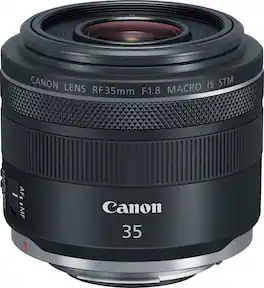
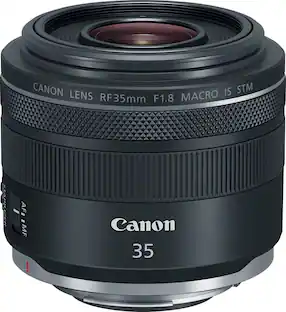
Canon - RF35mm F1.8 Macro IS STM Macro Lens for EOS R-Series Cameras - Black

Expand your photography and videography potential with this 35mm Canon Macro lens. Its light weight and compact form make it an easy carry-along companion, while the 0.5x magnification ratio and five stops of image stabilization ensure versatility. This Canon Macro lens has a control ring on its barrel for simple adjustments to settings.

Canon - RF50mm F1.8 STM Standard Prime Lens for EOS R-Series Cameras - Black

Some items like your keys or wallet you just take everywhere you go because you just never know. For anyone with an EOS R series camera, add the RF50mm F1.8 STM lens to that list. As part of the EOS R System, it’s nice and compact thanks to its RF mount so you can shoot – and get a great shot – anywhere and anytime. Size isn’t all though. As a fixed focal length lens, it lets you be creative with composition and can be used for a wide range of scenes from snapshots to portraits, landscapes to low-light situations and more. Those images will stand out, too, just like you intend whether on social media, or when sharing or printing, thanks to impressive optical features like a PMo aspherical lens to suppress aberrations, Super Spectra coating to reduce flaring and ghosting, and a large f/1.8 aperture for low-light shooting and beautiful bokeh. Pick it up and use it one time and you’ll see for yourself, and you won’t be able to leave the house without it.

Canon - RF85mm F2 Macro IS STM Medium Telephoto Lens for EOS R-Series Cameras - Black

The RF85mm F2 Macro IS STM medium telephoto lens expands on the versatility of bright, macro, IS equipped prime lenses built for the EOS R system. With a focal length of 85 millimeters and a bright, maximum aperture of f/2 for beautiful bokeh, this versatile lens is a great choice for portraits and street photography, as well as low light scenes or during concerts, and with the addition of macro capability, even close-up and macro photography will provide stellar results. The RF85mm F2 Macro IS STM is a lightweight, affordable lens that boasts high image quality and an impressive optical image stabilization system offering up to 5 stops of shake correction ideal for low-light scenes or when recording video, and featuring Hybrid IS enables stabilization when focusing on macro, close-range subjects. Like the RF35mm F1.8 Macro IS USM, it also includes half-size macro functionality allowing for a minimum focusing distance as close as 1.15 ft. With a built-in customizable control ring and a fast 12-pin communication system, the RF85mm F2 Macro IS STM is an ideal travel companion for your portrait, macro, low-light, and video needs.

Pros for Canon - RF45mm F1.2 STM Standard Prime Lens for EOS R-Series Cameras - Black
Weight, Build Quality, Autofocus Speed, Portability, Noise LevelImage Quality, Aperture, Price, Weight, MacroImage Quality, Price, Aperture, Ease of use, SizeImage Quality, Price, Weight, Bokeh, Portrait
Cons for Canon - RF45mm F1.2 STM Standard Prime Lens for EOS R-Series Cameras - Black
Image Stabilization, Weather ResistanceWeather SealingChromatic AberrationFocus Speed

Specs

Questions & Answers
  • Is this lens compatible with Canon EOS R series cameras?

    Yes, this lens is compatible with Canon EOS R series cameras.

    This question and answer was generated by AI based on customer and product data.
  • Does this lens have image stabilization?

    No, this lens does not have in-lens image stabilization.

    This question and answer was generated by AI based on customer and product data.
  • Does this lens have automatic and manual focus?

    Yes, this lens has both automatic and manual focus.

    This question and answer was generated by AI based on customer and product data.
  • What is the shortest focusing distance for this lens?

    The minimum focus distance of the lens is 17.7 inches.

    This question and answer was generated by AI based on customer and product data.
  • What is the largest aperture available on this lens?

    The maximum aperture available on this lens is f/1.2.

    This question and answer was generated by AI based on customer and product data.
Ask a question
No content

Customers often buy these together

Sponsored