
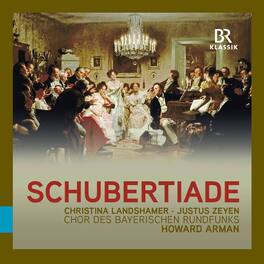
Christina Landshamer - Schubertiade - BLU-RAY
About This Item
- Details
- Genre: Music
- Description: In society music, or Gesellschaftsmusik, to which a large part of Franz Schubert's lied oeuvre belongs, polyphonic vocal compositions became very fashionable in around 1800 as part of bourgeois musical culture and communal singing. To describe Schubert's pieces for several male or female voices as choral songs is not entirely accurate, however, since at the time they were usually sung by soloists. However, amateur choirs such as the Gesellschaft der Musikfreunde in Vienna already existed and held regular concerts, and Schubert's polyphonic songs thus often came to the attention of a wider public more quickly than his solo songs performed in private circles. Society music had thus taken the step into the concert hall, and Schubert's name first appeared on a program of the Musikfreunde on January 25, 1821. Some of the composer's best-known songs for men's or women's choir with piano are collected in this SCHUBERTIADE, including the gently swaying barcarole InchDer GondelfahrerInch, in which Schubert evokes the glitter of moonlight on the Venetian canals, or the InchStändchenInch, which was written as a birthday serenade. One of his five settings of Mignon's InchNur wer die Sehnsucht kenntInch from Goethe's Wilhelm Meister was written for five-part male choir - a special feature here among his polyphonic songs is that Mignon's tormented soul is expressed through a differentiated harmony and refined treatment of the text. A prominent position among Schubert's religious pieces that were not intended for the church is occupied by InchMirjams SiegesgesangInch, where the male and female choirs finally unite and embody the Israelite people. The choir answers to a solo soprano as the precentor. This large-scale work depicts the exodus of the people of Israel from Egypt, with the prophetess Mirjam at their head; her three-movement hymn of praise leads into an impressive choral f
- Title: Schubertiade
- Format: Blu-ray
- MPAA Rating: NR (Motion Picture Association of America's (MPAA) film-rating system is used in the United States and its territories to rate a film's suitability for certain audiences.)
- Studio: BR Klassiks
- Release Date: 02/11/2022
- Region Code: A
- Genre: Music
- Other
- Product Name: Christina Landshamer - Schubertiade - BLU-RAY
- UPC: 4035719005288
In society music, or Gesellschaftsmusik, to which a large part of Franz Schubert's lied oeuvre belongs, polyphonic vocal compositions became very fashionable in around 1800 as part of bourgeois musical culture and communal singing. To describe Schubert's pieces for several male or female voices as choral songs is not entirely accurate, however, since at the time they were usually sung by soloists. However, amateur choirs such as the Gesellschaft der Musikfreunde in Vienna already existed and held regular concerts, and Schubert's polyphonic songs thus often came to the attention of a wider public more quickly than his solo songs performed in private circles. Society music had thus taken the step into the concert hall, and Schubert's name first appeared on a program of the Musikfreunde on January 25, 1821. Some of the composer's best-known songs for men's or women's choir with piano are collected in this SCHUBERTIADE, including the gently swaying barcarole InchDer GondelfahrerInch, in which Schubert evokes the glitter of moonlight on the Venetian canals, or the InchStändchenInch, which was written as a birthday serenade. One of his five settings of Mignon's InchNur wer die Sehnsucht kenntInch from Goethe's Wilhelm Meister was written for five-part male choir - a special feature here among his polyphonic songs is that Mignon's tormented soul is expressed through a differentiated harmony and refined treatment of the text. A prominent position among Schubert's religious pieces that were not intended for the church is occupied by InchMirjams SiegesgesangInch, where the male and female choirs finally unite and embody the Israelite people. The choir answers to a solo soprano as the precentor. This large-scale work depicts the exodus of the people of Israel from Egypt, with the prophetess Mirjam at their head; her three-movement hymn of praise leads into an impressive choral f
Reviews
This product doesn't have any reviews yet.
Compare similar products
In society music, or Gesellschaftsmusik, to which a large part of Franz Schubert's lied oeuvre belongs, polyphonic vocal compositions became very fashionable in around 1800 as part of bourgeois musical culture and communal singing. To describe Schubert's pieces for several male or female voices as choral songs is not entirely accurate, however, since at the time they were usually sung by soloists. However, amateur choirs such as the Gesellschaft der Musikfreunde in Vienna already existed and held regular concerts, and Schubert's polyphonic songs thus often came to the attention of a wider public more quickly than his solo songs performed in private circles. Society music had thus taken the step into the concert hall, and Schubert's name first appeared on a program of the Musikfreunde on January 25, 1821. Some of the composer's best-known songs for men's or women's choir with piano are collected in this SCHUBERTIADE, including the gently swaying barcarole InchDer GondelfahrerInch, in which Schubert evokes the glitter of moonlight on the Venetian canals, or the InchStändchenInch, which was written as a birthday serenade. One of his five settings of Mignon's InchNur wer die Sehnsucht kenntInch from Goethe's Wilhelm Meister was written for five-part male choir - a special feature here among his polyphonic songs is that Mignon's tormented soul is expressed through a differentiated harmony and refined treatment of the text. A prominent position among Schubert's religious pieces that were not intended for the church is occupied by InchMirjams SiegesgesangInch, where the male and female choirs finally unite and embody the Israelite people. The choir answers to a solo soprano as the precentor. This large-scale work depicts the exodus of the people of Israel from Egypt, with the prophetess Mirjam at their head; her three-movement hymn of praise leads into an impressive choral f
![The Lord of the Rings Trilogy: Extended Editions (4K Ultra HD) [UHD] [Standard] [4K Ultra HD Blu-ray]](https://pisces.bbystatic.com/image2/BestBuy_US/images/products/8d263cd1-cb65-4086-944d-02205b49ce6f.jpg;maxHeight=422;maxWidth=264?format=webp)
![Sinners (4K Ultra HD) [UHD] [Standard] [4K Ultra HD Blu-ray]](https://pisces.bbystatic.com/image2/BestBuy_US/images/products/978cd180-f005-472d-8640-c09d20b6c0b5.jpg;maxHeight=422;maxWidth=264?format=webp)
![Back to the Future Trilogy: 40th Anniversary Edition - 4K Blu-Ray [Standard] [4K Ultra HD Blu-ray]](https://pisces.bbystatic.com/image2/BestBuy_US/images/products/735f6825-457b-4b8c-aa84-4c1333e549e3.jpg;maxHeight=422;maxWidth=264?format=webp)
Eight-disc set includes Back To The Future (1985) Michael J. Fox stars as Marty McFly, a teen from 1985 who accidentally travels back to 1955 in a time machine constructed out of a DeLorean by his friend, frazzled scientist Doc Brown (Christopher Lloyd). Trapped in the past, Marty must restore the timeline by playing matchmaker to his future parents (Crispin Glover and Lea Thompson) while Doc's '50s counterpart tries to help him get back to 1985. Thomas F. Wilson also stars in director Robert Zemeckis' exciting blend of sci-fi, action, and comedy. 116 minutes. Back To The Future Part II (1989) Marty (Michael J. Fox) and Doc (Christopher Lloyd) are back for more adventures in time in this smash sequel. After zipping ahead to the year 2015, the duo returns to an altered 1985, leading to another trip to the 1950s in order to undo the damage caused by Biff Tannen (Thomas F. Wilson) and a sports almanac he brought back from the future. Fox also appears as Marty's kids, Marty, Jr., and Marlene. With Lea Thompson, Elisabeth Shue. 108 minutes. Back To The Future Part III (1990) The third and final entry in the popular time-traveling trilogy finds Marty (Michael J. Fox) heading to the Old West to help his pal Doc (Christopher Lloyd). But while Doc falls head-over-heels for a sweet schoolmarm (Mary Steenburgen), it's Marty's feud with notorious gunslinger and outlaw Buford InchMad DogInch Tannen (Thomas F. Wilson) that may prevent them from ever returning to the present. Lea Thompson co-stars, with Fox also appearing as Marty's ancestor Seamus McFly. 118 minutes.
| Pros for Christina Landshamer - Schubertiade - BLU-RAY | |||
|---|---|---|---|
| There were no pros for this product— | There were no pros for this product— | Overall Performance | There were no pros for this product— |