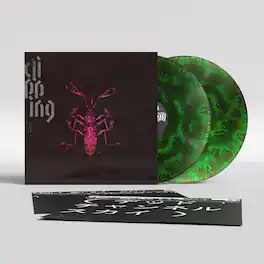
Clipping. - There Existed An Addiction To Blood - VINYL LP
Reviews coming soon
About this product
Vinyl LP pressing. The science-fiction visionary Octavia Butler once declared that Inchthere is nothing new under the sun, but there are new suns. Inch The aphorism could apply to any art form where the basic contours are fixed, but the appetite for innovation remains infinite. Enter Clipping, flash fiction genre masters in a hip-hop world firmly rooted in memoir. If first person confessionals historically reign, the mid-city Los Angeles trio of rapper Daveed Diggs and producers William Hutson and Jonathan Snipes have spent the last half-decade terraforming their own patch of soil, replete with conceptual labyrinths and industrial chaos. They have conjured a mutant emanation of the future, built at odd angles atop the hallowed foundation of the past. Sing. Their third album for Sub Pop, There Existed an Addiction to Blood, finds them interpreting another rap splinter sect through their singular lens. This is Clipping.'s transmutation of horrorcore, a purposefully absurdist sub-genre that flourished in the mid-90s.
Specifications
- GenreDance and electronicDescriptionVinyl LP pressing. The science-fiction visionary Octavia Butler once declared that Inchthere is nothing new under the sun, but there are new suns. Inch The aphorism could apply to any art form where the basic contours are fixed, but the appetite for innovation remains infinite. Enter Clipping, flash fiction genre masters in a hip-hop world firmly rooted in memoir. If first person confessionals historically reign, the mid-city Los Angeles trio of rapper Daveed Diggs and producers William Hutson and Jonathan Snipes have spent the last half-decade terraforming their own patch of soil, replete with conceptual labyrinths and industrial chaos. They have conjured a mutant emanation of the future, built at odd angles atop the hallowed foundation of the past. Sing. Their third album for Sub Pop, There Existed an Addiction to Blood, finds them interpreting another rap splinter sect through their singular lens. This is Clipping.'s transmutation of horrorcore, a purposefully absurdist sub-genre that flourished in the mid-90s.ArtistClipping.TitleThere Existed An Addiction To BloodFormatVINYLLabelSub Pop
Reviews
This product doesn't have any reviews yet.
Compare similar products

Vinyl LP pressing. The science-fiction visionary Octavia Butler once declared that Inchthere is nothing new under the sun, but there are new suns. Inch The aphorism could apply to any art form where the basic contours are fixed, but the appetite for innovation remains infinite. Enter Clipping, flash fiction genre masters in a hip-hop world firmly rooted in memoir. If first person confessionals historically reign, the mid-city Los Angeles trio of rapper Daveed Diggs and producers William Hutson and Jonathan Snipes have spent the last half-decade terraforming their own patch of soil, replete with conceptual labyrinths and industrial chaos. They have conjured a mutant emanation of the future, built at odd angles atop the hallowed foundation of the past. Sing. Their third album for Sub Pop, There Existed an Addiction to Blood, finds them interpreting another rap splinter sect through their singular lens. This is Clipping.'s transmutation of horrorcore, a purposefully absurdist sub-genre that flourished in the mid-90s.

Daneshevskaya-the creative alias of Brooklyn musician Anna Beckerman-is an ode to the singer's Lithuanian familial roots, and while her music can be delicate and dreamy, it's underpinned by a sense of great ambition. Her first offering on new tag home Winspear, Long Is The Tunnel, features notable contributions from Lewis Evans of Black Country, New Road, and production work by members of the critically-praised art-rock band Model/Actriz. Over the course of the seven-track project, Daneshevskaya shares standout tracks like the delicately disorienting InchBig BirdInch and InchSomewhere In The MiddleInch-an oblique folk/rock track with compelling dynamic shifts.
Because of their mix of hellified gangster S**t and progressive compositions, I once jokingly called Clipping InchDeathrow Tull.Inch Well, it's not a joke anymore. While Clipping's last few projects have been record-long concepts like classic prog rock, their cyberpunk-infused new album Dead Channel Sky is mixtape-like, a carefully curated collection in which every track is a love letter to a possible present. It sounds crisp and classic at the same time. When something strikes us as retrospective and futuristic at the same time, it's a reminder of how slipshod our present moment truly is. Juxtaposing high-tech, corporate command-and-control systems (the InchcyberInch) with the lo-fi, D.I.Y. underground (the InchpunkInch), cyberpunk proper starts in 1982 and ends in 1999, from Blade Runner to The Matrix. Concurrently, hip-hop matured, went through it's Golden Era, then melted into further forms it went from from Fab 5 Freddy to Public Enemy to Missy Elliott. While other genres flirted with it, hip-hop was fickle and fey. Rap and rock birthed mutant offspring maligned by most, and hip-hop's relations with electronica rarely fared any better.What if someone explicitly merged hip-hop and cyberpunk - those twin suns of the '80s and '90s - into one set and sound? After all, both movements are the result of hacking the haunted leftovers of a war-torn culture that's long since moved on.On Dead Channel Sky, Clipping texture-map the twin histories of hip-hop and cyberpunk onto an alternate present where Rammellzee and Bambaataa are the superheroes of old; where Cybotron and Mantronix are the reigning legends; where Egyptian Lover and Freestyle are debated endlessly, and Ultramag and Public Enemy are the undeniable forefathers; where the lost movements of 1980s and the 1990s are still happening rave, trip-hop, hip-house, acid house, drum & bass, big beat-the detritus of a dif

Vinyl LP pressing includes . Since the of CLPPNG, things have changed for the band-William finished his Ph.D. in Theater and Performance Studies with a dissertation on experimental music, Jonathan composed scores for the films Starry Eyes, The Nightmare, Excess Flesh, and Contracted Phase II, and Daveed hit Broadway. Their activities outside Clipping have always influenced their work in the band, but never as much as in the creation of Splendor & Misery. Splendor & Misery is an Afrofuturist, dystopian concept album that follows the sole survivor of a slave uprising on an interstellar cargo ship, and the onboard computer that falls in love with him. Thinking he is alone and lost in space, the character discovers music in the ship's shuddering hull and chirping instrument panels. William and Jonathan's tracks draw an imaginary sonic map of the ship's decks, hallways, and quarters, while Daveed's lyrics ride the rhythms produced by it's engines and machinery. In a reversal of H.P. Lovecraft's concept of cosmic insignificance, the character finds relief in learning that humanity is of no consequence to the vast, uncaring universe. It turns out, pulling the rug out from under anthropocentrism is only horrifying to those who thought they were the center of everything to begin with. Ultimately, the character decides to pilot his ship into the unknown-and possibly into oblivion-instead of continuing on to worlds whose systems of governance and economy have violently oppressed him.
Specs
Be the first to ask a question.
We’ll try to get your question answered within 24 hours by a Best Buy customer or brand representative.