Corgi - Lockheed P-38L-5-LO Lightning "Putt Putt Maru" Col. Charles McDonald 475th FG Philippines 1945 Aviation Archive 1/72 - Multi
Corgi - Lockheed P-38L-5-LO Lightning "Putt Putt Maru" Col. Charles McDonald 475th FG Philippines 1945 Aviation Archive 1/72 - Multi
Related Item

About This Item
- General
- Brand: Corgi
- Product Name: Lockheed P-38L-5-LO Lightning "Putt Putt Maru" Col. Charles McDonald 475th FG Philippines 1945 Aviation Archive 1/72
- Color: Multi
- Recommended Minimum Age: 15 years
- Warranty
- Warranty - Parts: None
- Warranty - Labor: None
- Other
- Scale: 1/72
- UPC: 3342614112302
Brand new 1/72 scale diecast model of the Lockheed P-38 L-5-LO Lightning Fighter Aircraft "'Putt Putt Maru', Col. Charles McDonald, 475th FG USAF, Philippines" (1945) United States Air Force from *The Aviation Archive* Series by Corgi, this collectible comes in a brand new box and features a detailed exterior, true-to-scale detail, a sliding door, removable engine covers, an opening canopy, and includes a display stand with a pilot figure in the cockpit. It is an officially licensed product in the manufacturer’s original unopened packaging, with dimensions approximately Length-6.25 and Wingspan-8.75 inches. Constructed from diecast metal and plastic, it offers durability and a heavy, realistic feel, with authentic panel lines, antennas, access panels, and surface details for an accurate representation of the real-life airplane, making it perfect for collectors and military history enthusiasts. Having seen the introduction of advanced monoplane fighter designs in both the German and Japanese air forces, America realized its own Air Force urgently needed an upgrade. In February 1937, an official requirement was issued for a new pursuit fighter with unprecedented performance, and Lockheed Aircraft Company, under the guidance of talented designer Clarence "Kelly" Johnson, set out to meet this challenge. Johnson concluded that a single-engine design could not achieve the specifications and instead developed a twin-engine aircraft featuring twin booms to house the engines and superchargers, with a centrally positioned nacelle for the cockpit and heavy armament. The resulting XP-38 was a radical and stunning departure from previous designs, impressing officials with its maiden flight and later shattering the US Transcontinental speed record by 23 minutes, though it ended in an emergency landing after running out of fuel. The aircraft’s potential was undeniable, leading the US Army Air Force to order sixty-six units, making it America’s first 400 mph fighter. While its introduction brought challenges due to its groundbreaking design, continuous development transformed the Lightning into an exceptionally effective high-altitude interceptor. With engines driving outwardly rotating propellers, it became remarkably stable, and its range and firepower made it formidable in combat. Most notably, the P-38 Lightning avenged the Pearl Harbor attack when sixteen aircraft from the 339th Fighter Squadron intercepted and shot down the bomber carrying Admiral Isoroku Yamamoto, the architect of the raid.
- Brand New Condition: This product is 100% brand new, unused, and in original condition.
- Brand New Condition: This product is 100% brand new, unused, and in original condition.
Reviews
This product doesn't have any reviews yet.
Compare similar products
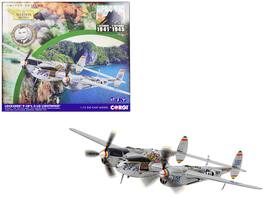
Brand new 1/72 scale diecast model of the Lockheed P-38 L-5-LO Lightning Fighter Aircraft "'Putt Putt Maru', Col. Charles McDonald, 475th FG USAF, Philippines" (1945) United States Air Force from *The Aviation Archive* Series by Corgi, this collectible comes in a brand new box and features a detailed exterior, true-to-scale detail, a sliding door, removable engine covers, an opening canopy, and includes a display stand with a pilot figure in the cockpit. It is an officially licensed product in the manufacturer’s original unopened packaging, with dimensions approximately Length-6.25 and Wingspan-8.75 inches. Constructed from diecast metal and plastic, it offers durability and a heavy, realistic feel, with authentic panel lines, antennas, access panels, and surface details for an accurate representation of the real-life airplane, making it perfect for collectors and military history enthusiasts. Having seen the introduction of advanced monoplane fighter designs in both the German and Japanese air forces, America realized its own Air Force urgently needed an upgrade. In February 1937, an official requirement was issued for a new pursuit fighter with unprecedented performance, and Lockheed Aircraft Company, under the guidance of talented designer Clarence "Kelly" Johnson, set out to meet this challenge. Johnson concluded that a single-engine design could not achieve the specifications and instead developed a twin-engine aircraft featuring twin booms to house the engines and superchargers, with a centrally positioned nacelle for the cockpit and heavy armament. The resulting XP-38 was a radical and stunning departure from previous designs, impressing officials with its maiden flight and later shattering the US Transcontinental speed record by 23 minutes, though it ended in an emergency landing after running out of fuel. The aircraft’s potential was undeniable, leading the US Army Air Force to order sixty-six units, making it America’s first 400 mph fighter. While its introduction brought challenges due to its groundbreaking design, continuous development transformed the Lightning into an exceptionally effective high-altitude interceptor. With engines driving outwardly rotating propellers, it became remarkably stable, and its range and firepower made it formidable in combat. Most notably, the P-38 Lightning avenged the Pearl Harbor attack when sixteen aircraft from the 339th Fighter Squadron intercepted and shot down the bomber carrying Admiral Isoroku Yamamoto, the architect of the raid.
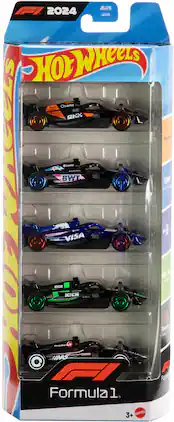
Speed into the high-octane action of Formula 1 with a 5-pack of Hot Wheels Formula 1 race cars in 1:64 scale. Each die-cast vehicle features graphics of five of the hottest racing teams on the circuit including McLaren F1 Team, BWT Alpine F1 Team, Visa Cash App RB Formula One Team, KICK Sauber F1 Team and MoneyGram Haas F1 Team. The set is designed for true automotive enthusiasts who appreciate the legacy and collectability of a Hot Wheels and Formula 1 collaboration. Put them on display or recreate legendary moments from the pinnacle of motorsport on Hot Wheels tracks. Track sold separately.

The Hot Wheels City Mega Garage playset is four levels of parking garage awesomeness! It comes with one 1:64 scale vehicle but can hold almost 60 more (additional cars sold separately). At the center is a corkscrew elevator that carries cars between different floors and releases them onto a track. Kids control it with a hand-crank and determine whether cars continue to other adventures or if they roll into a parking spot where they're put on display. Multiple connection points on the base allow kids to connect the playset to other Hot Wheels sets (sold separately), and there are an additional four outlets to connect orange track pieces to it for the ultimate in stunting and building. One 1:64 scale Hot Wheels vehicle in included for action right out of the box!

The Hot Wheels 20-Car Pack delivers a multipack of 1:64 scale vehicles in an open-window package that displays the entire set! Collectors, car enthusiasts and kids will love the collection of modern and vintage models and hot designs for push-around play, track-set action and to put on display. Included in each set are two exclusive vehicles for the ultimate in collectability. Colors and decorations may vary.
| Pros for Corgi - Lockheed P-38L-5-LO Lightning "Putt Putt Maru" Col. Charles McDonald 475th FG Philippines 1945 Aviation Archive 1/72 - Multi | |||
|---|---|---|---|
| There were no pros for this product— | There were no pros for this product— | Quality, Size, Ease of use, Storage, Assembly | Quality, Size, Variety, Design, Color |
| Cons for Corgi - Lockheed P-38L-5-LO Lightning "Putt Putt Maru" Col. Charles McDonald 475th FG Philippines 1945 Aviation Archive 1/72 - Multi | |||
| There were no cons for this product— | There were no cons for this product— | Car Count | There were no cons for this product— |