
D'India / Ensemble Arte Musica - Musiche a Una E Due Voci - COMPACT DISCS [CD]
About This Item
- Details
- Genre: Classical
- Description: These songs for one and two voices come from the first four of D'India's five books of Musiche, a series containing masterpieces of astonishing originality in the style of monody (solo melody with accompaniment), which had eclipsed the polyphonic madrigal in popularity at the dawn of the 17th century. With a career based largely in Turin and Rome, Sigismondo D'India nevertheless demonstrates stylistic links to both Monteverdi and Gesualdo, and it is the latter's influence which supports new scholarship claiming D'India grew up in Naples (not Sicily) in the shadow of the great madrigalist's free thinking on harmony. That very harmonic freedom - to accentuate key emotions in the text with piquant chord changes - is the hallmark of D'India's own, self-styled 'true manner' of composing monody, adopted from Gesualdo's intense, chromatic polyphony to the solo song or duet, and it suggests a Neapolitan, rather than Roman-Florentine, musical background. In D'India's own words, he uses 'intervals out of the ordinary, moving with the greatest invention from one consonance to the next, depending on the variety of the meaning of the words' for 'greater impact and greater power to move the emotions of the soul'. It is this sense for the dramatic power of song that positions D'India as a true proto-operatic composer. In fact, his three-part setting of Clorinda's death scene from Tasso's Gerusalemme liberata (Amico hai vinto) predates by several years that of his contemporary Monteverdi the revolutionary Il combattimento di Tancredi e Clorinda. Perhaps the young D'India's wide travels across Italy, absorbing the musical styles at each locale and acquiring a broad grasp of the varied stylistic practices throughout the peninsula in the early Baroque, gave him the conviction to claim his own style as the 'true manner'. In any case, it's originality and vision are truly remarkable.
- Artist: D'INDIA / ENSEMBLE ARTE MUSICA
- Title: Musiche a Una E Due Voci
- Format: CD
- Label: Brilliant Classics
- Release Date: 08/24/2018
- Genre: Classical
- Other
- Product Name: D'India / Ensemble Arte Musica - Musiche a Una E Due Voci - COMPACT DISCS
- UPC: 5028421956343
Reviews
This product doesn't have any reviews yet.
Compare similar products
![D'India / Ensemble Arte Musica - Musiche a Una E Due Voci - COMPACT DISCS [CD]](https://pisces.bbystatic.com/image2/BestBuy_US/images/products/78efd7f1-4fa6-41d8-801d-7c72e444e575.jpg;maxHeight=422;maxWidth=264?format=webp)
These songs for one and two voices come from the first four of D'India's five books of Musiche, a series containing masterpieces of astonishing originality in the style of monody (solo melody with accompaniment), which had eclipsed the polyphonic madrigal in popularity at the dawn of the 17th century. With a career based largely in Turin and Rome, Sigismondo D'India nevertheless demonstrates stylistic links to both Monteverdi and Gesualdo, and it is the latter's influence which supports new scholarship claiming D'India grew up in Naples (not Sicily) in the shadow of the great madrigalist's free thinking on harmony. That very harmonic freedom - to accentuate key emotions in the text with piquant chord changes - is the hallmark of D'India's own, self-styled 'true manner' of composing monody, adopted from Gesualdo's intense, chromatic polyphony to the solo song or duet, and it suggests a Neapolitan, rather than Roman-Florentine, musical background. In D'India's own words, he uses 'intervals out of the ordinary, moving with the greatest invention from one consonance to the next, depending on the variety of the meaning of the words' for 'greater impact and greater power to move the emotions of the soul'. It is this sense for the dramatic power of song that positions D'India as a true proto-operatic composer. In fact, his three-part setting of Clorinda's death scene from Tasso's Gerusalemme liberata (Amico hai vinto) predates by several years that of his contemporary Monteverdi the revolutionary Il combattimento di Tancredi e Clorinda. Perhaps the young D'India's wide travels across Italy, absorbing the musical styles at each locale and acquiring a broad grasp of the varied stylistic practices throughout the peninsula in the early Baroque, gave him the conviction to claim his own style as the 'true manner'. In any case, it's originality and vision are truly remarkable.
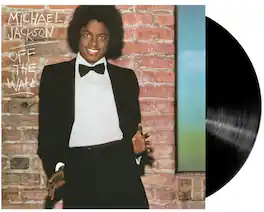
Limited vinyl LP repressing in gatefold jacket. Off the Wall is the fifth solo studio album by Michael Jackson. It was released on August 10, 1979, following Jackson's critically well-received film performance in The Wiz. While working on that project, Jackson and Quincy Jones had become friends, and Jones agreed to work with Jackson on his next studio album. Recording sessions took place between December 1978 and June 1979 at Allen Zentz Recording, Westlake Recording Studios, and Cherokee Studios in Los Angeles, California. Jackson collaborated with a number of other writers and performers such as Paul McCartney, Stevie Wonder and Rod Temperton. Five singles were released from the album. It was his first solo under Epic Records, the tag he would record on until his death roughly 30 years later. Album Tracks 1. Don't Stop 'Til You Get Enough 2. Rock with You 3. Workin' Day and Night 4. Get on the Floor 1. Off the Wall 2. Girlfriend 3. She's Out of My Life 4. I Can't Help It 5. It's the Falling in Love 6. Burn This Disco Out
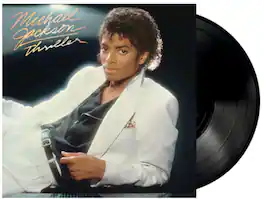
Limited vinyl LP repressing in gatefold jacket. Thriller is the sixth solo studio album by Michael Jackson. It was released by Epic Records on November 30, 1982, as the follow-up to Jackson's critically and commercially successful 1979 album Off The Wall. Thriller explores similar genres to those of Off The Wall, including pop, post-disco, rock and funk. Recording sessions took place on April to November 1982 at Westlake Recording Studios in Los Angeles with a production budget of $750, 000, assisted by producer Quincy Jones. Seven singles were released from the album, all of which reached the Top 10 on the Billboard Hot 100. In just over a year, Thriller became-and currently remains-the best-selling album of all time, with estimated sales of 65 million copies worldwide. It has become the first album ever to be certified 32 times multi-platinum for U.S. sales, marking more than 32 million sales shipped. The album won a record-breaking eight Grammy Awards in 1984, including for Album of the Year. Album Tracks 1. Wanna Be Startin' Somethin' Jackson, Michael 6 03 2. Baby Be Mine Jackson, Michael 4 20 3. The Girl Is Mine Jackson, Michael with Paul McCartney 3 42 4. Thriller Jackson, Michael 5 58 1. Beat It (Single Version) Jackson, Michael 4 18 2. Billie Jean (Single Version) Jackson, Michael 4 53 3. Human Nature Jackson, Michael 4 05 4. P.Y.T. (Pretty Young Thing) Jackson, Michael 3 59 5. The Lady in My Life Jackson, Michael 4 57

Limited vinyl LP repressing in gatefold jacket. Bad is the seventh solo studio album by Michael Jackson. It was released on August 31, 1987, nearly five years after Jackson's previous studio album, Thriller. Bad was recorded during the first half of 1987. The lyrical themes on the record relate to media bias, paranoia, racial profiling, romance, self-improvement and world peace. The album is widely regarded as having cemented Jackson's status as one of the most successful artists of the 1980s, as well as enhancing his solo career and being one of the best musical projects of his career. Five of the singles hit #1 in the United States, while a sixth charted within the Top Ten, and a seventh charted within the Top Twenty on the Hot 100. Bad peaked at #1 in thirteen countries and charted within the Top Twenty in other territories. Album Tracks 1. Bad 2. The Way You Make Me Feel 3. Speed Demon 4. Liberian Girl 5. Just Good Friends 1. Another Part of Me 2. Man in the Mirror 3. I Just Can't Stop Loving You - Michael Jackson Feat. Siedah Garrett 4. Dirty Diana 5. Smooth Criminal
| Pros for D'India / Ensemble Arte Musica - Musiche a Una E Due Voci - COMPACT DISCS [CD] | |||
|---|---|---|---|
| There were no pros for this product— | There were no pros for this product— | Sound Quality | There were no pros for this product— |