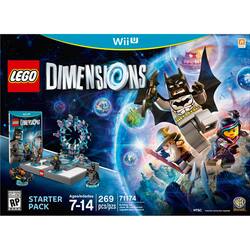
LEGO Dimensions Starter Pack Standard Edition - Nintendo Wii U
- Details
- Genre: Action and Adventure
- Key Specs
- Edition: Standard Edition
- ESRB Rating: E10+ (Everyone 10+) (The overall rating of the game, based on its age-appropriateness, interactive elements, and types of featured content, as established by the Entertainment Software Rating Board (ESRB).)
- ESRB Descriptors: Cartoon violence, Crude humor (The type and severity of content in the game, such as the nature of its themes, humor, language, etc. These elements are part of a three-part guide established by the Entertainment Software Rating Board (ESRB) to determine a game's overall age-appropriate rating.)
- Compatible Platform(s): Nintendo Wii U
- Software Format: Physical (Physical software requires a disc, cartridge, etc. be inserted into the gaming console or computer to download and/or operate the software. Digital software allows for downloading and/or playing the software on the gaming console or computer without a physical disc, cartridge, etc. Physical (Download Code Only) software is purchased in physical form with a code that allows for downloading and/or playing the software on the gaming console or computer without a physical disc, cartridge, etc.)
- General
- Brand: WB Games
- Model Number: 1000534189
- Product Name: LEGO Dimensions Starter Pack
- Publisher: WB Games
- Developer: Telltale Games
- Game Details
- Edition: Standard Edition
- Genre: Action and Adventure
- Game Franchise: Lego Batman
- Game Series: 3
- Certifications Listings & Approvals
- ESRB Rating: E10+ (Everyone 10+) (The overall rating of the game, based on its age-appropriateness, interactive elements, and types of featured content, as established by the Entertainment Software Rating Board (ESRB).)
- ESRB Descriptors: Cartoon violence, Crude humor (The type and severity of content in the game, such as the nature of its themes, humor, language, etc. These elements are part of a three-part guide established by the Entertainment Software Rating Board (ESRB) to determine a game's overall age-appropriate rating.)
- Compatibility
- Compatible Platform(s): Nintendo Wii U
- Software Format: Physical (Physical software requires a disc, cartridge, etc. be inserted into the gaming console or computer to download and/or operate the software. Digital software allows for downloading and/or playing the software on the gaming console or computer without a physical disc, cartridge, etc. Physical (Download Code Only) software is purchased in physical form with a code that allows for downloading and/or playing the software on the gaming console or computer without a physical disc, cartridge, etc.)
- Requirements
- Video Game Content Included: Full game
- Other
- UPC: 883929450398
At the center of the LEGO Multiverse lies an ancient planet that is inhabited by the evil mastermind, Lord Vortech. It is believed that the person who controls the Foundational Elements on which this planet is built will control all of the Multiverse. Vowing to become that ruler, Lord Vortech determines that by summoning characters from a variety of LEGO worlds, he'll be able to find the building blocks of the LEGO civilization. One day, a mysterious and powerful vortex appears in a variety of LEGO worlds, and different characters from DC Comics, The Lord of the Rings, The LEGO Movie and more are swept away. Noticing their friends are being taken, Batman, Gandalf and Wyldstyle jump into the vortex on a journey they never imagined. Now, realizing Lord Vortech's intentions, the three intrepid heroes must venture through space and time to save their friends and all of LEGO humanity.
Team up with the Caped Crusader, Gandalf the Great and Wyldstyle from The LEGO Movie to vanquish Lord Vortech and save LEGO humanity from annihilation in LEGO Dimensions. This Starter Pack delivers everything you need to begin your buildable adventure, including a copy of the game, LEGO Toy Pad, bricks to construct the LEGO Gateway, three minifigures and the LEGO Batmobile vehicle. Let your creativity and imagination guide you on your adventure, as you'll team up with unlikely allies from a variety of worlds, including DC Comics, The Lord of the Rings, The LEGO Movie, LEGO Ninjago, Back to the Future and more, to thwart your enemies. Use a combination of up to seven minifigures, vehicles and gadgets by dropping them on the LEGO Toy Pad to bring them into the universe. Let your imagination run wild in a solo journey, or team up with a buddy for cooperative drop-in/-out gameplay. Grab your blocks and flex your creative muscles — all of LEGO civilization is depending on you.
Whats Included
- LEGO Dimensions game
- LEGO Toy Pad
- LEGO Gateway bricks
- Batman, Gandalf and Wyldstyle LEGO minifigures
- LEGO Batmobile vehicle