Orchestra Del Maggio Musicale Fiorentino Galli - Gianni Schicchi - BLU-RAY
Reviews coming soon
About this product
When Il trittico premiered at New York's Metropolitan Opera in December 1918, Gianni Schicchi became an immediate hit. The libretto is based on an incident mentioned in Dante's Divine Comedy. The action in Puccini's Gianni Schicchi takes place in Buoso Donati's bedroom in 13th-century Florence, immediately after his death, as his greedy relatives feign grief and search for his will. The mood shifts to anger when the relatives discover that they have been disinherited. They seek out the clever and resourceful Schicchi to make a counterfeit will. Schicchi, however, turns their scheme against them, bequeathing most of the dead man's fortune to himself while the relatives, all parties to the crime of forgery, are forced to sit by silently. The aria O mio babbino caro is one of Puccini's most popular arias for soprano. Bruno de Simone plays the character of Gianni Schicchi. As Italy's finest basso buffo, he is perfect for this role. Puccini completed the score on 20 April, 1918, eight months before the scheduled premiere. At that performance it was presented as the third part of a trilogy of newly written one-act operas by Puccini billed as Il trittico (The Triptych); the first two were Il tabarro (The Cloak) and Suor Angelica (Sister Angelica). Il tabarro was a dark tragedy and Suor Angelica a sweet one, so by closing with Gianni Schicchi Puccini rounded off the night with a high-spirited comic farce. Critical reaction at the time judged that Gianni Schicchi was Inchan uproarious delightInch, and it was the most favorably received of the three.
Format
Blu-raySpecifications
- GenreMusicDescriptionWhen Il trittico premiered at New York's Metropolitan Opera in December 1918, Gianni Schicchi became an immediate hit. The libretto is based on an incident mentioned in Dante's Divine Comedy. The action in Puccini's Gianni Schicchi takes place in Buoso Donati's bedroom in 13th-century Florence, immediately after his death, as his greedy relatives feign grief and search for his will. The mood shifts to anger when the relatives discover that they have been disinherited. They seek out the clever and resourceful Schicchi to make a counterfeit will. Schicchi, however, turns their scheme against them, bequeathing most of the dead man's fortune to himself while the relatives, all parties to the crime of forgery, are forced to sit by silently. The aria O mio babbino caro is one of Puccini's most popular arias for soprano. Bruno de Simone plays the character of Gianni Schicchi. As Italy's finest basso buffo, he is perfect for this role. Puccini completed the score on 20 April, 1918, eight months before the scheduled premiere. At that performance it was presented as the third part of a trilogy of newly written one-act operas by Puccini billed as Il trittico (The Triptych); the first two were Il tabarro (The Cloak) and Suor Angelica (Sister Angelica). Il tabarro was a dark tragedy and Suor Angelica a sweet one, so by closing with Gianni Schicchi Puccini rounded off the night with a high-spirited comic farce. Critical reaction at the time judged that Gianni Schicchi was Inchan uproarious delightInch, and it was the most favorably received of the three.TitleGianni SchicchiFormatBlu-rayMPAA RatingNRStudioDynamic
Reviews
This product doesn't have any reviews yet.
Compare similar products

When Il trittico premiered at New York's Metropolitan Opera in December 1918, Gianni Schicchi became an immediate hit. The libretto is based on an incident mentioned in Dante's Divine Comedy. The action in Puccini's Gianni Schicchi takes place in Buoso Donati's bedroom in 13th-century Florence, immediately after his death, as his greedy relatives feign grief and search for his will. The mood shifts to anger when the relatives discover that they have been disinherited. They seek out the clever and resourceful Schicchi to make a counterfeit will. Schicchi, however, turns their scheme against them, bequeathing most of the dead man's fortune to himself while the relatives, all parties to the crime of forgery, are forced to sit by silently. The aria O mio babbino caro is one of Puccini's most popular arias for soprano. Bruno de Simone plays the character of Gianni Schicchi. As Italy's finest basso buffo, he is perfect for this role. Puccini completed the score on 20 April, 1918, eight months before the scheduled premiere. At that performance it was presented as the third part of a trilogy of newly written one-act operas by Puccini billed as Il trittico (The Triptych); the first two were Il tabarro (The Cloak) and Suor Angelica (Sister Angelica). Il tabarro was a dark tragedy and Suor Angelica a sweet one, so by closing with Gianni Schicchi Puccini rounded off the night with a high-spirited comic farce. Critical reaction at the time judged that Gianni Schicchi was Inchan uproarious delightInch, and it was the most favorably received of the three.
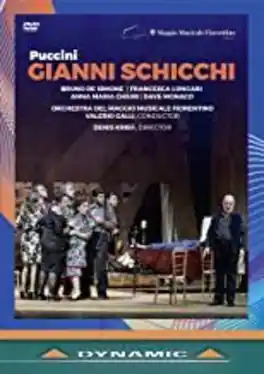
When Il trittico premiered at New York's Metropolitan Opera in December 1918, Gianni Schicchi became an immediate hit. The libretto is based on an incident mentioned in Dante's Divine Comedy. The action in Puccini's Gianni Schicchi takes place in Buoso Donati's bedroom in 13th-century Florence, immediately after his death, as his greedy relatives feign grief and search for his will. The mood shifts to anger when the relatives discover that they have been disinherited. They seek out the clever and resourceful Schicchi to make a counterfeit will. Schicchi, however, turns their scheme against them, bequeathing most of the dead man's fortune to himself while the relatives, all parties to the crime of forgery, are forced to sit by silently. The aria O mio babbino caro is one of Puccini's most popular arias for soprano. Bruno de Simone plays the character of Gianni Schicchi. As Italy's finest basso buffo, he is perfect for this role. Puccini completed the score on 20 April, 1918, eight months before the scheduled premiere. At that performance it was presented as the third part of a trilogy of newly written one-act operas by Puccini billed as Il trittico (The Triptych); the first two were Il tabarro (The Cloak) and Suor Angelica (Sister Angelica). Il tabarro was a dark tragedy and Suor Angelica a sweet one, so by closing with Gianni Schicchi Puccini rounded off the night with a high-spirited comic farce. Critical reaction at the time judged that Gianni Schicchi was Inchan uproarious delightInch, and it was the most favorably received of the three.

This production is new staging of the Teatro del Maggio Musicale Fiorentino. Il Tabarro is one of the three one-act operas that compose Giacomo Puccini's Il Trittico. Michele is married to young Giorgetta and shares with her a life full of hardships on a barge over the river Seine. She is in love with Luigi, a young longshoreman hired by her husband during the loading of the barge. When Michele overhears his wife giving a rendezvous to Luigi by night, he waits for the man and attacks him, forces him to admit he is his wife's lover and finally strangles him. Then he hides the body under his cloak, (il tabarro) and when Giorgetta, in mortal fear, comes on deck and asks Michele if he does not wish her to come and rest near him under his cloak, her wronged husband throws it open and Giorgetta discovers in horror her dead lover's body rolling at her feet. The element of Didier Gold's Houppelande that most attracted Puccini was the opportunity to represent, in music, a river, which is what acts as a backdrop in this plot and determines it's pace. The importance of this atmosphere is enormous, because it is linked to the mise en scene more tightly than usual. The action entirely takes place on a barge over the Seine in Paris, which is placed in the centre of the scene. The music describing the river uses a cyclic repetition of ostinato patterns, representing the monotonous flowing of the water, as inexorable as destiny and as regular as the flow of time. The pulse of the river cyclically marks, in the first part of Tabarro, the life of this world of vanquished longshoremen and boatmen. But even when it disappears, the musical identity between drama and location does not cease to exist.

Suor Angelica is one of the three one-act operas that comprise Puccini's Il Trittico. Of the three, it's the most lyrical and tragic; it also features an all female cast. Set in a 17th-century convent near Florence, it tells the tragic tale of a noblewoman who is forced to become a nun to repent the sin of having had a child outside wedlock, thus causing a huge scandal in her social circle. The baby is immediately taken from her, and Angelica is left with no news about him, nor her family, for seven long years. Although seemingly adjusted to the convent's daily routine - she has become an expert in herbal remedies - Angelica is desperate to hear from her family, but when an aunt finally visits her, Suor Angelica is coldly informed that her son died from an incurable disease two years earlier. The aria Senza mamma (Without Mama) is the tragic peak of both this moment and the whole opera. In her distress, Angelica resolves there is only one option left to be reunited with her child she proceeds to prepare some poison and drink it. On the verge of death she asks for forgiveness, which the Virgin Mary grants her, appearing with a young boy by her side. InchAnna Maria Chiuri, who plays the character of the Princess, has a beautifully projected and even contralto voice, a monumental fraseggio which well suits the character's elusiveness... Valerio Galli directs the Orchestra del Maggio Musicale Fiorentino with great self assurance. The performance is excellent, the sound is homogeneous, round and sparkling with energy. Suor Angelica's intimate religious sense flows naturally into the colors and shades of the finale. Inch (Connessiallopera. It)
Specs
Be the first to ask a question.
We’ll try to get your question answered within 24 hours by a Best Buy customer or brand representative.