Rey-Joly Werba Rocha Morace Giovannini Cirillo Peruta Benetti Caputo Orchestra E Coro Del T - BLU-RAY
Reviews coming soon
About this product
Parma native Ferdinando Paer, who wrote more than 50 operas, composed Agnese in 1809 for a private entertainment and a company of amateur singers. In 1824, with a few changes to the score, this opera semiseria in two acts reached the Theathre- Italien in Paris where it gained international success; among it's early admirers were Berlioz, Chopin and Victor Hugo who mentioned it in his Les Misérables but a few decades after it's première it fell into oblivion. In modern times it was first revived in concert form by Conductor Diego Fasolis and finally, in 2019 with the addition of a critical revision, it was performed at the Teatro Regio di Torino. The plot presents several fairy-tale elements, which are very well realized through the stage setting. When Agnese elopes with her beloved Ernesto, her father Uberto loses his mind and believes her dead. He is therefore hospitalized into a mental institution, where most of the action takes place. In the Ospedale dei pazzi sympathetic doctors, security guards and administrators try to help Uberto regain his sanity, to no avail. In the meanwhile, Agnese, betrayed and abandoned by Ernesto, to whom she bore a daughter, goes back to her father to ask for forgiveness, unaware of his troubles. Ernesto is repentant of his philandering ways and follows Agnese to win her back. The opera ends with Uberto regaining his mental clarity when he hears Agnese sing an old song, and a general reconciliation occurs. In director Leo Muscato's words Inchthe most interesting aspect of this opera... is the irony that is present from the beginning to the end of the storyInch which imbues even the most dramatic circumstances. The set design for this wonderful, world premiere on video opera, is made of a series of movable boxes which are similar to carillons and which open-up displaying different environments.
Specifications
- GenreMusicDescriptionParma native Ferdinando Paer, who wrote more than 50 operas, composed Agnese in 1809 for a private entertainment and a company of amateur singers. In 1824, with a few changes to the score, this opera semiseria in two acts reached the Theathre- Italien in Paris where it gained international success; among it's early admirers were Berlioz, Chopin and Victor Hugo who mentioned it in his Les Misérables but a few decades after it's première it fell into oblivion. In modern times it was first revived in concert form by Conductor Diego Fasolis and finally, in 2019 with the addition of a critical revision, it was performed at the Teatro Regio di Torino. The plot presents several fairy-tale elements, which are very well realized through the stage setting. When Agnese elopes with her beloved Ernesto, her father Uberto loses his mind and believes her dead. He is therefore hospitalized into a mental institution, where most of the action takes place. In the Ospedale dei pazzi sympathetic doctors, security guards and administrators try to help Uberto regain his sanity, to no avail. In the meanwhile, Agnese, betrayed and abandoned by Ernesto, to whom she bore a daughter, goes back to her father to ask for forgiveness, unaware of his troubles. Ernesto is repentant of his philandering ways and follows Agnese to win her back. The opera ends with Uberto regaining his mental clarity when he hears Agnese sing an old song, and a general reconciliation occurs. In director Leo Muscato's words Inchthe most interesting aspect of this opera... is the irony that is present from the beginning to the end of the storyInch which imbues even the most dramatic circumstances. The set design for this wonderful, world premiere on video opera, is made of a series of movable boxes which are similar to carillons and which open-up displaying different environments.TitleAgneseFormatBlu-rayMPAA RatingNRStudioDynamic
Reviews
This product doesn't have any reviews yet.
Compare similar products
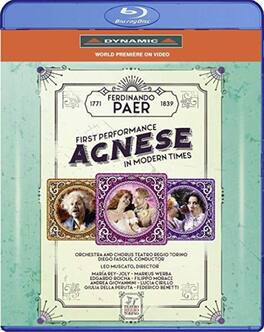
Parma native Ferdinando Paer, who wrote more than 50 operas, composed Agnese in 1809 for a private entertainment and a company of amateur singers. In 1824, with a few changes to the score, this opera semiseria in two acts reached the Theathre- Italien in Paris where it gained international success; among it's early admirers were Berlioz, Chopin and Victor Hugo who mentioned it in his Les Misérables but a few decades after it's première it fell into oblivion. In modern times it was first revived in concert form by Conductor Diego Fasolis and finally, in 2019 with the addition of a critical revision, it was performed at the Teatro Regio di Torino. The plot presents several fairy-tale elements, which are very well realized through the stage setting. When Agnese elopes with her beloved Ernesto, her father Uberto loses his mind and believes her dead. He is therefore hospitalized into a mental institution, where most of the action takes place. In the Ospedale dei pazzi sympathetic doctors, security guards and administrators try to help Uberto regain his sanity, to no avail. In the meanwhile, Agnese, betrayed and abandoned by Ernesto, to whom she bore a daughter, goes back to her father to ask for forgiveness, unaware of his troubles. Ernesto is repentant of his philandering ways and follows Agnese to win her back. The opera ends with Uberto regaining his mental clarity when he hears Agnese sing an old song, and a general reconciliation occurs. In director Leo Muscato's words Inchthe most interesting aspect of this opera... is the irony that is present from the beginning to the end of the storyInch which imbues even the most dramatic circumstances. The set design for this wonderful, world premiere on video opera, is made of a series of movable boxes which are similar to carillons and which open-up displaying different environments.
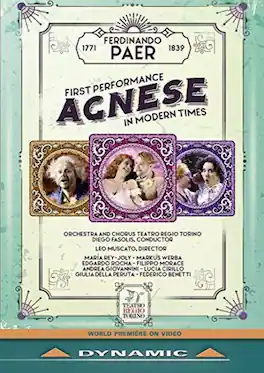
Parma native Ferdinando Paer, who wrote more than 50 operas, composed Agnese in 1809 for a private entertainment and a company of amateur singers. In 1824, with a few changes to the score, this opera semiseria in two acts reached the Theathre- Italien in Paris where it gained international success; among it's early admirers were Berlioz, Chopin and Victor Hugo who mentioned it in his Les Misérables but a few decades after it's première it fell into oblivion. In modern times it was first revived in concert form by Conductor Diego Fasolis and finally, in 2019 with the addition of a critical revision, it was performed at the Teatro Regio di Torino. The plot presents several fairy-tale elements, which are very well realized through the stage setting. When Agnese elopes with her beloved Ernesto, her father Uberto loses his mind and believes her dead. He is therefore hospitalized into a mental institution, where most of the action takes place. In the Ospedale dei pazzi sympathetic doctors, security guards and administrators try to help Uberto regain his sanity, to no avail. In the meanwhile, Agnese, betrayed and abandoned by Ernesto, to whom she bore a daughter, goes back to her father to ask for forgiveness, unaware of his troubles. Ernesto is repentant of his philandering ways and follows Agnese to win her back. The opera ends with Uberto regaining his mental clarity when he hears Agnese sing an old song, and a general reconciliation occurs. In director Leo Muscato's words Inchthe most interesting aspect of this opera... is the irony that is present from the beginning to the end of the storyInch which imbues even the most dramatic circumstances. The set design for this wonderful, world premiere on video opera, is made of a series of movable boxes which are similar to carillons and which open-up displaying different environments.
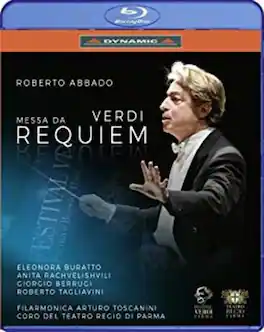
Giuseppi Verdi's Messa da Requiem arose out of the composer's admiration for the influential poet and novelist Alessandro Manzoni, and as a response to the lack of appreciation shown to the writer in the press after the his death in 1873. The extraordinary character of Verdi's Requiem confronts us with unanswerable questions, from the stormy and terrifying Dies irae, to consolatory and touching lyrical oases in which Verdi communicates liturgical texts in the most profound and expressive ways possible. This Teatro Regio di Parma production, which was performed open-air at the Parco Ducale of Parma, was dedicated to the victims of the Covid-19 pandemic and all the health workers engaged in the emergency. The mayor of Parma introduces the performance with a brief and touching speech and a minute's silence. Conductor Roberto Abbado declared in an interview InchI think that Verdi felt the need to compose a sacred work to deal with some themes that, as he got older, he felt very strongly about. They are themes that every human being sooner or later asks themselves. Verdi is not afraid to show that he fears death, and therefore his approach is extremely humble and human, showing... some of the frailties we all have. How does the Messa da Requiem end? It ends, in my opinion, with a huge question mark. Basically, I believe, Verdi, like many of us, cannot answer these questions. I, myself, cannot answer them.Inch
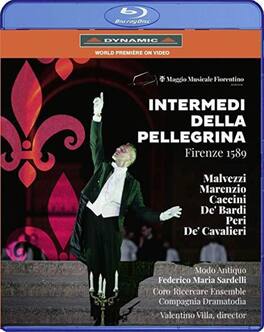
Florence, May 2nd, 1589 on occasion of the wedding of the Grand Duke Ferdinando I and Christina of Lorraine an impressive celebration apparatus was put up to display the magnificence of the Medici household. Behind this official event lay an ambitious project which involved an incredible team of the most important poets and musicians of the time, such as Cristofano Malvezzi, Luca Marenzio, Giulio Caccini, Jacopo Peri, Emilio De' Cavalieri as well as Count Giovanni De' Bardi, who was engaged to compose the Intermedi for Girolamo Bargagli's play La Pellegrina. Renaissance intermediums were sumptuous musical interludes inserted between the acts of a theatrical show on allegorical and moral themes with eclectic references to classical mythology. They are considered as the forerunners of musical opera. The spectacular show, which was performed using a complex stage machinery set up in Palazzo Pitti's Boboli gardens, was an immediate success, so much that the intermediums were performed in the days to follow during another two plays. The Six intermediums in La Pellegrina provide for choral madrigals, double and triple choirs, solo accompanied numbers and instrumental pieces, inserted into the impressive and sumptuous staging by Bernando Buontalenti. 430 years later, Teatro del Maggio Musicale Fiorentino in collaboration with Galleria Degli Uffizi produces the first staging in modern times of the Intermedi della Pellegrina through an itinerant show in Palazzo Pitti's Boboli Gardens. Stage director Valentino Villa's approach was to Inchattempt at an ironic historical reconstruction, [where] imageries blur together, classical mythology is grafted onto contemporary iconographyInch. Conductor Federico Maria Sardelli leads Modo Antiquo and Chorus Master Alberto Allegrezza is at the head of Coro Ricercare Ensemble and Compagnia Dramatodìa.
Specs
Be the first to ask a question.
We’ll try to get your question answered within 24 hours by a Best Buy customer or brand representative.