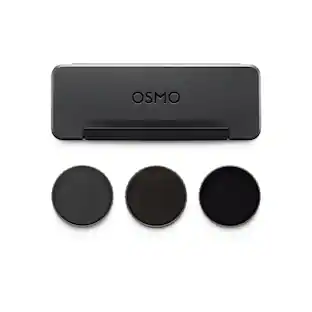
Vaonis - Dual Band Filter for Vespera Telescope, Bundle with Light Pollution Filter
Reviews coming soon
About this product
The Vespera Dual Band Filter is a dual narrowband interference filter that will significantly improve your photo quality whether you are viewing from an urban or natural environment.By selecting very precisely the wavelengths of Hydrogen Alpha (H-alpha) and Oxygen III (O-III), found mainly in nebulae, the filter will increase the contrast between the Stellar object and the sky background. Thus, its use makes it possible to obtain a higher-quality image, with sharper stars and finer details.Keep only the essentialThe Dual Band filter has been designed to allow only two particular wavelengths to pass through to the Vespera sensor: O-III H-alphaDue to the filtered wavelengths, it is particularly effective for photographing nebulae in emission, dark nebulae endowed with hydrogen, planetary nebulae, supernova remnants.For globular clusters, the selectivity of the Dual Band filter will help you to obtain sharper stars. A filter specifically studied for Vespera The optical quality of the Dual Band filter has been specifically studied by our engineers to offer use at full aperture, without any impact on the optical diameter of the instrument. The lens ring is equipped with an electronic micro-card that allows Vespera to detect the Dual Band filter and adapt its observation and image processing parameters. Transmission curve The filter features 12nm of bandwidth in each wavelength (O-III = 500.7nm, H-alpha = 656.3nm).
Features
INCLUDED
Vaonis Dual Band Filter for Vespera Telescope, Bundle with Light Pollution Filter.
ENHANCED OPTICAL QUALITY
Experience superior viewing with a 78mm filter size, meticulously crafted from high-quality glass for pristine astronomical observations.
OPTIMAL LIGHT TRANSMISSION
The dual-band filter, including Oxygen III and H-Alpha (Night Sky) types, significantly reduces light pollution for clearer celestial images.
SEAMLESS COMPATIBILITY
Specifically designed for the Vespera Telescope, ensuring a perfect fit and effortless integration for immediate use.
ROBUST DURABILITY
Constructed with a durable glass and plastic build, this filter withstands regular use, providing lasting performance and protection.
Specifications
- BrandVaonisModel NumberAC022 + AC023Product NameVaonis Dual Band Filter for Vespera Telescope, Bundle with Light Pollution FilterColorExterior: BlackLens CompatibilityVespera TelescopeLens Filter TypeColor
Reviews
This product doesn't have any reviews yet.


Compare similar products
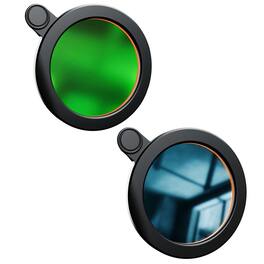
The Vespera Dual Band Filter is a dual narrowband interference filter that will significantly improve your photo quality whether you are viewing from an urban or natural environment.By selecting very precisely the wavelengths of Hydrogen Alpha (H-alpha) and Oxygen III (O-III), found mainly in nebulae, the filter will increase the contrast between the Stellar object and the sky background. Thus, its use makes it possible to obtain a higher-quality image, with sharper stars and finer details.Keep only the essentialThe Dual Band filter has been designed to allow only two particular wavelengths to pass through to the Vespera sensor: O-III H-alphaDue to the filtered wavelengths, it is particularly effective for photographing nebulae in emission, dark nebulae endowed with hydrogen, planetary nebulae, supernova remnants.For globular clusters, the selectivity of the Dual Band filter will help you to obtain sharper stars. A filter specifically studied for Vespera The optical quality of the Dual Band filter has been specifically studied by our engineers to offer use at full aperture, without any impact on the optical diameter of the instrument. The lens ring is equipped with an electronic micro-card that allows Vespera to detect the Dual Band filter and adapt its observation and image processing parameters. Transmission curve The filter features 12nm of bandwidth in each wavelength (O-III = 500.7nm, H-alpha = 656.3nm).
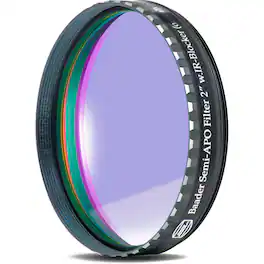
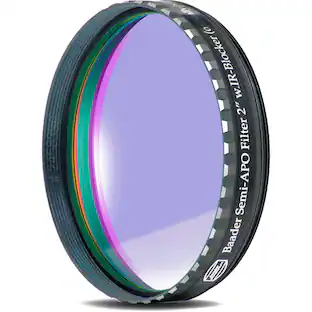
It's no secret that astrophotography enthusiasts and professional photographers alike seek the utmost clarity and contrast in their celestial captures. The Baader Planetarium Semi-APO Filter 2" is an innovative solution designed to enhance the visual quality of images taken with achromatic refractor telescopes. This high-quality filter effectively minimizes the distracting violet fringe that often diminishes the sharpness and contrast of astronomical images.Crafted with a potent combination of a stronger Fringe Killer coating and the Moon & Skyglow Neodymium substrate, this filter offers a performance akin to the synergy of the Fringe Killer and Moon & Skyglow filters, but with an intensified violet cut. The result is a filter that not only provides a significant value but also delivers a neutral view that maintains the natural color balance of the observed object.The Semi-APO Filter's high efficiency in fringe reduction is matched by its ability to remain inconspicuous in use. Its presence is virtually undetectable as it works to eradicate most of the violet aberration, leaving behind images that boast remarkable sharpness and enhanced contrast. Even users with smaller refractors will notice a substantial improvement in the aesthetic quality of their astrophotography.Moreover, the filter's Neodymium substrate goes beyond mere fringe reduction. It actively boosts color contrasts, particularly when observing planets such as Jupiter and Mars, due to its RGB enhancement capabilities. This makes the Baader Semi-APO Filter 2" a versatile tool in the astrophotographer's kit, suitable for capturing a wide array of celestial phenomena with increased detail and vibrancy.Durable and effective, the Baader Semi-APO Filter is a testament to Baader Planetarium's commitment to providing innovative optical solutions that cater to the discerning needs of astronomy enthusiasts. Whether you're capturing the grandeur of the night sky or honing in on planetary details, this filter is an indispensable asset for achieving high-contrast, sharp, and aesthetically pleasing astrophotography results.

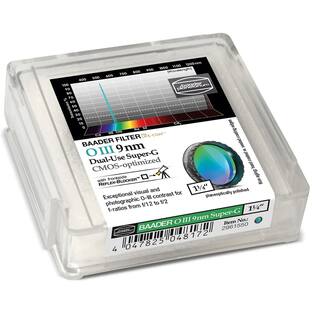
Over the years, the Baader 7.5nm Solar Continuum Filter has become an essential tool for both visual and photographic observations of the sun. This advanced filter functions as a narrow band photosphere filter, specifically designed for solar observation in white light. It delivers unparalleled contrast in the photosphere of the sun, enhancing your viewing and photography experience.The Baader Solar Continuum Filter operates as a monochromator, effectively suppressing the effects of atmospheric turbulence. This results in images that are significantly sharper and more detailed. The filter is optimized for the spectral range around 540nm, a range where our eyes have the highest sensitivity and where lens systems, including apochromats, catadiopters, or eyepieces, work most sharply and with the highest contrast. This narrowband filter blocks all other spectral ranges, reducing air turbulence and enhancing image sharpness, even on apochromatic telescopes, catadioptric systems, and pure mirror systems. As a monochromatic filter, it is ideally suited for use on monochromatic cameras, providing a substantial gain on pure color systems. While it is less effective with color cameras, as only the green pixels are utilized, the filter still significantly improves image sharpness and reduces the effects of air turbulence. However, with a color camera, the full potential of the filter's enhanced image quality cannot be fully exploited due to the reduced camera resolution.The Baader 7.5nm Solar Continuum Filter surpasses its predecessor, the 10nm half-band-width model, by offering a half-band-width of only 7.5nm, thereby increasing contrast even more. This single filter eliminates the need for stacking, as the contrast gain of a single 7.5nm filter makes it unnecessary.The Baader 7.5 nm Solar Continuum Filter also boasts all the advantages of the CMOS-optimized Baader filters. These include increased contrast, reflex-blocker coatings for the largest ever freedom from halos, identical filter thickness to existing standards for parfocality, and blackened edges all around to eliminate any reflection due to light falling onto the edge of a filter. Each filter is coated individually, with a sealed coating edge, ensuring durability and longevity. The Life-Coat feature guarantees a non-aging coating for life, even in the most adverse environments. In summary, the Baader 7.5nm Solar Continuum Filter is a high-performance tool that enhances solar observation and photography, delivering sharper, more detailed images with increased contrast.
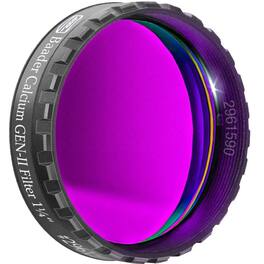
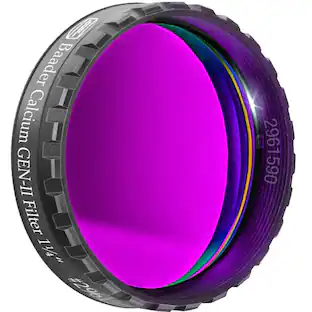
Take your solar imaging to the next level with the Calcium Gen-II 1.25" Unstacked Ca-K Solar Imaging Filter with LPFC. This advanced filter allows you to explore the fascinating boundary region between the sun's photosphere, visible in white light, and the chromosphere, typically observed with narrow-band H-alpha filters. With the Calcium Gen-II filter, you can observe not only familiar white light structures like sunspots, but also the chromospheric network that covers the sun's entire surface. This network is a precursor to sunspot formation and is accompanied by supergranulation cells and Ellerman Bombs. The filter operates at the emission line of calcium at 394 nm, which is in the near UV spectrum. As such, it's crucial to remember that this filter is designed for camera use only, as the human eye is not equipped to safely handle UV radiation. For optimal results, we recommend using this filter with a monochrome camera and mirror telescopes. While many lens telescopes can still be used for calcium observations, unmodified DSLRs may require significantly longer exposure times. All calcium filters necessitate an additional solar filter. The Baader GEN-II package includes a sheet of AstroSolar Photo Film OD 3.8, 20x30 cm (#2459278) to construct your own solar filter, allowing you to start observing without the need for additional purchases. The Calcium Gen-II filter supersedes the older K-Line Filter 1 1/4" (stacked) # 2458355. Thanks to modern manufacturing techniques, this single filter provides superior quality and a narrower half-band width (FWHM) of only 5 nm, eliminating the need for filter stacking. The low-profile filter mount is only 6 mm high when screwed in, making it compatible with standard filter wheels/drawers. For cameras with a 2"-nosepiece, the filter can be used with a filter drawer like the Baader UFC System or a filter wheel. The Baader Calcium GEN-II boasts all the benefits of the new generation of CMOS-optimized Baader filters, including increased contrast, Reflex-Blocker coatings for maximum halo freedom, identical filter thickness for parfocality, blackened edges for reflection elimination, individually coated filters with sealed coating edges, and Life-Coat for a durable, non-aging coating. In summary, the Calcium Gen-II 1.25" Unstacked Ca-K Solar Imaging Filter with LPFC is a powerful tool for any solar imaging enthusiast, offering a unique perspective on our sun's complex and captivating features.
Specs
More to consider
Baader Planetarium Calcium Gen-II 1.25" Unstacked Ca-K Solar Imaging Filter with LPFC
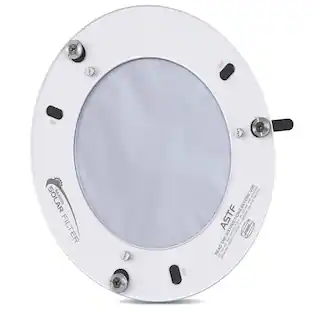
$302.52The price was $335.00Baader Planetarium 160mm AstroSolar BDSF 3.8 White-Light Digital Solar Filter for Telescopes
$158.61The price was $164.00


Capture the moments Sponsored
Tamron 70-300mm F/4.5-6.3 Di III RXD Telephoto Zoom Lens for Sony E-Mount
$369.99The price was $399.99Aura Home Aura Walden 15" Digital Wifi Photo Frame-Carbon with Paper Mat
Black Friday Deal$249.99The price was $299.99Digipower Rainbow RGB 135 LED Video Light for Digital/Mirrorless Cameras and Light Stands
$47.49The price was $94.99Aura Home Aura Aspen 12" Digital Wifi Photo Frame- Carbon with Paper Mat
Black Friday Deal$199.99The price was $229.99Insta360 Flow 2 AI Tracker Bundle Gimbal Stabilizer for Smartphones
Black Friday Deal$99.99The price was $129.99SANDISK 1TB Extreme PRO SDXC UHS-I Memory Card: National Park Foundation Edition, R/W up to 250/170MB/s
$289.99The price was $429.99







Keep exploring
Neewer 2X Macro Lens for DJI Osmo Nano/Action 5 Pro/4, 3-4cm Focus, Close-Up, LS-68
$36.99The price was $41.99Neewer 4-Pack Magnetic ND/CPL Filter Kit for DJI Pocket 4 & 3, ND16/64/256 + CPL, HD Glass
$36.99The price was $46.99Neewer Snap-On ND/CPL Filter Set for DJI Osmo Action - 4-Pack for Action 3, 4 & 5 Pro Cameras
$25.99The price was $35.99Neewer 67mm Multi-Effect Filter Kit for Phones - Clip-On ND/CPL/Star/Color Set for iPhone & Samsung
$43.99The price was $54.99NiSi 82mm True Color ND-VARIO Pro Nano 1-5 Stops 0.3-1.5 Variable ND Filter
$196.00The price was $245.00