
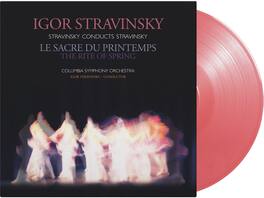
Igor Stravinsky - Le Sacre Du Printemps - VINYL LP
Reviews coming soon
About This Item
- Details
- Genre: Classical
- Description: The Rite of Spring Scenes from Pagan Russia in Two Parts. It was Igor Stravinsky who dragged classical music, kicking and screaming, into the twentieth century. Sure, his contemporaries had paved the way. No longer was the Romantic melody-rich work the dominant force. The new way was about orchestral colors and tone painting. But it was Stravinsky who broke altogether with the Romantic past and created Modernism. It was almost as if all the old rules had not just been bent but completely destroyed. In the modern world, anything goes. Stravinsky made a name for himself at a very early age. In his twenties, his work, Fireworks brought him to the attention of Serge Diaghilev, director of the Ballet Russes, who commissioned from Stravinsky a ballet based on the Firebird legend. It was a huge success and Diaghilev commissioned two more. The results were Petrouchka and The Rite of Spring. The story of the premier of The Rite of Spring is famous. The audience was first treated to Les Sylphides, a ballet based on the music of Chopin. The Rite of Spring was to follow. No doubt lulled into a pleasant, dreamy state by the earlier work, and expecting something similarly pastoral with the Rite, named after all about the most pleasant of seasons, they were in for a rude shock. A clue comes from it's subtitle Scenes from Pagan Russia. It opened with a bassoon bleating way higher than any bassoon was ever supposed to go and then descended into 30 minutes of barbarism and pagan ritual sacrifice. The music was jarring, dissonant, difficult. The huge percussion sections pounded out primitive rhythms, and Nijinsky's provocative choreography challenged the audience's sensibilities. This version was recorded at the Ballroom of the St. George Hotel, Brooklyn, NY, January 5 & 6, 1960 with The Columbia Symphony Orchestra.TRACKLIST SIDE A Premier Tableau L'adoration de la Terre Part 1 -
- Artist: Igor Stravinsky
- Title: Le Sacre Du Printemps
- Format: VINYL
- Label: Vinyl Passion
- Release Date: 07/25/2025
- Genre: Classical
- Number Of Discs: 1
- Other
- Product Name: Igor Stravinsky - Le Sacre Du Printemps - VINYL LP
- UPC: 8719039007325
Reviews
This product doesn't have any reviews yet.
Compare similar products
The Rite of Spring Scenes from Pagan Russia in Two Parts. It was Igor Stravinsky who dragged classical music, kicking and screaming, into the twentieth century. Sure, his contemporaries had paved the way. No longer was the Romantic melody-rich work the dominant force. The new way was about orchestral colors and tone painting. But it was Stravinsky who broke altogether with the Romantic past and created Modernism. It was almost as if all the old rules had not just been bent but completely destroyed. In the modern world, anything goes. Stravinsky made a name for himself at a very early age. In his twenties, his work, Fireworks brought him to the attention of Serge Diaghilev, director of the Ballet Russes, who commissioned from Stravinsky a ballet based on the Firebird legend. It was a huge success and Diaghilev commissioned two more. The results were Petrouchka and The Rite of Spring. The story of the premier of The Rite of Spring is famous. The audience was first treated to Les Sylphides, a ballet based on the music of Chopin. The Rite of Spring was to follow. No doubt lulled into a pleasant, dreamy state by the earlier work, and expecting something similarly pastoral with the Rite, named after all about the most pleasant of seasons, they were in for a rude shock. A clue comes from it's subtitle Scenes from Pagan Russia. It opened with a bassoon bleating way higher than any bassoon was ever supposed to go and then descended into 30 minutes of barbarism and pagan ritual sacrifice. The music was jarring, dissonant, difficult. The huge percussion sections pounded out primitive rhythms, and Nijinsky's provocative choreography challenged the audience's sensibilities. This version was recorded at the Ballroom of the St. George Hotel, Brooklyn, NY, January 5 & 6, 1960 with The Columbia Symphony Orchestra.TRACKLIST SIDE A Premier Tableau L'adoration de la Terre Part 1 -
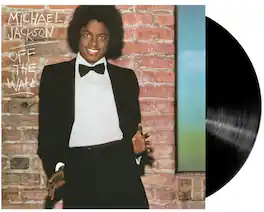
Limited vinyl LP repressing in gatefold jacket. Off the Wall is the fifth solo studio album by Michael Jackson. It was released on August 10, 1979, following Jackson's critically well-received film performance in The Wiz. While working on that project, Jackson and Quincy Jones had become friends, and Jones agreed to work with Jackson on his next studio album. Recording sessions took place between December 1978 and June 1979 at Allen Zentz Recording, Westlake Recording Studios, and Cherokee Studios in Los Angeles, California. Jackson collaborated with a number of other writers and performers such as Paul McCartney, Stevie Wonder and Rod Temperton. Five singles were released from the album. It was his first solo under Epic Records, the tag he would record on until his death roughly 30 years later. Album Tracks 1. Don't Stop 'Til You Get Enough 2. Rock with You 3. Workin' Day and Night 4. Get on the Floor 1. Off the Wall 2. Girlfriend 3. She's Out of My Life 4. I Can't Help It 5. It's the Falling in Love 6. Burn This Disco Out
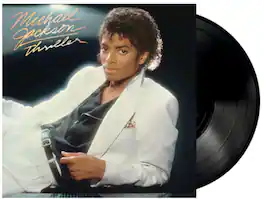
Limited vinyl LP repressing in gatefold jacket. Thriller is the sixth solo studio album by Michael Jackson. It was released by Epic Records on November 30, 1982, as the follow-up to Jackson's critically and commercially successful 1979 album Off The Wall. Thriller explores similar genres to those of Off The Wall, including pop, post-disco, rock and funk. Recording sessions took place on April to November 1982 at Westlake Recording Studios in Los Angeles with a production budget of $750, 000, assisted by producer Quincy Jones. Seven singles were released from the album, all of which reached the Top 10 on the Billboard Hot 100. In just over a year, Thriller became-and currently remains-the best-selling album of all time, with estimated sales of 65 million copies worldwide. It has become the first album ever to be certified 32 times multi-platinum for U.S. sales, marking more than 32 million sales shipped. The album won a record-breaking eight Grammy Awards in 1984, including for Album of the Year. Album Tracks 1. Wanna Be Startin' Somethin' Jackson, Michael 6 03 2. Baby Be Mine Jackson, Michael 4 20 3. The Girl Is Mine Jackson, Michael with Paul McCartney 3 42 4. Thriller Jackson, Michael 5 58 1. Beat It (Single Version) Jackson, Michael 4 18 2. Billie Jean (Single Version) Jackson, Michael 4 53 3. Human Nature Jackson, Michael 4 05 4. P.Y.T. (Pretty Young Thing) Jackson, Michael 3 59 5. The Lady in My Life Jackson, Michael 4 57
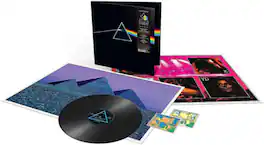
Limited 180gm vinyl LP pressing in gatefold jacket. The 50th anniversary edition of the original studio album remastered by James Guthrie comes in a gatefold jacket with posters and stickers. Album Tracks 1. Speak to Me 2. Breathe (In the Air) 3. On the Run 4. Time 5. The Great Gig in the Sky 1. Money 2. Us and Them 3. Any Colour You Like 4. Brain Damage 5. Eclipse
| Pros for Igor Stravinsky - Le Sacre Du Printemps - VINYL LP | |||
|---|---|---|---|
| There were no pros for this product— | There were no pros for this product— | Sound Quality | There were no pros for this product— |