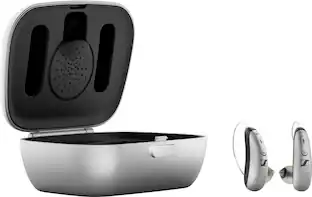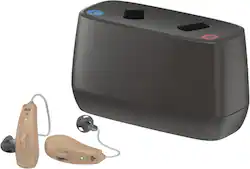
Jabra - Enhance Select 50R Rechargeable Hearing Aids - With Remote Professional Care and Bluetooth Streaming - Beige
- Key Specs
- Color: Beige
- General
- Brand: Jabra
- Model Number: 22900505
- Product Name: Enhance Select 50R Rechargeable Hearing Aids - With Remote Professional Care and Bluetooth Streaming
- Color: Beige
- Consumer Lifestage: Adult
- Features
- Programmable: true
- Number of Hearing Channels: 8 (The quantity of frequency range groups that are split up and processed by the device. The higher the number, the more selections a user will have to customize the listening experience.)
- Number of Listening Modes: 4 (The quantity of preset or customizable settings available for listening in different sound environments.)
- Hearing Range Compression/Expansion Technology: Wide Dynamic Range Compression (WDRC) (The manner in which a device detects a frequency of sound and compresses or expands it so the listener can hear those sounds better.)
- Hearing Loss Relief Features: External sound augmentation, Sound filtering
- Controls on Device: Environment mode selection, Volume control (The function(s) on the physical product that be regulated or modified by the user.)
- Microphone Pattern: Hypercardioid (Refers to how the device receives sound from different directions and captures it. Multi-directional patterns capture sound from multiple sources while a single direction pattern focuses on sound from a single source.)
- Ear-to-Ear Synchronization Capabilities: Background noise reduction, Increased microphone accuracy, Phone calls, Volume changes
- Protective Qualities: Water Resistant, Sweat Resistant
- Ingress Protection (IP) Rating: IP68 (A 4 to 6 character code classifying a product's degree of protection against intrusion of solid particles and liquids as well as impact. Each number in the IP Code denotes a level of protection, determined through testing and published by the International Electrotechnical Commission (IEC). The first digit represents the degree of protection against solid foreign objects or particles and the second digit represents the degree of protection against water ingress.)
- Environmental Sound Settings: Automatic, Custom, Preset
- Design
- Fit: Right ear, Left ear
- Design: Behind-The-Ear (BTE)
- Audio
- Noise Reduction Type: Low level, Automatic (The manner in which a device lowers the volume of loud and intense noise to reduce undesired noise while leaving desired speech signals completely intact.)
- Frequency Range: 100-8060
- Included
- Number of Devices Included: 2
- Ear Tip Sizes Included: Small, Medium, Large
- Ear Tip Shapes Included: Dome
- Connectivity
- App Compatible: true (The product can be connected to a program or software application on a mobile device, which then receives collected data from the product.)
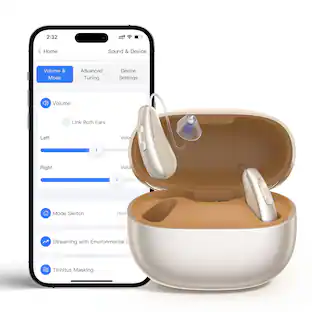
- App Compatible Features: Customizable sound settings, Environment mode selection, Sound adjustment, Stream phone calls, Stream music/media
- Wireless Connectivity: Bluetooth (The manner in which a device sends data to another device over a short distance without the use of wires or cables.)
- Operating System Compatibility: Apple iOS, Android
- Power
- On/Off Power Switch: true
- Low Battery Alert: true
- Rechargeable Battery: true
- Battery Chemistry: Lithium-ion
- Maximum Battery Life: 30 hours
- Battery Charge Time: 3 hours (Battery charge time will vary depending on the product configuration, product model, applications loaded on the product, power management setting of the product and the product features used by the customer. Charging time will likely decrease with time and usage of the battery.)
- Charging Interface(s): USB-C (The connection for transmitting power to charge the device.)
- Charging Accessory Included: Cradle
- Replaceable Battery: false
- Certifications Listings & Approvals
- FDA Medical Device Classification: Class II (The classification of the device as registered with the United States Food and Drug Administration (FDA).)
- Dimensions
- Product Height: 0.55 inches (The out of box height of the item. Height is measured as the vertical distance from the bottom of the item to the top as it would be primarily used or placed.)
- Product Length: 1.06 inches (The out of box length of the item. Length is measured as the longest dimension of the item.)
- Product Width: 0.33 inches (The out of box width of the item. Width is measured as the horizontal distance from one side of the item to the other as it would be primarily used or placed.)
- Product Weight: 0.1 ounces (The out of box weight of the item.)
- Warranty
- Warranty - Parts: 3 years
- Warranty - Labor: 3 years
- Other
- UPC: 5708296314058
The Jabra Enhance Select 50R are custom-programmable hearing aids, nearly invisible when worn, and lightweight for all-day comfort. They integrate advanced microphones and can be remotely adjusted by a Jabra Enhance licensed hearing professional to your unique needs to help you hear your best. Shop with confidence and take advantage of our 3-year warranty and 3-year loss and damage coverage. Bluetooth streaming is available for both Apple/Android compatible devices so you can listen to calls and stream music directly to your hearing aids. For device compatibility, please see our “Specifications Sheet” by navigating to Features - Manuals & Guides - Specification Sheet. 3 years of professional virtual hearing care from Audiology Team includes: 1) Orientation and individual programming of your hearing aids, plus unlimited ongoing adjustments & fine-tuning, based on your hearing needs, 2) Demonstrating how to use and maintain your hearing aids (device parts, batteries, charging case, cleaning, etc.), 3) Walking you through setup step-by-step to ensure hearing aid wires and domes fit comfortably, 4) Reassessing and reprogramming hearing aids based on changes in your hearing or health conditions, and 5) Video chats with a licensed hearing specialist about your hearing and hearing aids, as often as needed.
- Premium licensed care at your fingertips: Includes unlimited access to our dedicated Audiology Team from initial setup to 3 years of personalized follow-up care, including adjustments and video chats 7 days a week without leaving home.
- Custom-programmable to your hearing ability: Virtually meet with our Audiology Team to get your hearing aids custom-programmed to your individual hearing needs. You can also customize your hearing aid settings without Audiology Team support if desired.
- Medical-grade technology with Bluetooth streaming for calls/music: Medical-grade microphones improve speech clarity with built-in noise-canceling technology for the most natural sound quality. Connect to the world around you using Bluetooth technology and your compatible Apple/Android smartphone.
- Nearly invisible & lightweight for all-day comfort: Designed to provide you with optimal comfort and is nearly invisible when worn. These hearing aids pack advanced technology in a form factor that maximizes sound quality, comfort, and aesthetics so you can wear them all day.
- Control hearing aids with easy-to-use app: The Jabra Enhance Select app makes it easy to control your hearing aids and schedule remote adjustments from our Audiology Team – all from the palm of your hand. (Apple & Android compatible devices)
- Everything you need for less than you’d expect: You’ll get world-class licensed care, high-tech hearing aids, and a 3-year warranty with loss & damage coverage (subject to deductible) for thousands less than you’d expect.
- Long-lasting, rechargeable battery: Up to 24 hours on a single charge means worry-free sound on your day out. Conveniently recharge your hearing aids with our included charger that’s perfect for your nightstand.
- More Details: See Jabra Enhance website for compatibility and warranty/loss & damage details. For use by adults 18+ in US with mild to moderate hearing loss. Audiology Team support and programming only available in 50 states & DC, may not be able to remotely program for certain types of hearing loss.
Whats Included
- Hearing Aid (2)
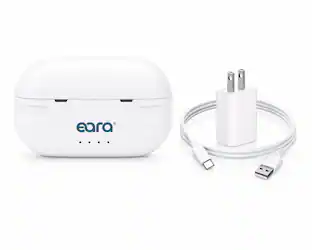
- Charger
- USB-C charging cable
- Ear measurement tool
- Assorted sizes of silicon domes
- Cleaning brush
- Cleaning cloth
- Wax guards
- (6) Activation and warranty inserts
Q: What types of devices are compatible with the Bluetooth streaming feature?
A: Bluetooth streaming is available for both Apple and Android-compatible devices.
Q: Do the hearing aids have a low battery alert?
A: The Jabra Enhance Select 50R hearing aids do have a low battery alert feature.
Q: Can the hearing aids be adjusted remotely by a hearing professional?
A: The Jabra Enhance Select 50R hearing aids can be remotely adjusted by a Jabra Enhance licensed hearing professional.
Q: What is the maximum battery life of the hearing aids?
A: The maximum battery life of these hearing aids is 30 hours.
Q: Are the hearing aids water resistant?
A: The Enhance Select 50R Rechargeable Hearing Aids have a water resistant design and an IP rating of IP68.
Q: How long does it take to fully charge the hearing aids?
A: It takes 3 hours to fully charge the hearing aids.
A: Hello Gary1234- Jabra Enhance professional support is included for no additional charge in this Jabra Enhance Select 50R offer! In addition to a pair of customizable hearing aids, you get three years of access to our dedicated Audiology Team for remote support, including an initial orientation by video call, custom programming, and follow-up appointments whenever you need them. You can schedule appointments, request remote programming adjustments from our Audiology Team, and make changes using the Jabra Enhance Select app. Also, kindly contact our Jabra Enhance support team at (800) 854-2772 for appointment scheduling and other support questions. You also get three years of warranty and loss & damage protection (subject to loss & damage deductible).
A: Hi! Thank you for your inquiry and interest in Jabra Enhance! Like most US OTC hearing aids, Jabra Enhance Select is available for sale and intended for use only within the United States. We do not support use outside of the US, and our licensed professionals cannot provide service outside the 50 states and DC. We hope at some point in the future to offer our products and services outside the US, but in the meantime, we wish you the best in finding the best hearing aid for you in Canada!
People also viewed
 $159.99The price was $169.99
 $149.99The price was $199.99
 $199.99The price was $249.99


Today's top picks
 $673.20The price was $676.54
- $159.99The price was $169.99