A:AnswerAccording to a couple of articles online I just read about your turntable, the turntable has a preamp that can be turned off. If you turn off the preamp, you should be able to connect the turntable to the phono inputs of the receiver. Alternatively, you can leave the turntable preamp on and connect the turntable to the CD or tape inputs of the receiver.
I don't know what to say about the speakers: you are correct, you will need two speakers to connect to the receiver. The receiver can handle speakers whose impedance is anywhere between 4 ohms and 16 ohms.
A:AnswerYou need to determine if it is the receiver or the source component first that is not outputting the volume. Try the radio first to see if you get some type of noise. If it is the receiver makes zero noise on the fm, then the receiver is most likely broken. Its usually more than a chip, It could be an hdmi board failure or the audio board which is an expensive repair. I would recommending doing a full set up again including unplugging all the equipment. After reconnecting, plug everything back in and wait for all the boxes to reset, then test again if no sound comes out then it is most likely a board failure. You can try replacing or swapping the cables around, Believe it or not they do go bad sometimes. I had a power cord that just stopped working. I brought the receiver in for service without bringing the offending power cord and there was no problem found. I brought the unit back home and it worked. Then 3 months later it shut off again. I decided to swap power cords and the receiver turned on. When I tested the offending cord on 3 other devices, they failed to turn on. So you never know or assume anything when trying to diagnose audio issues.
A:AnswerFirst you need to check the 8 ohm/4 ohm specs of the receiver. Speakers present a variable load to the receiver that can vary depending on the type of music and volume played. Think of a car in motion on a flat highway vs a steep grade. The amps output will vary according to this load. The subwoofer has its own amp so it does not figure into this equation. If you own the speakers already, you should be able to get their ohm rating on the back or the spec sheet. If the amp has a 4/8 ohm selector, the choice is obvious if you know the speakers rating. If the speaker is 6 ohms, then you have to consult the amps manual for the correct setting. If you are a loud listener, I would recommend an 8 ohm speaker with high efficiency rating 90 or greater.
A:AnswerIt can use banana or bare wire. Bananas are convenience and not required for most speaker cables. However, some speaker cables do require bananas.
A:AnswerYes this receiver should be able to drive your 8 ohm RCA speakers. You can connect your TV's headphone out or audio out to the TV input of TX-8020. I use it to play my TV audio through my TX-8020 by connecting my TV's audio out through a Y RCA cable.
A:AnswerYou can send the video using the HDMI or S video connection to your tv. Just mute the TV speakers so that you get the sound from your TX-8020 receiver and the connected speakers.
A:AnswerSince you didn't specify which turntable you have, but you did say that it didn't have a pre-amp, I assume it is not an AT-LP60-USB, which is a widely used model. The AT-LP60-USB has a pre-amp. I don't know what amplifier you have, since you didn't specify that either, but if the amplifier doesn't have a pre-amp built in, then you need to buy a small pre-amp for the turntable because the actual signal out of the tone arm is very small, and you probably need to increase the strength of the signal going in to the amplifier. For specifications as to size, go the the manufacturer's web page; everything is there.
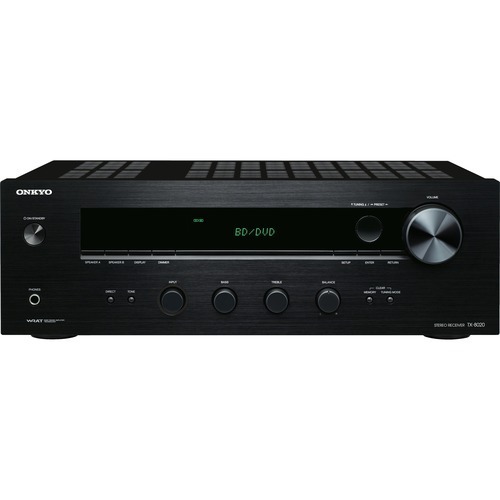
A:AnswerIt uses 120 volts and the power consumption is 180 watts. The OUTPUT power (to the speakers) is 50 watts continuous power per channel (there are two channels).
Note that this information is for the North American version of the receiver. There is also a European version that uses 230 volts and has an output power of 90 watts per channel.
A:AnswerIt will work but it is not recommended to use speakers with different ohm rating or efficiency ratings. It will result in 1 pair playing too soft and the other playing too loud. It is always best to use the same speakers or a pair with same ohm rating and spl efficiency.