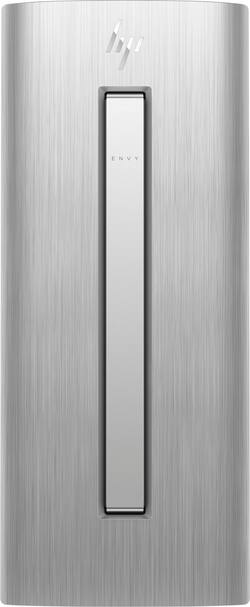
ENVY Desktop - Intel Core i7 - 16GB Memory - 1TB Hard Drive + Intel Optane Memory - HP finish in natural silver
- Key Specs
- Processor Model: Intel 7th Generation Core i7 (Your computer's processor is like its brain. Working in combination with system memory, the power of the processor determines the complexity of software you can run, how many programs you can have open at the same time, and how fast those programs will run. Most computers feature an AMD, Intel or Snapdragon processor.)
- Storage Type: HDD
- Total Storage Capacity: 1024 gigabytes
- System Memory (RAM): 16 gigabytes (Random-access memory (RAM) is a computing device's short-term data storage, which allows active information to be accessed quickly. The size and type of RAM determines how efficiently the device can handle large amounts of information at one time. For example, gaming or video editing requires more RAM for optimal performance.)
- Graphics Type: Integrated (Dedicated graphics uses a separate graphics card for processing video images. Because it does not use memory from the system's RAM, there is no extra burden on the CPU and graphics are processed more efficiently. Integrated graphics shares system RAM to process video images.)
- Graphics: Intel HD Graphics 630 (Often referred to as a "graphics processing unit" (GPU), this device is responsible for displaying image content and decoding/encoding video content in programs and games.)
- General
- Brand: HP
- Model Number: 750-624
- Product Name: ENVY Desktop - Intel Core i7 - 16GB Memory - 1TB Hard Drive + Intel Optane Memory
- Color: HP finish in natural silver
- Year of Release: 2018
- Processor
- Processor Brand: Intel
- Processor Model: Intel 7th Generation Core i7 (Your computer's processor is like its brain. Working in combination with system memory, the power of the processor determines the complexity of software you can run, how many programs you can have open at the same time, and how fast those programs will run. Most computers feature an AMD, Intel or Snapdragon processor.)
- Processor Model Number: 7700
- CPU Base Clock Frequency: 3.6 gigahertz (Actual central processing unit (CPU) speed may vary by device configuration and design. The average rate at which the processor is able to execute tasks under normal operating conditions as asserted by the manufacturer.)
- Storage
- Storage Type: HDD
- Total Storage Capacity: 1024 gigabytes
- Hard Drive Capacity: 1024 gigabytes (The amount of data that can be stored on the device's mechanical hard drive. Hard disk drives (HDDs) typically have larger capacities than solid state drives (SSDs) but may have slower speeds.)
- Memory
- System Memory (RAM): 16 gigabytes (Random-access memory (RAM) is a computing device's short-term data storage, which allows active information to be accessed quickly. The size and type of RAM determines how efficiently the device can handle large amounts of information at one time. For example, gaming or video editing requires more RAM for optimal performance.)
- Type of Memory (RAM): DDR4 SDRAM (Each type of RAM delivers a different level of speed, bandwidth, energy efficiency and performance.)
- Number of Memory Sticks Included: 2
- System Memory RAM Expandable To: 16 gigabytes (Adding more random-access memory (RAM) to a computer speeds up performance and improves efficiency. Upgrades to memory are limited by the number of expansion slots for additional RAM and existing RAM installed on the device.)
- Graphics
- Graphics Type: Integrated (Dedicated graphics uses a separate graphics card for processing video images. Because it does not use memory from the system's RAM, there is no extra burden on the CPU and graphics are processed more efficiently. Integrated graphics shares system RAM to process video images.)
- GPU Brand: Intel
- Graphics: Intel HD Graphics 630 (Often referred to as a "graphics processing unit" (GPU), this device is responsible for displaying image content and decoding/encoding video content in programs and games.)
- Compatibility
- Operating System: Windows 10 Home (The operating system manages all software and hardware, including files, memory and connected devices. Most importantly, it lets you interact with your device and your programs in a visual way; otherwise, you'd be typing computer code to get anything done.)
- Connectivity
- Number of HDMI Outputs (Total): 2
- Number of DisplayPort Outputs (Total): 0
- Number of USB Ports (Total): 7
- Wireless Connectivity: Wi-Fi, Bluetooth (The manner in which a device sends data to another device over a short distance without the use of wires or cables.)
- Wireless Networking Standard: Wi-Fi 5 (The wireless networking standard used by the device. Each iteration of the standard developed by the Wi-Fi Alliance corresponds to an existing IEEE 802.11 protocol; for example, standard 802.11ac (or AC) is termed Wi-Fi 5. Refers specifically to the standard the device is designed to use, but ultimately determines product interoperability and backward compatibility including previous versions.)
- Number Of Ethernet Ports: 1
- Cooling
- CPU Cooling System: Air
- Expansion
- Number Of Internal 5.25" Bays: 1
- Number Of External 3.5" Expansion Bays: 1
- Features
- Media Card Reader: true (A hardware device that allows for access to data on a memory card and enables the transfer of its files to a computer. These devices may have one or multiple slots for various types of memory cards, and may be integrated into the computer or available as an external device.)
- Audio Technology: 5.1 channel surround
- Size: Standard
- Dimensions
- Product Height: 15.8 inches (The out of box height of the item. Height is measured as the vertical distance from the bottom of the item to the top as it would be primarily used or placed.)
- Product Width: 6.5 inches (The out of box width of the item. Width is measured as the horizontal distance from one side of the item to the other as it would be primarily used or placed.)
- Product Depth: 15.9 inches (The out of box depth of the item. Depth is measured as the distance from the front of the item to the back as it would be primarily used or placed.)
- Product Weight: 21.7 pounds (The out of box weight of the item.)
- Certifications Listings & Approvals
- ENERGY STAR Certified: true (Devices carrying the ENERGY STAR service mark, such as computer products and peripherals, kitchen appliances, and other products, generally use 20% to 30% less energy than required by federal standards.)
- EPEAT Qualified: false (The Electronic Product Environmental Assessment Tool (EPEAT) was designed to provide an environmental assessment tool for purchasers. In order to qualify for EPEAT, a product must meet all 23 required criteria.)
- Included
- Included Software: HP Recovery Manager, HP Support Assistant, Netflix, McAfee LiveSafe (30 days trial), CyberLink Power Media Player, Dropbox (25 GB Cloud Storage) (free for 1 year), HP JumpStart and HP Sure Connect 2.0
- Optical Drive Type: None (An optical disk drive (ODD) uses a laser light to read data from or write data to an optical disc. These discs include CDs, DVDs, and Blu-ray Discs. This allows you to play music or watch movies using prerecorded discs.)
- Keyboard Included: true
- Mouse Included: true
- Warranty
- Warranty - Parts: 1 year
- Warranty - Labor: 1 year
- Other
- UPC: 191628383740
HP ENVY Desktop: Accomplish tasks efficiently with this HP desktop computer. Its Intel Core i7 processor supplies plenty of power for video editing and gaming, and the 16GB of RAM lets you run multiple programs at the same time without performance lag. This HP desktop computer has a large 1TB hard drive for storing files and the Intel Optane Memory is a smart system accelerator that adapts to your everyday computing activities.
- Windows 10 operating system: Windows 10 brings back the Start Menu from Windows 7 and introduces new features, like the Edge Web browser that lets you markup Web pages on your screen. Learn more ›
- 7th Gen Intel® Core™ i7-7700 processor: Powerful quad-core, eight-way processing performance. Intel Turbo Boost Technology delivers dynamic extra power when you need it, while increasing energy efficiency when you don't.
- 16GB system memory for intense multitasking and gaming: Reams of high-bandwidth DDR4 RAM to smoothly run your graphics-heavy PC games and video-editing applications, as well as numerous programs and browser tabs all at once.
- DVD/CD burner: Reads and writes to a variety of media formats, including DVD+R/RW, DVD-R/RW and CD-R/RW.
- 1TB hard drive + Intel Optane Memory: Holds your extensive collection of digital photos, music, games, and videos. Intel Optane Memory is designed to reduce performance bottlenecks and accelerate hard disk drives (HDD).
- Cloud support lets you access your files anywhere: Store your photos, videos, documents and other files on Dropbox for secure access across multiple devices. Fees may apply.
- Built-in media reader for simple photo transfer: Supports Memory Stick, Memory Stick PRO, SD, SDHC, SDXC and Memory Stick Select memory card formats.
- 1 USB Type-C port: To maximize performance on the latest high-speed devices.
- 5 USB 3.0 ports maximize the latest high-speed devices: Also includes 2 USB 2.0 ports to connect more accessories and peripherals. The USB 3.0 ports are backward-compatible with USB 2.0 devices (at 2.0 speeds).
- Next-generation wireless connectivity: Connects to your network or hotspots on all current Wi-Fi standards. Connect to a Wireless-AC router for speed nearly 3x faster than Wireless-N. Gigabit LAN port also plugs into wired networks.
- Bluetooth 4.2 interface syncs with compatible devices: Wirelessly transfer photos, music and other media between the desktop and your Bluetooth-enabled cell phone or MP3 player, or connect Bluetooth wireless accessories.
- Wireless keyboard and wireless mouse: For greater comfort.
- Multimedia software package included: HP Recovery Manager, HP Support Assistant, Netflix, McAfee LiveSafe (30 days trial), CyberLink Power Media Player, and more.
- Additional ports: Microphone and headphone jacks. HDMI output.
Whats Included
- HP ENVY 750-624
- Mouse, keyboard
A: My HP envy 750-624 has 4 core I7 7700 quad with Optane memory. I am very very very pleased with the machine. Very FAST!!! What I was not please with is the support from Best Buy, Windows, or HP on a new machine right out of the box. The HP Envy 750-624 has16 gig of Intel Optane memory in from of the hard drive making the hard drive look like solid state and as fast. This was very confusing knowing it had a WD Blue 1TB sata drive. You can not run normal Windows defrag on the C drive. I called Best Buy support and they refused to talk to me with out an extended warranty and hung up the call. I called Windows and they wanted a credit card to talk to me and they hung up my call. I called HP and HP wanted me to buy a support warranty on a brand new machine with one year warranty I refused and HP hung up the call. I called the Geek Squad at the store where I bought the PC ( only help I got ) and was told to return the machine for exchange. I returned it then setup and new machine and same thing!!!!!!!!!!! Solid State Drive!! So I figured there must be some one that could tell me what is going on with this. I found it on the Intel Web site. The Optane memory speeds up the data retrieval on a hard drive as fast as a solid state and it does that. But the problem is the memory looks like solid state to Win 10 and will not defrag. So to get around this you can run "Power Shell as admin" and "defrag C:" problem fixed!!!! By the way this is FREE!! No credit card or extended anything required!!
Q: Does this computer have a cd burner in it.
A: Hello, I see that you are interested in knowing if the HP Envy 750-624 comes with a cd burner. The answer is yes, the HP Envy 750-624 comes with a built in cd/dvd burner which allows you to read and write to a variety of media formats, including DVD+R/RW, DVD-R/RW and CD-R/RW. I hope that answered your question. Feel free to visit us again if you have any concerns! Thank you.
Q: Can an internal SSD be added?
A: Yes, I just purchased and installed a Samsung SSD in this computer. There are three available hard drive bays, one available SATA connection, and one power cable available. The item you will need with the SSD is a SATA cable as there is not one in the case already that can be used.
Q: What are the dimensions and weight? Thanks in advance.
A: Hello, I see that you are interested in knowing the dimensions and weight of the HP Envy 750-624. The dimensions are: -Height 15.8 inches -Width 6.5 inches -Depth 15.9 inches -Weight 21.7 pounds. I hope that answered your question. Feel free to visit us again if you have any concerns! Thank you.
A: There's probably enough space within the case, but the PSU doesn't have the required hookups for power or the output needed to actually run the card.
Q: Can the HP Envy desktop be downgraded to Windows 7?
A: I suppose it could be but I don't know why you would want to do that. This computer is lightening fast as is. It took me a while to appreciate Windows 10, but now that I'm used to it, I rather like it and think it is as simple to use as Windows 7 was with several advantages.
A: This PC has 2 HDMI outputs and no DVI outputs.
A: The Optane memory is a supplement to the hard drive and system memory, essentially offloading the page file from the hard disk into a solid state memory module. If it fails, all you'd need to do is remove the module and the machine would continue to operate as any conventional setup.
People also viewed
 $739.99The price was $839.99
 $859.99The price was $989.99
 $819.99The price was $1,009.99
 $659.99The price was $849.99
 $359.99The price was $399.99
 $929.99The price was $1,219.99
Today's top picks
 $199.99The price was $249.99
 $799.99The price was $1,199.99
 $789.99The price was $1,049.99
 $209.99The price was $439.99
 $25.99The price was $39.99