Pros
Heats up fast
Sears without the need for a separate burner
Less flareups and shorter ones with hidden burners
Food doesn’t stick much to enameled cast iron
Sloped interior guides grease to drip tray
Disposable drip tray makes cleanup easier
Nonstick interior makes cleanup easier
Sloped exterior guides drippings off grill
Igniters don’t require batteries
Still usable even in high winds
Separates to operate as portable grill
Compact size for grilling space
Handle for lid isolates heat well
Flat cooking plate available
Cons
Overly complicated instructions that still miss vital information
Plastic base and feet likely will not last
Plastic shelves likely will not last
More plastic and fabric used to secure tank does not give a sense of longevity
Wheels only on 2 feet makes movement more awkward
Burner controls change quickly making fine adjustments finicky
Side shelf does not feel like it locks in place firmly
Slot for holding propane tank finicky to put tank in
Heavy top doesn’t have any sort of bumpers
Recommends against metal utensils
Recommends cleaning hot but not with metal tools
No teppanyaki plate option
Hard to recommend over the larger Furnace grill
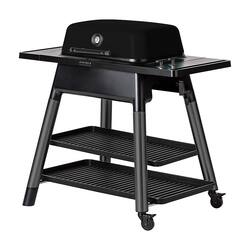
The Everdure Force is likely an unfamiliar brand design by a chef you may not know. A quick Google search of Hesten Blumenthal will help provide some context of who exactly decided the regular grills we know are not good enough. The main complaint the Force and its larger counterpart aim to solve is not getting hot enough. Making a steak like the steakhouses requires high heat to sear in moisture. Some brands attempt to solve this by offering a separate infrared burner that requires you to use it separately, then turn it off and use the main part of the grill. These grills claim to do the searing and grilling using the same burners. They achieve this by moving the burners closer to the grill surface while pointing the flame directly up on a covered section of the grating to help control flareups.
Design
The best way to describe the overall appearance is, unconventional. Instead of heavy stamped stainless steel everywhere with a closed in cabinet, the Force is a blend of mainly aluminum and plastic. The lid is a heavy aluminum and comes in multiple colors and bottom is sloped metal with a nonstick coating to facilitate easier cleanup. The main part of the grill sits on a plastic base held up by aluminum legs. Storage is provided by open plastic shelves. Once assembled, it feels relatively sturdy but does not give the feel of heft of traditional grills available in the US. The liberal use of plastic and fabric makes one wonder how long the stand will last. The good thing is the main body is all metal and is completely capable of being used without the stand as a portable grill for tailgating or at a campsite. It could potentially also be adapted as a countertop grill for a back-yard kitchen.
Assembly and Operation
The main body requires very little assembly, only requiring installing the handle and the hose. The stand is a bit more involved but not overly hard except the instructions are overly complicated while at the same time being vague in important ways. An example is a list of fasteners at the beginning of the manual which does not match what is in the box, partly because it attempts to provide a list for more than one grill. Then, when providing assembly instructions, it depends on text descriptions instead of simple diagrams of what bolts and washers go where. As an example, washers are provided for the base, but the instructions only say to use them in two locations. One of the two locations only applies to half of the screws as well making things more confusing. There are two rods provided for you to install, but you must bend into place. It does not tell you if the rods should bend making you wonder if the rods were made too long. There is only one location where that length works so it is not a matter of improper installation.
While assembly instructions could use refinement, operation is vague. Admittedly, if you have used a gas grill the operation is straightforward, but it still seems strange, so little time is spent on instructing you on proper use. Overall, the instructions seem more as if they were written with a focus on health and safety versus proper assembly and operation. Perhaps this is the difference in regulations in Britain? The good thing is Everdure has several videos on YouTube that can help fill in the gaps for those that might be grilling for the first time. Hopefully Everdure will refine the manual and offer a downloadable version on their website. It would also be great if they even offered some of Hesten Blumenthal’s recipes that are achievable by the average person.
Performance
The worst enemy of grilling is wind with extreme cold being a second. Too much of either or some of both and all grilling is canceled. On the day the grill arrived, a cold front hit with winds gusting to over 25mph and temps dropping into the mid-40s. Granted, 40F is nothing for most grills but 25mph winds even on a warm day can kill the heat of quite a few grills. As a test, the standard 5-minute warmup was done and even with the winds the grill was able to reach 475 degrees F. Of course, this is not ideal for searing, but on testing the steaks still sizzled and smoked as if they were getting a proper sear. Although the top had to be closed for the remainder of the cooking, it surprisingly was able to hold high enough temps to cook two strip steaks better than a standard grill. Normally, during these winds the gusts can cause a current in standard grills which either causes the flame to go out or the safety in the tank to activate reducing flow. Surprisingly, the Force did neither of these. The flame was a cooler yellow, but it stayed steady and allow for reasonably confident grilling in what would seem impossible conditions. In fact, after searing the burners had to be turned down. This turned out to be less than precise as the adjustment from full heat to low occurs in just one quarter turn of the nob. Operation is smooth but ideally a larger range should have been provided to more precisely adjust the burners to your desired setting.
Cooking strip steak usually also means a fair bit of flareups and the Force was no exception. However, what was different was the flareups were much less intense and shorter. As the grease dripped by the flames it could still ignite, but since it continued to fall it burned out quickly. Through several grilling sessions with different greasy, fatty foods the same thing happened. Grilling those more tricky foods have become less stressful. What is nice is both the inside and outside of the base are sloped metal with a non-stick surface. Spills on the outside are easy to clean up and drippings on the inside are guided into a disposable drip tray.
Besides the liberal use of plastic, the grilling surface is probably the best and worst of the grill at the same time. It is heavy cast iron, which is great for strength and withstanding the heat. The downside is it is vitreous cast iron, meaning you should not use metal utensils or brushes. The instructions recommend silicone utensils, which is fine for the grilling. Foods usually stick very little so silicone works well for the task. The problem is when it comes to cleaning the grates. Even though very little sticks, food still gets on the grates. The instructions recommend cleaning them hot while the food is still loose, but where can you find a non- metal brush that works on a hot grill? This leaves you no options except to let it cool off and wash it with a nylon brush and plastic scraper. Their manual even suggests using their tools and utensils, which ironically are all metal. This makes cleaning the grates tedious as the food has solidified in what is nearly concrete on the grating once it is cold. There is always the old trick of turn the heat on high and close the lid to burn it all off. Unfortunately, not only does this not work, Everdure recommends against keeping it on high for extended periods with the lid closed as it would damage the grill. Unless Everdure provides a new procedure or tool, the current method is just cooking the remains until they are char. If buildup becomes excessive then they will be washed in soapy water.
Grilling Results
With the easy searing, low flareups, and easy release from the grating consistent grilling was easy to achieve. A good crust could be produced on a steak without overcooking the inside. Chicken could be heated quickly locking the juices inside so can easily full cook chicken without it drying out or ripping off when removing it from the grates. Salmon burgers seared very well producing a nice, thing crispy crust with a moist fully cooked inside and easily release from the grating as well. Of course, you will not get the flavor or charcoal or wood but its far more convenient. Hopefully, as weather permits the grill to achieve high temps the possibility of chargrilled foods can become a reality which can make up for the lack of charcoal flavor.
Final Thoughts
The Everdure Force is a unique take on grilling and solves some old problems of most grills and possibly introduces some new ones of its own. Hopefully, future versions will cut down on the usage of plastic for something that is designed to stay outdoors and be around high heat frequently. That said, the Force combines the convenience of cooking inside with more of the taste of steakhouse cooking. If the design interests you, you might look at its big brother, the Furnace, before making your final decision as it also has an option for a teppanyaki plate as well as the flat plate offered for the Force. If you like the idea of being able to produce the grill marks, thin crust, and moist interior of a steakhouse steak with little fuss, the Everdure Force might be a good fit.