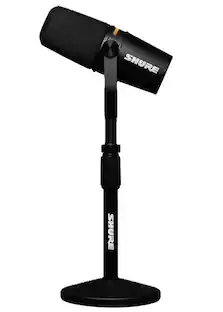
The Shure MV7X is a professional-quality XLR dynamic microphone, ideal for close mic applications that require vocal intelligibility with a balanced tone. Voice Isolation Technology ensures the microphone is laser-focused on your voice and does not capture any unwanted background noise to give you perfect recordings in imperfect rooms. The attractive and durable all-metal design features an adjustable yoke that can be mounted onto a variety of microphone stands forflexible placement options.
Key Specs
Polar Pattern: Cardioid
Output(s): XLR
Microphone Type: Dynamic microphones
Wireless: false
General
Brand: Shure
Model Number: MV7X
Product Name: MV7X Podcast Microphone – XLR Outputs for Podcasting, Live Streaming, Music Recording & Youtube Content
Color: Black
Dimensions
Product Height: 4.33 inches (The out of box height of the item. Height is measured as the vertical distance from the bottom of the item to the top as it would be primarily used or placed.)
Product Length: 10.83 inches (The out of box length of the item. Length is measured as the longest dimension of the item.)
Product Width: 4.92 inches (The out of box width of the item. Width is measured as the horizontal distance from one side of the item to the other as it would be primarily used or placed.)
Product Weight: 1.12 pounds (The out of box weight of the item.)
Audio
Polar Pattern: Cardioid
Output(s): XLR
Minimum Frequency Response: 50 hertz (Describes the maximum range of frequencies or musical tones a product can reproduce, from very low tones to very high treble tones. The minimum frequency or musical tone the speaker can reproduce. High treble tones have higher frequencies while low tones and deep bass have lower frequencies.)
Maximum Frequency Response: 16 kilohertz (Describes the maximum range of frequencies or musical tones a product can reproduce, from very low tones to very high treble tones. The maximum frequency or musical tone the speaker can reproduce. High treble tones have higher frequencies while low tones and deep bass have lower frequencies.)
Features
Microphone Type: Dynamic microphones
Wireless: false
Lighting Type: None
Compatibility
Camera/Camcorder Compatible: false
Included
Number of Microphones Included: 1
Windscreen Included: true
Warranty
Warranty - Parts: 2 years
Warranty - Labor: 2 years
Other
UPC: 042406738071
The Shure MV7X is a professional-quality XLR dynamic microphone, ideal for close mic applications that require vocal intelligibility with a balanced tone. Voice Isolation Technology ensures the microphone is laser-focused on your voice and does not capture any unwanted background noise to give you perfect recordings in imperfect rooms. The attractive and durable all-metal design features an adjustable yoke that can be mounted onto a variety of microphone stands forflexible placement options.
A: The MV7X has a standard 5/8" threading and comes with a 3/8" adapter. This fits most standard microphone stands, but other adapters are available from third parties if needed.
The vast majority of our reviews come from verified purchases. Reviews from customers may include My Best Buy members, employees, and Tech Insider Network members (as tagged). Select reviewers may receive discounted products, promotional considerations or entries into drawings for honest, helpful reviews.
Rated 5 out of 5 stars
A must-have mic for podcasters!
Excellent quality! These microphones arebworth the money! Our voices are crystal clear and we dont have to project nearly as much as we did with the cheaper tech we previously used!
honestly one of the. est decisions i ever made buying this mic. the sound quality is top tier and unmatchable makes recording such a breeze and my life more at ease.yeeee!!
[Employee of bestbuy] Price to performance compared to the sb7 is crazy good would definitely recommend. You can also use the filter from the sb7 it does a better job.
INTRO:
Nowadays with podcasts, broadcasting & streaming becoming more commonplace, Shure is entering the scene with an affordable podcast/broadcast microphone at the premium entry level with the MV7X—an XLR-only variant of the Shure MV7.
UNBOXING:
The unboxing experience for the MV7X is quite simple. You’ve got a basic cardboard box with a recyclable egg carton style insert that holds the MV7X. Maybe I would have liked to see a more protective insert with foam, but if the objective is to use more environmentally friendly materials, then I have no problem with that.
Overall, the packaging was protective enough. And after repackaging it and shaking the box around, it remained stationary without knocking around inside the box.
Other than that, it comes with a 3/8" Thread Adapter, warranty information and a safety guide.
BUILD:
The MV7X appears well built. Both the housing and the yoke mount are made of metal, and they feel like they could take a reasonable beating with impacting performance.
The foam windscreen screen is easy to remove and replace, but I do wish it were a bit more snug. It doesn’t rustle or make noise when used in a normal environment, but if you were actually using this in a very windy environment for some reason, I might be a bit concerned since any movement of the foam screen could be picked up by the microphone and could impact your audio recordings.
Overall, the MV7X is decently well-built and is aesthetically pleasing despite being smaller than microphones like the Shure SM7B or Samson Q9U.
MOUNTING HARDWARE:
The yoke mount hardware uses 5/8” threading which is common for most mic stands (although you can use the included adapter for 3/8" if needed). It’s rigid, sturdy and made of metal. It allows you to rotate it in either direction and once you figure out the direction you want to face it, you can tighten the hand screws to secure it in that position.
However, one minor headache of this mounting hardware is that the whole mic has to rotate in order to screw onto your stand, rather than just the base where the threading is. This becomes a problem for certain stands if the mounting point rotates and lacks grip. Unfortunately, this was the case for my Samson MBA38 boom arm (see pictures). This made it difficult to remove once it was mounted a bit too tight. If your microphone stand does not have this issue, then you need not be worried. But if it does, I advise you to not tighten all the way if you intend to unmount the microphone from your stand. I had to grab some vice grips and put a bit of damage on my stand to remove the MV7X. Whereas my Samson Q9U could be screwed on and off at the base without rotating the entire yoke mount.
Aside from that, you can remove the yoke mount via the hand screws and use a different mount if you please. However, there are small washers between each screw, and they are just a bit challenging to put back in once removed.
Overall, the mounting hardware is decent, and this niche blip I ran into shouldn’t really impact the overall rating. Many other microphone mounting hardware systems would experience the exact same problem in my particular case, but I felt it was worth the warning.
MICROPHONE SENSITIVITY:
*All testing performed with the MOTU M2 audio interface
Let’s get into sound by talking about microphone sensitivity. Since dynamic microphones are passive, you typically need to speak closer to them in order for them to pick up a reasonable signal. This makes dynamic microphones typically better for noisy environments, since noises that are not closer to the microphone will be less likely to be captured in a recording. So less background noise will be captured and you’ll be less likely to introduce a feedback loop if there are live monitoring speakers nearby.
Shure says that the XLR sensitivity at minimum gain is -55dBV/Pa (1.78mV) at 1kHz, 1 Pa = 94dB SPL. Whereas the Samson Q9U over XLR is even less sensitive at -57 dBV/Pa and the Shure SM7B at -59dBV/Pa.
Just from my testing of the MV7X against the Q9U, the MV7X certainly has an advantage in terms of its sensitivity. While good etiquette for speaking into one of these microphones is typically to speak 4-6 inches away from the microphone, there are times where that is undesirable and in my experience, the MV7X does a good job alleviating that with some additional gain.
However, should you decide to speak closer to the microphone, you’ll be pleased to know that you’ll get excellent noise rejection with lower gain while still retaining a clean sound with plenty of volume.
Lastly, I was pleased to find that the noise floor is quite low even with the gain cranked to the max on my interface.
PLOSIVES:
When it comes to plosives, the MV7X doesn’t quite have the low-end boom that some other microphones have, but it does not do a good job rejecting plosives with just the included foam screen. You can further eliminate plosives by adding a pop filter in front of the microphone and/or speaking further away from the microphone, but out of the box, its plosive rejection is not very good.
One suggestion I have seen to solve this issue is to use a thicker windscreen foam such as the one used on the Shure SM7B. While using the SM7B foam would create an air gap, it would still put much more foam between your voice and the capsule to prevent much more of those unwanted plosive frequencies from reaching the capsule. I can confirm that this worked quite well for me.
SOUND QUALITY:
The tonality of the Shure MV7X is really midrange focused. While my Samson Q9U picks up more low-end, the MV7X really doesn’t aim for that. The MV7X is great for speech that does not need the use of the proximity effect. But if you’re really wanting to lean into that lower, bassier radio DJ voice, I’m not sure that the MV7X is the best microphone for the job. The closer you speak to the microphone, the more bass you will get, but the amount of plosives will be very distracting to your audience unless you address it with a thicker windscreen. Even so, I had to speak quite close to the microphone to achieve a reasonable proximity effect on the MV7X.
Aside from that, I personally did like the way that my voice sounded on the MV7X. It was very clear, as opposed to dull and warm. I think for my voice, something like the MV7X is a good choice. I don’t typically speak with much of a bassy resonance, so I tend not to lean in for proximity effect. So the MV7X delivered a clear tonality for me with an emphasis in the midrange and treble without sounding bright..
And of course, the best way to demonstrate this is to give you some sound tests! Please visit the soundcloud link here to hear speech samples:
https://soundcloud.com/xephyroth/sets/shure-mv7x-microphone-test/s-39sFnXvAUqy?si=be8747d24761462db13e25ca00a47e68
APPLICATION:
Shure has a few different marketing materials online showing the MV7X being used for singing as well as broadcast speech. I think that these are appropriate usages of this microphone, whereas I’m not sure I’d find it optimal for capturing an instrument, as you’d have to place the microphone relatively close to your instrument in order to pick up a clear signal.
If you’re a singer, this could potentially be a decent mic with passive noise rejection to avoid background noises from being captured in your recordings. This could work well for live studio sessions, but the plosives could be problematic with the default windscreen.
But for speech—whether for streaming, podcasting, broadcasting, I do think the MV7X is a good microphone and could serve very well for those not looking to pay for a much more expensive SM7B.
CONCLUSION:
Overall, I like the MV7X and think it is a good broadcast style microphone. While its plosive rejection is not very good with the default foam windscreen, replacing that windscreen can yield much better plosive rejection. The noise floor is low, and the sensitivity is decent for picking up speech within a relatively close proximity. While I don’t think Shure got everything right, I think that the MV7X could be worth it for someone who does not want to pay extra for hybrid XLR/USB microphones like the Shure MV7 or Samson Q9U. Those mics can potentially provide more flexibility and value compared to just MV7, but if you’re solely looking for XLR, the MV7X is a good microphone, but perhaps not the most versatile or feature rich.
The Shure MV7X is a professional-quality XLR dynamic microphone, ideal for close mic applications that require vocal intelligibility with a balanced tone. Voice Isolation Technology ensures the microphone is laser-focused on your voice and does not capture any unwanted background noise to give you perfect recordings in imperfect rooms. The attractive and durable all-metal design features an adjustable yoke that can be mounted onto a variety of microphone stands forflexible placement options.
The MV6 USB Gaming Microphone features everything gamers and streamers need to get professional sound right out of the box. Combining iconic design, Voice Isolation Technology and advanced DSP features such as Auto Level Mode, Digital Popper StopperTM, and Real- time Denoiser, the MV6 makes it pro-level sound even more accessible. The MV6 features a USB-C output for connectivity to any PC or Mac, and a 3.5mm headphone output for real-time monitoring of your sound. Configure your sound using the free Shure MOTIV MixTM app on desktop.