A:AnswerGood question. What makes one T.V. better than another? You stepping into some deep territory. This T.V. is comparable in many ways and in some ways better and some ways not as good. The consumer has to make that determination. I feel that this T.V. is a better all around choice. You won't know until you have had the unit for long periods of time. Do the blacks hold up, does the picture hold up, is the T.V. reliable? These are questions that can't be addressed for several years. I have had my old cheap T.V. for 15+ years. I can turn it on and it works just like the first day I bought it. I am afraid now that these new fangled T.V.'s with their flat panel design, 3d Technology, and THX certification won't hold up near as well. Only time will tell. And who actually manufactures is another miss conception. Most manufactures use panels from other manufacturers etc... Apparently through all the research I can find, Panasonic makes their own televisions, including the panel. Electronics is a big pain in the butt right now. So many things to compare. Their are LCD, LED, Plasma, and DLP's. All I can say is what does the costumer prefer. If you buy a refrigerator you buy it based on well it cools, you buy a car for how well it drives, and you buy other products based on their performance. To many consumers are focusing on aspects that just aren't issues when purchasing a T.V. Why would anyone buy a T.V. or another because it is a half an inch or an inch thinner than the other one. When you factor in the stand who cares. Someone I know bought a thin panel led and the first thing he showed me was how thin it it was instead of the picture quality. My first and foremost question should be picture quality. That is one reason I chose a plasma. LED, LCD, etc.. all have motion blur and color is off including blacks. I have not seen one yet that can keep up with Plasma displays.
As far as Samsung vs Panasonic. Panasonic Electric Corporation has been in business for year and use to be owned by Matsushita Electronics. Panasonic has now bought them out. Panasonic products are primarily made in Japan but they have a plant in China (go figure) and several plants throughout the world. Samsung imports a lot of its parts from other companies.
The T.V.s are similar but I, personally, prefer the Japanese made Panasonic. I would prefer U.S. products however the U.S. is completely out of U.S. products and imports way to many products. American cars are made with foreign parts now.
Sorry, if you do your shopping well and read a lot. Forget the lack of knowledge by retailers such as Best Buy, Sears, etc... Most of the employees do not have a clue, especially when your talking specs. The consumer needs to make that determination. Narrow down your pick to 2 or 3 brands and find the set that matches your needs. If you don't need 3d then don't get it. Choose wisely and keep your receipts. Remember, what you see in the store is not what you will see at home. TVs look much smaller in the retail shops. Color and sound don't look near as good in some cases. Most retailers have their TVs hooked up to an HD source. Just be careful. I would talk to people who know what they are talking about and learn as much as you can. Case in point. Older TV's use to boast about resolution. 800 lines of resolution. During that period of time broadcasts were at best a little better than two hundred lines of resolution. DVD and SVHS brought the lines up to 400+. No source had 800 Lines of resolution but people bought these things. Same with speakers. Watts. Everyone is hooked on watts. Why do you buy speakers. Because of sound not watts. Watts is almost a useless spec. Maybe you should concentrate on DB's. Your ear hears decibels not watts.
Anyway do your homework and understand the product itself. That is the best I can tell you.
Mike
A:AnswerWith a micro USB cable that is supplied with the glasses - they recomend that you plug into the TV only but I ma sure you can plug into a computer as well to charge.
A:AnswerI have my vt hooked directly to off the air programming and I've never noticed the sound being unusually loud or quiet on any channel. I can't guantee this would be the case with an hdmi or component attached cable box.
A:AnswerI got one pair in the box. They are over $120 through panasonic. If they are in stock. I bought a generic pair for $80. There is a subtle difference between the glasses. I don't watch much in 3d so it is not a major issue for me.
A:AnswerIt has the rigid stand that comes with the unit. It has a large footprint but is sturdy and supports the TV adequately. You cannot rotate it or adjust it vertically.
A:AnswerYes, this unit has a universal remote control. The buttons are laid out quite well and it is intuitive. There are lots of menu items on this TV and the remote allows you to navigate them effortlessly.
A:AnswerYes, it has 2D to 3D conversion, however as in all new models of 3D TVs it is not that good as it is using an algorithm to determine what should be at what depth, whereas when movies are filmed n 3D you get the effect of having two cameras in stereoscopic vision. They can later be optimized on a computer during rendering to increase or decrease the effect.
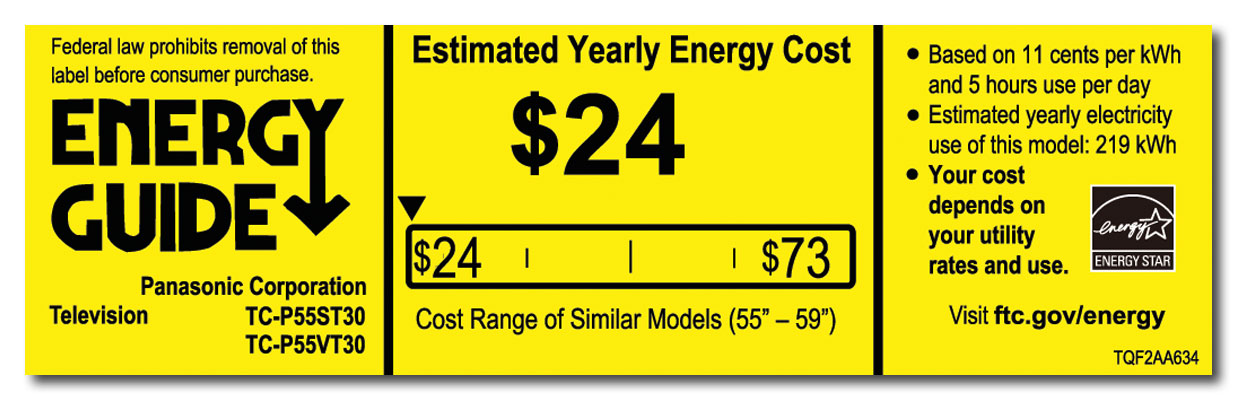
A:Answeryes but if the room your tv is in has poor air flow it wont matter and the size of the room will make a big different to if you have a big tv in a little room your more like to heat up the room faster
A:AnswerNo if you have panasonic 3d classes they will work on newer panasonic tv models. Any new 3d classes you see in stores are gonna be lighter and better viewing angle for 3d