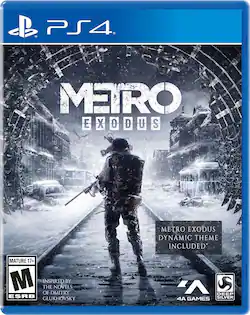
First off, let’s take a minute to observe that the Metro series has, and most likely always will be, a series that’s success is built primarily on the cult following of players who’ve always had a deep love for what’s being offered with the franchise. But that’s not to say that each new entry hasn’t attempted to do something special that opens the door for new players. Not the gimmicky sort of special, but the kind that has charm and care in the details during creation - especially concerning the players immersion. 4A is by and large a AA developer, some could even consider them somewhat of an independent studio when it comes to their working conditions and team size. While this aspect definitely shows through at times in all of the Metro games, the series also operates on par with, and sometimes better than, big budget blowouts. Exodus is absolutely no different. Just like Last Light did previously, Exodus takes what came before and tries to refine the fat down, while also building upon the strengths of the series. And just like all other entries in the Metro series, Exodus releases to mixed reviews, and a somewhat bitter reception from all to the bugs that are all too familiar to a Metro release.
For those new to the series: Metro is a narrative driven survival FPS, with an emphasis on SURVIVAL. While not Resident Evil, Dead Space, or The Last of us - Metro does embody elements from these sort of titles. But also brings to mind titles like Singularity, Fallout, and most importantly S.T.A.L.K.E.R. - post-apocalyptic, (mostly) stealth-driven shooters that are hellbent on immersing the player in the atmospheric wasteland, then challenging them to survive the world and it’s deadly inhabitants. Metro leans more towards the horror outings with its creature designs and dreadful tones.
Previous Metro titles focused more on linear and claustrophobic levels, whereas Exodus allows the player to exit the confines of the Metro underground and explore semi-open world wastelands, each broken up by the four seasons, as well offering completely different environments. This isn’t to say the linear and claustrophobic environments aren’t still preserved. In fact, Exodus does a good job funneling it’s levels down into some intense areas that operate just like previous titles. The open environments still leave the player open for encounters out in the wild, these tend to feel a little less intense, and sometimes frustrating depending on the enemy behaviors. Human enemies can be rather dumb. And the creatures tend to be viscous and overbearing. Though these issues aren’t all encompassing of the game, nor do they really break immersion.
Gunplay has never been priority in Metro, as opposed to the overall feel of the experience, but they do their job in feeling pretty good to shoot. Especially some of the more creative weapon build outs. Those who have played Metro Redux know the gunplay can feel comfortable and good, though that wasn’t always the case - and the same goes again with Exodus. The guns feel good and do their job, but the perfection of the aim falls apart at distances, and sometimes when playing stealthy. Some frustrations came from the lack of pulling off a headshot, even though you had the enemy lined up perfectly. This is an area I’d personally like to see patched up, and soon, as the guns are great and would be even better with precision. Players looking for action, twitch type gunplay will find themselves disappointed with Metro, as the series is focused on more concentrated and paced out scenarios - survival scenarios. This by and large plays into movement too. Metro is not creamy or crunchy, but more janky, like...Fallout, though with a better emphasis on gun control and button mapping.
Speaking of movement, the character is definitely more of a tank - despite the sound design saying different - thus even running will make you feel like gravity is hugging you in it’s entirety. This is to translate the reality of the character to the player, and it definitely works. Right up until you take your feet off the trail and into the sticks - this is when movement gets a little sticky and the character hangs up on literally everything. Again, I get the immersion factor here, but in this case it’s absolutely breaking the immersion - a mechanic that should’ve been streamlined for the sake of optimization. Among all of Metro’s immersion mechanics, this is really the only one I felt could go far away and never come back. The rest I found to be alright, and far from the complaints of other reviewers. Many of which seem to come from lack of holding the players hand - something that opposing reviewers have knocked the game for. But by and large, most complaints that I see against the game are features overlooked by the player.
As mentioned, Metro is a game that likes immersion, therefore HUD elements are greatly reduced to be non-existent, and instead incorporated onto the character - much like Dead Space. Most of these features are put on the wrist of the character in the form of watches/bands. Most importantly is the compass, which will always point you towards your waypoint. This is not given immediately, but instead a little later on after the tutorial period. Right from the start you will have a radiation gauge on your wrist, so you can monitor areas where a gas mask is needed. The map seems to be a tricky thing for some players, but fear not THERE IS A MAP, and the map does tell you what your main mission is if you flip it over. Main objectives are marked with a big X on the map, while side missions will show up as smaller (!) marks on the map - the player is absolutely free to approach what they want, however they desire - with only 1 or 2 being a little confusing at first. Side Missions will provide you with game-changing gear in some circumstances, so they’re worth doing, not to mention they’re nothing exhausting.
Crafting is another fantastic addition that can be easily overlooked by both old and new players. Your backpack and crafting tables should be taken advantage of, especially if you’re a player that’s finding themself short of supplies or bullets. You can craft everything needed at these 2 places - the backpack is great for building a lot of survival supplies on the fly: health, air filters, ball bearing ammo, arrows, and other similar items to keep you going. And the tables will permit the player to get into deeper customizations and crafting. But most importantly is guns. You can pick up and put down any gun you comes across, as well as dissemble them for parts and ammo. Players can carry 2 guns and 1 specialty gun (I.E. Air Pressure gun or Crossbow) and all guns can be altered with parts found, or just to your heart’s content, straight out of the backpack.
Overall, there’s a lot of greatness to be experienced in Metro Exodus, especially if you’re a fan of the series. A vast beautiful, and atmospheric game full of tense moments, as well as adventurous moments into the wild open environments to find crafting items and lore. The gameplay is great blend of survival and gunplay. It offers a stylistic blend of horror and post-apocalyptic sci-fi to immerse players in the story of Artyom and his family of merry misfits that have just emerged from the underground. Though it’s not to say the game comes without some shortcomings upon release. Hiccups and bugs are definitely present, though I personally haven’t experienced anything game breaking in my playthroughs...yet. Load times are a little too long, though as some have said - it’s mainly when booting the game up into the first gameplay of the day, or if you reset the game. The load times are a little shorter between deaths, though I’ve had a few bouts of waiting that were near 2 minutes, and that’s a little ridiculous in-between deaths. My biggest gripes are toward the lack of precision in gunplay/shooting, and getting hung up on the environment when exploring off the path. Those 2 really broke immersion for me and became frustrating at times - looking at you sticky environment. The gunplay issue can be compensated for once the player learns the guns, but it’s still something that’d really help if it were fixed. But knowing 4A Games is basically a AA developer with the skeleton framing of an independent studio, they’ve really done a fantastic job building a AAA experience, and hopefully with a little time we’ll see these minor issues with Exodus get tightened up properly for players in the fence waiting.