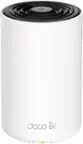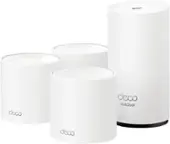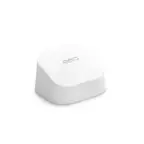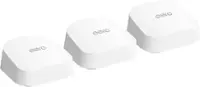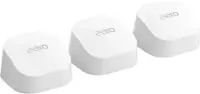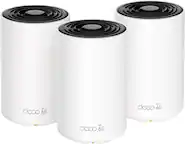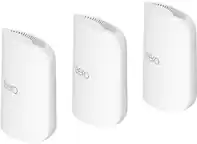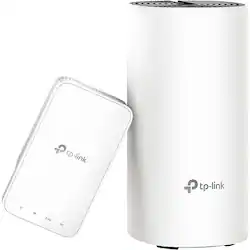
TP-Link - Wireless-AC1200 Dual-Band Mesh Wi-Fi System - White
- Key Specs
- Wi-Fi Speed: 1.167 gigabits per second (The maximum rate at which data is transferred between a network device and wireless router.)
- General
- Brand: TP-Link
- Model Number: DECO E3 2-PACK
- Product Name: Wireless-AC1200 Dual-Band Mesh Wi-Fi System
- Color: White
- Security
- Data Encryption: true
- Encryption Type: WPA-PSK, WPA2-PSK (The security protocols or certification programs that protect the Wi-Fi network.)
- Firewall Type: SPI (The method the firewall uses to filter and process data to increase network security, primarily by blocking malicious traffic requests while allowing legitimate traffic through.)
- Parental Controls: true (Allows user to block unwanted content, signals, channels, networks, etc. from being received or accessed.)
- Network
- Quality Of Service (QoS) Traffic Prioritization: true (Allows a user to manage a device's network performance by configuring the types of traffic that receive top priority for transmission. High priority functions and applications receive maximum network performance, while low priority traffic receives minimum performance.)
- Band Technology: Dual (Refers to the number of frequency bands used to wirelessly transmit an internet signal. For example, dual-band devices may use one 2.4 and one 5 GHz band, while tri-band devices may use one 2.4 and two 5 GHz bands. Multiple bands also provide more flexibility for designating connected devices to specific band use.)
- Ethernet Standard: 10/100 (Each standard is a variation of the IEEE 802.3 set of computer networking technologies known as Ethernet. New versions evolved to include higher bandwidth, different physical media, and other new and improved features. Standards are often denoted by speeds (in Megabits per second). For example, a 10/100/1000 Ethernet port transmits at 10 Mbps, 100 Mbps, and 1000 Mbps (1 Gbps).)
- Frequency Band: 2.4 GHz, 5.0 GHz (Bands may be grouped into categories such as low- and high-band VHF (Very High Frequency), low- and high-band UHF (Ultra High Frequency), or certain frequency channels (measured in MHz or GHz). Generally, higher frequencies transmit information faster but have shorter range than lower frequencies.)
- Wireless Networking Standard: Wi-Fi 5 (The wireless networking standard used by the device. Each iteration of the standard developed by the Wi-Fi Alliance corresponds to an existing IEEE 802.11 protocol; for example, standard 802.11ac (or AC) is termed Wi-Fi 5. Refers specifically to the standard the device is designed to use, but ultimately determines product interoperability and backward compatibility including previous versions.)
- Wireless Standard: AC, N (The wireless networking protocol used by the device. Each iteration of the protocol is based on the 802.11 standard developed by the Institute of Electrical and Electronics Engineers (IEEE) Standards Association. Denoted by letters following 802.11 (802.11a, 802.11ac, etc.), each version, published in alphabetical order, encompasses all previous versions.)
- Number of 2.4Ghz Streams: 1 (A router's streams are like lanes on a highway. The more streams a router has, the less traffic congestion. Because the 2.4 GHz band is used to transmit wireless signals to a wide variety of devices, there is often high amounts of traffic on that stream. But with multiple streams, each can be designated to a specific device for optimal performance. For example, if one 2.4 GHz stream is assigned to one device, such as a desktop computer, it leaves the remaining streams open for guest users, devices that use more data, or devices with specific band compatibility.)
- Number of 5.0Ghz Streams: 1 (A router's streams are like lanes on a highway. The more streams a router has, the less traffic congestion. The 5.0 GHz band provides high speed, short-range data transmission and typically has less traffic than the 2.4 GHz band. With multiple streams, each can be designated to a specific device for optimal performance. For example, if one 5.0 GHz stream is assigned to one device, such as a streaming media player, it leaves the remaining streams open for guest users, devices that need less data, or devices with specific band compatibility.)
- Routing Protocol: Static IP routing (The protocol used for communicating and distributing information in a computer network.)
- Transport Protocol: PPTP, L2TP, PPPoE (The protocol used for connection-oriented transmissions, flow control, etc. within the transport layer of the network.)
- Certifications Listings & Approvals
- ENERGY STAR Certified: false (Devices carrying the ENERGY STAR service mark, such as computer products and peripherals, kitchen appliances, and other products, generally use 20% to 30% less energy than required by federal standards.)
- Features
- Integrated Modem: false
- Wireless: true
- Ports
- Port Type(s): RJ-45 (USB 2.0 connects external drives, gaming controllers, smartphones, MP3 players and other accessories.USB 3.0 transfers data faster than USB 2.0, but only when used with USB 3.0 devices.USB Type-C provides fast speeds and versatile power, featuring connectors with identical ends that plug in upside down or right side up. Adapters allow for video as well as backward compatibility.Thunderbolt provides ultra-high bandwidth for fast data transfer between devices featuring a Thunderbolt or MiniDisplayPort connection.HDMI allows you to connect a projector or display HD media on your HDTV or monitor.Media card slots allow you to transfer photos from your digital camera or camcorder.)
- Speed
- Wired Speed: 100 megabits per second (The maximum rate at which data is transferred between a network device and router using an Ethernet cable.)
- Wi-Fi Speed: 1.167 gigabits per second (The maximum rate at which data is transferred between a network device and wireless router.)
- Other
- UPC: 845973085292
Expand your Wi-Fi router network coverage with this TP-Link Deco whole home mesh Wi-Fi system. Up to 2,500 sq. ft of coverage delivers seamless Wi-Fi throughout your home. This TP-Link Deco whole home mesh Wi-Fi system connects up to 100 devices for extra convenience and lets you closely monitor and manage your home network remotely with the Deco app.
- Compatible with 802.11ac: Backward compatible with 802.11a/b/g/n networks, so you can easily upgrade.
- Dual-band 2.4GHz/5.0GHz frequency: Delivers a fast response when transferring files.
- QoS (Quality of Service): Optimize your Wi-Fi. Maintain a strong connection during any task by prioritizing HD streaming, gaming and more.
- Encryption: Includes WPA-PSK and WPA2-PSK to keep your network secure.
- Parental control: Lets you automatically block specific content on connected devices.
- Compatible with 802.11ac: Backward compatible with 802.11a/b/g/n networks, so you can easily upgrade.
- Dual-band 2.4GHz/5.0GHz frequency: Delivers a fast response when transferring files.
- QoS (Quality of Service): Optimize your Wi-Fi. Maintain a strong connection during any task by prioritizing HD streaming, gaming and more.
- Encryption: Includes WPA-PSK and WPA2-PSK to keep your network secure.
- Parental control: Lets you automatically block specific content on connected devices.
Whats Included
- TP-Link Deco E3
- 2 routers
- Network cable
- TP-Link Deco E3
- 2 routers
- Network cable
A: Yes, the Deco E3 operates as a Mesh WiFi router for your home. You will need to connect your existing Internet source (i.e. cable modem) to the Deco via Ethernet cable during setup. Regards, TP-Link Support
A: Based on my personal experience, the smaller range extender that comes in this two-pack set will not have the range to reach 40yards; especially if there are various added physical barriers that could interfere with signal strength. I would recommend adding a stronger range extender and see if it would do the job for you.
A: Deco Mesh is not compatible with other wireless or mesh systems. It is a full replacement for an existing system or in AP mode can replace the wireless connection.
Q: will this mesh as an extender with my deco 3000 system?
A: Hi! Yes, all of our Deco Mesh systems are compatible with each other and can be used to expand existing Deco Mesh networks.
A: The primary Deco unit must be connected to your Internet source (i.e., your modem) via Ethernet cable.
A: This router does not have a built in modem. I currently have my AC-1200 plugged into my cable modem. I disabled WiFi on the cable modem and the only SSID being advertised is the one configured in the AC-1200.
A: If you have an existing WiFi mesh system from Spectrum, it would depend on whether you want to continue using that system as your primary WiFi gateway, or switch entirely to the Deco as your primary WiFi gateway. If the former, you would want to set up the Deco in Access Point Mode and connect it to your existing network via Ethernet. If the latter, you would want to set up the Deco in Router Mode and remove your existing Mesh WiFi router system. Your Internet speed is primarily dependent upon your Internet provider and subscription. Your WiFi speed (in comparison to your existing WiFi mesh system) will depend on the specifications/WiFi speed capabilities of your existing Mesh setup, the physical layout of your home, and where each Deco node is placed.