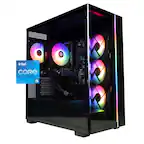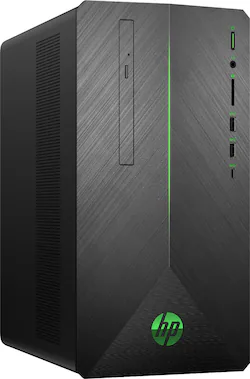
HP - Pavilion Gaming Desktop - AMD Ryzen 5 2400G - 8GB Memory - AMD Radeon RX 580 4GB - 1TB HDD 128GB SSD - Black
- Key Specs
- Processor Model: AMD 2nd Generation Ryzen 5 (Your computer's processor is like its brain. Working in combination with system memory, the power of the processor determines the complexity of software you can run, how many programs you can have open at the same time, and how fast those programs will run. Most computers feature an AMD, Intel or Snapdragon processor.)
- Storage Type: SSD, HDD
- Total Storage Capacity: 1128 gigabytes
- System Memory (RAM): 8 gigabytes (Random-access memory (RAM) is a computing device's short-term data storage, which allows active information to be accessed quickly. The size and type of RAM determines how efficiently the device can handle large amounts of information at one time. For example, gaming or video editing requires more RAM for optimal performance.)
- General
- Product Name: Pavilion Gaming Desktop - AMD Ryzen 5 2400G - 8GB Memory - AMD Radeon RX 580 4GB - 1TB HDD 128GB SSD
- Brand: HP
- Model Number: 690-0024
- Processor
- Processor Brand: AMD
- Processor Model: AMD 2nd Generation Ryzen 5 (Your computer's processor is like its brain. Working in combination with system memory, the power of the processor determines the complexity of software you can run, how many programs you can have open at the same time, and how fast those programs will run. Most computers feature an AMD, Intel or Snapdragon processor.)
- Processor Model Number: 2400G
- Storage
- Storage Type: SSD, HDD
- Total Storage Capacity: 1128 gigabytes
- Solid State Drive Capacity: 128 gigabytes (The amount of data that can be stored on the device's solid state drive (SSD). SSD is a flash-based storage with faster speeds than a hard disk drive (HDD).)
- Hard Drive Capacity: 1000 gigabytes (The amount of data that can be stored on the device's mechanical hard drive. Hard disk drives (HDDs) typically have larger capacities than solid state drives (SSDs) but may have slower speeds.)
- Solid State Drive Interface: SATA (Connects the solid state drive to the host system. PCI and SATA interfaces are the most common; PCI interfaces are typically faster, but SATA interfaces are compatible with a wider range of systems.)
- Hard Drive Interface: SATA (Connects the hard drive to the host system for transferring data between the hard disk cache and system memory. IDE and SATA interfaces are primarily used for personal computing, while larger servers and workstations typically use SAS or SCSI.)
- Hard Drive RPM: 7200 revolutions per minute (A hard drive's data is stored on disks, or platters, that spin while transferring information to the host system. The higher the RPM, the faster the hard drive's performance.)
- Hard Drive Accelerator: None (A module integrated (or added) into a PC to improve performance speed. By acting as a high-speed cache, an accelerator speeds up access times to the hard drive, which results in faster web browsing, improved gaming experience, and overall more responsiveness.)
- Memory
- System Memory (RAM): 8 gigabytes (Random-access memory (RAM) is a computing device's short-term data storage, which allows active information to be accessed quickly. The size and type of RAM determines how efficiently the device can handle large amounts of information at one time. For example, gaming or video editing requires more RAM for optimal performance.)
- Type of Memory (RAM): DDR4 SDRAM (Each type of RAM delivers a different level of speed, bandwidth, energy efficiency and performance.)
- System Memory RAM Speed: 2666 megahertz (How fast the information-storing hardware operates. The faster the RAM, the faster memory can be transferred to other system components. Ultimately, faster RAM improves operational efficiency.)
- Number of Memory Sticks Included: 3
- System Memory RAM Expandable To: 32 gigabytes (Adding more random-access memory (RAM) to a computer speeds up performance and improves efficiency. Upgrades to memory are limited by the number of expansion slots for additional RAM and existing RAM installed on the device.)
- Compatibility
- Operating System: Windows 10 Home (The operating system manages all software and hardware, including files, memory and connected devices. Most importantly, it lets you interact with your device and your programs in a visual way; otherwise, you'd be typing computer code to get anything done.)
- Connectivity
- Ethernet Card: 10/100/1000 (Also known as an Ethernet adapter, this card plugs into a computer's motherboard and enables it to access an Ethernet network. Ethernet data transmission speeds are measured in Mbps (megabits per second) and Gbps (gigabits per second). For example, a 10/100 Ethernet port transmits 10 and 100 Mbps, while a 10/100/1000 Ethernet port transmits 10 and 100 Mbps and has a maximum speed of 1000 Mbps (1 Gbps).)
- Expansion
- Number of M.2 Slots: 2 (This interface is most commonly used for high-speed solid state drives (SSDs), and is often used in laptops due to its small size.)
- Number Of Internal 2.5" Bays: 1
- Number Of Internal 3.5" Bays: 1
- Number Of External 5.25" Expansion Bays: 1
- Features
- Media Card Reader: true (A hardware device that allows for access to data on a memory card and enables the transfer of its files to a computer. These devices may have one or multiple slots for various types of memory cards, and may be integrated into the computer or available as an external device.)
- Audio Technology: 5.1 channel surround
- Size: Standard
- Dimensions
- Product Height: 13.3 inches (The out of box height of the item. Height is measured as the vertical distance from the bottom of the item to the top as it would be primarily used or placed.)
- Product Width: 6.7 inches (The out of box width of the item. Width is measured as the horizontal distance from one side of the item to the other as it would be primarily used or placed.)
- Product Depth: 11 inches (The out of box depth of the item. Depth is measured as the distance from the front of the item to the back as it would be primarily used or placed.)
- Certifications Listings & Approvals
- ENERGY STAR Certified: true (Devices carrying the ENERGY STAR service mark, such as computer products and peripherals, kitchen appliances, and other products, generally use 20% to 30% less energy than required by federal standards.)
- EPEAT Qualified: false (The Electronic Product Environmental Assessment Tool (EPEAT) was designed to provide an environmental assessment tool for purchasers. In order to qualify for EPEAT, a product must meet all 23 required criteria.)
- Included
- Included Software: HP Recovery Manager, HP Support Assistant, HP Games Powered by WildTangent, Netflix, McAfee LiveSafe (30 days trial), CyberLink Power Media Player, Dropbox (25 GB Cloud Storage) (free for 1 year), HP JumpStart and HP Connection Optimizer
- Other
- UPC: 192545572545
Enjoy totally immersive gameplay with this bold and powerful HP Pavilion gaming desktop. Lag is nonexistent thanks to AMD Radeon RX 580 graphics, while high-speed performance is provided by an AMD Ryzen processor and 8GB of DDR4 RAM. Interior expansion slots allow for upgrades that ensure your HP Pavilion gaming desktop remains up to date.
- Windows 10 operating system: Windows 10 brings back the Start Menu from Windows 7 and introduces new features, like the Edge Web browser that lets you markup Web pages on your screen. Learn more ›
- Virtual Reality Ready: This computer has the required specs to run Virtual Reality hardware and software and is compatible with Oculus Rift, HTC Vive, and Windows Mixed Reality Ultra.
- 8GB system memory for advanced multitasking: Substantial high-bandwidth RAM to smoothly run your games and photo- and video-editing applications, as well as multiple programs and browser tabs all at once.
- DVD/CD burner: Reads and writes to a variety of media formats, including DVD+R/RW, DVD-R/RW and CD-R/RW.
- 1TB hard drive and 128GB solid state drive (SSD) for a blend of storage space and speed: The hard drive provides ample storage, while the SSD delivers faster start-up times and data access.
- Cloud support lets you access your files anywhere: Store your photos, videos, documents and other files on Dropbox for secure access across multiple devices. Fees may apply.
- AMD Radeon RX 580 graphics: Driven by 4GB GDDR5 dedicated video memory to quickly render high-quality images for videos and games.
- Built-in media reader for simple photo transfer: Supports SD, SDHC and SDXC memory card formats.
- 2 SuperSpeed 10Gbs USB 3.1 ports: Ultra-fast data connections to transfer large files rapidly.
- 2 USB 2.0 ports: Quick plug-and-play connectivity for your devices and accessories.
- Next-generation wireless connectivity: Connects to your network or hotspots on all current Wi-Fi standards. Connect to a Wireless-AC router for speed nearly 3x faster than Wireless-N. Gigabit LAN port also plugs into wired networks.
- Bluetooth 4.2 interface syncs with compatible devices: Wirelessly transfer photos, music and other media between the desktop and your Bluetooth-enabled cell phone or MP3 player, or connect Bluetooth wireless accessories.
- Multimedia software package included: HP Recovery Manager, HP Support Assistant, HP Games Powered by WildTangent, Netflix, McAfee LiveSafe (30 days trial), and more.
- Additional ports: Microphone and headphone jacks. HDMI output.
Whats Included
- HP Pavilion Gaming 690-0024
- Mouse, keyboard
Product Manuals
Q: How good does Fortnite play on this
A: I don't play Fortnite, but if I'm able to play Overwatch on ultra, you can definitely play Fortnite. Trust me.
Q: How many RAM slots does this have, and how many are used when you buy it?
A: This model has 2 DDR4 slots. It has 1x8gb card preinstalled.
A: So ive seen an official HP answer above on this 690 as well as another computer in this hp pavilion gaming computer (with the same external casing) on best buy that had another HP answer that say you can exchange it. But im hearing is that you can't. I honestly dont know how you can. HP is being very shady about this. I opened up the case myself and measured the PSU. Its 2.8125 x 2.9375 x 6.25 inch or 71.4375 x 74.6125 x 158.75 mm. So not only is this PSU NOT standard but proprietary. ALSO, the motherboard seems to be proprietary as well and must be replaced too. NOW HP...lets see what you say about the above.. I was really happy with this product but because you can't upgrade it fully, I'll probably be returning this product.
A: Yes, upgrading the memory would solve the issue. We apologize that the original configuration was not strong enough!! Your system can support up to 32G of RAM, Type DDR4-2666, with speed PC4-21300 MB/s. Adding an additional 8G card of this type would be perfect, or you can do two 16G cards of this type.
Q: Can this pc run dual monitor
A: Yes, this computer will easily support dual monitors!
Q: is this the 8Gb version of the rx580 or the 4 gb
A: This one uses the 4GB version of the RX 580
Q: Is this computer good for Twitch streaming while playing games like Overwatch or Rainbow?
A: Yes, this computer has more than enough power for those games. It only has the minimum required for Twitch, so you might occasionally experience lag (depending on your internet connection and other external factors), but for the most part it will run just fine.
Q: How far can you upgrade the processor?
A: It supports a TDP of up to 65w. Currently the top processor would be the AMD Ryzen7-2700