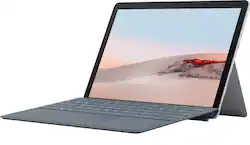
Microsoft - Surface Go 2 - 10.5" Touch-Screen - Intel Core M - 8GB - 128GB SSD - Device Only - Platinum
- Key Specs
- Screen Size: 10.5 inches (Size of the screen, measured diagonally from corner to corner.)
- Screen Resolution: 1920 x 1280 (Screens come in a range of resolutions (measured in pixels, horizontal x vertical). The higher the resolution, the greater the picture quality.)
- Processor Model: Intel Core m3-8100Y (Your computer's processor is like its brain. Working in combination with system memory, the power of the processor determines the complexity of software you can run, how many programs you can have open at the same time, and how fast those programs will run. Most computers feature an AMD, Intel or Snapdragon processor.)
- Total Storage Capacity: 128 gigabytes
- Operating System: Windows 10 Home in S mode (The operating system manages all software and hardware, including files, memory and connected devices. Most importantly, it lets you interact with your device and your programs in a visual way; otherwise, you'd be typing computer code to get anything done.)
- Voice Assistant Built-in: No (A digital assistant built into the device that uses voice commands to answer questions and control smart devices.)
- Wireless Connectivity: Bluetooth, Wi-Fi (The manner in which a device sends data to another device over a short distance without the use of wires or cables.)
- 2-in-1 Design: true (A laptop and a tablet combined in one lightweight, portable device. Sometimes referred to as "convertible" or "hybrid" laptops, these devices deliver the processing power and keyboard of a laptop. When you're ready to play, either detach the screen or fold your 2-in-1 into tablet mode to comfortably watch movies, play games, read an e-book and more.)
- Security Features: Facial recognition
- General
- Product Name: Surface Go 2 - 10.5" Touch-Screen - Intel Core M - 8GB - 128GB SSD - Device Only
- Brand: Microsoft
- Model Number: MHM-00001
- Model Family: Microsoft Surface Go
- Year of Release: 2020
- Color: Platinum
- Display
- Screen Type: PixelSense
- Screen Size: 10.5 inches (Size of the screen, measured diagonally from corner to corner.)
- Screen Resolution: 1920 x 1280 (Screens come in a range of resolutions (measured in pixels, horizontal x vertical). The higher the resolution, the greater the picture quality.)
- Stylus Input: Built for Windows Ink (Active) (An active stylus/pen is able to communicate directly with a compatible device; active electromagnetic resonance (EMR) pens are powered via a device's screen and active electrostatic (AES) pens require an additional power source. A passive stylus does not have electronic features and is compatible with most capacitative touch screens.)
- Processor
- Processor Brand: Intel
- Processor Model: Intel Core m3-8100Y (Your computer's processor is like its brain. Working in combination with system memory, the power of the processor determines the complexity of software you can run, how many programs you can have open at the same time, and how fast those programs will run. Most computers feature an AMD, Intel or Snapdragon processor.)
- Storage
- Total Storage Capacity: 128 gigabytes
- Memory
- System Memory (RAM): 8 gigabytes (Random-access memory (RAM) is a computing device's short-term data storage, which allows active information to be accessed quickly. The size and type of RAM determines how efficiently the device can handle large amounts of information at one time. For example, gaming or video editing requires more RAM for optimal performance.)
- Expandable Memory Compatibility: microSD, microSDXC
- Compatibility
- Operating System: Windows 10 Home in S mode (The operating system manages all software and hardware, including files, memory and connected devices. Most importantly, it lets you interact with your device and your programs in a visual way; otherwise, you'd be typing computer code to get anything done.)
- Operating System Compatibility: Windows
- Voice Assistant Built-in: No (A digital assistant built into the device that uses voice commands to answer questions and control smart devices.)
- Connectivity
- Wireless Connectivity: Bluetooth, Wi-Fi (The manner in which a device sends data to another device over a short distance without the use of wires or cables.)
- Compatible Wireless Standard(s): Wireless-A, Wireless-AC, Wireless-AX, Wireless-B, Wireless-G (The wireless networking standard(s) the device is backwards compatible with. This includes networking protocols based on the IEEE 802.11 standard (alphabetically ascending) and the Wi-Fi Alliance standard (numerically ascending), both of which provide high-throughput wireless local area networks (WLANs). Devices designed to work with specific standard(s) will be backwards compatible with previous versions but may not run at optimal performance when using earlier iterations.)
- Headphone Jack: true (The device features an interface that allows for the connection of headphones.)
- Bluetooth Version: 5.0 (The Bluetooth specification formalized by the Bluetooth Special Interest Group. All versions of the Bluetooth standard are backwards compatible with previous versions.)
- GPS Enabled: false
- Interface(s): 3.5mm audio, Proprietary, USB Type C (Refers to the types of connections that devices use to interact and communicate with each other.)
- Data Plan Required: false
- Power
- Charging Interface(s): Proprietary (The connection for transmitting power to charge the device.)
- Battery Life (up to): 10 hours (Battery life will vary depending on the product configuration, product model, applications loaded on the product, power management setting of the product and the product features used by the customer. As with all batteries, the maximum capacity of this battery will decrease with time and usage.)
- Camera
- Front-Facing Camera: true
- Front Facing Camera Megapixels: 5 megapixels (The more megapixels, the more detail that the camera facing the user can capture.)
- Front Facing Camera Video Resolution: 1080p (Refers to the number of pixels, both horizontally and vertically, used by the camera facing the user to capture video. The higher the resolution the finer the video detail that can be seen.)
- Rear-Facing Camera: true
- Rear Facing Camera Megapixels: 8 megapixels (The more megapixels, the more detail that the camera facing away from the user can capture.)
- Rear Facing Camera Video Resolution: 1080p (Refers to the number of pixels, both horizontally and vertically, used by the camera facing away from the user to capture video. The higher the resolution the finer the video detail that can be seen.)
- Features
- 2-in-1 Design: true (A laptop and a tablet combined in one lightweight, portable device. Sometimes referred to as "convertible" or "hybrid" laptops, these devices deliver the processing power and keyboard of a laptop. When you're ready to play, either detach the screen or fold your 2-in-1 into tablet mode to comfortably watch movies, play games, read an e-book and more.)
- Keyboard Included: false
- Security Features: Facial recognition
- Stylus Dock: None
- Included
- Included Software: Office 365 30-day trial
- Stylus Included: false
- Other
- UPC: 889842593860
Your perfect everyday companion. New 10.5" Surface Go 2 is perfect for keeping up and winding down - delivering tablet portability with laptop versatility, long battery life, a stunning touchscreen, and Windows security for the whole family. Browse, shop, and manage email with ease, relax with your favorite TV shows, and much more.
- Perfectly portable: Starting at just 1.2 pounds (not including Type Cover*), and featuring a new 10.5" touchscreen display.
- Your fast, everyday companion: For browsing, shopping, emails, homework and more, with battery life up to 10 hours.¹ And charge your Surface Go 2 to 80% in less than 1.5 hours.⁴
- Stay connected: Includes USB-C™ port and headphone jack. Full HD front- and rear-facing cameras let you make crisp, clear calls to friends and family, or take and share great photos.
- Get back to email or homework faster: Features Instant On when you open the Type Cover,* and find the power you need thanks to improved standby that extends battery life when you're away.
- Browse, play, and binge watch: A bigger 10.5" PixelSense™ Display with improved 220ppi resolution, is designed to be viewed, touched, and written on.
- Premium sound with clear, powerful volume: Includes built-in Dolby® Audio™, perfect for listening to music and audio books, and streaming your favorite shows.
- Video calls and virtual meetings come to life: With spectacular audio and video with far-field Studio Mics, Dolby® Audio™ sound, and HD cameras.
- Laptop mode: Work Smart - Connect Surface Go Signature Type Cover* for a great typing experience when and where you need it.
- Tablet mode: Just write - Take notes and complete homework directly on screen.
- Studio mode: Express yourself - Adjust the built-in Kickstand to set your perfect angle for drawing, sketching and coloring with Surface Pen.* * Some accessories and software sold separately.
- Seamless, safe, and secure: Sharing Surface Go 2 with your family is seamless and secure, with parent-managed screen time limits, spending control, and content filtering - plus plenty of space for photos, videos, and music.
- Windows 10 Home in S Mode: Do great things with Windows 10.
- Seamless activities for the whole family, securely backed up with OneDrive.: Jot down ideas, write papers, help out with homework, create and practice presentations, and keep it organized across your devices.
Whats Included
- Microsoft Surface Go 2 - 10.5" Touch-Screen - 128GB Storage - Device Only
- Power Supply
- Safety and warranty documents
Q: Is the storage on surface go 2 expandable from 128gb to 256 gb?
A: While the device's internal storage may not be expanded, Surface Go 2 has a MicroSD memory card slot which will allow you to expand its total storage to 256GB.
A: Do you mean, does this have celluar data ie LTE? Mine is without, there is one that has cellular data
Q: Can you connect an external monitor?
A: Yes, you may need a dongle to convert USB-C to desired connection on monitor
Q: Does this have Microsoft word?
A: Surface Go 2 comes with a one-month free trial for Microsoft 365 Family, which includes Microsoft Word.
Q: Is the surface go 2 wifi capable?
A: Yes it is capable !
Q: Can this be taken out of Windows 10 S-Mode?
A: Yes it can be taken out of S Mode. Keep in mind running S Mode helps the CPU not get out of control. Also note once taken out of S Mode it can not be turned back.
Q: will I be able to play league of legends on this device?
A: Unknown for legends but it should be able to match at at least the minimum requirements of most games. I would go to the game website check what the minimum requirements are. This tablet should be able to run a lot of games but look first before buying the game.