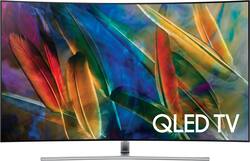
Samsung - 55" Class - LED - Curved - Q7C Series - 2160p - Smart - 4K UHD TV with HDR
- Key Specs
- Display Type: LED
- Screen Size Class: 55 inches (The group size measurement of a screen. This differs from a screen size measured diagonally from corner to corner.)
- High Dynamic Range (HDR): true (An HDR-compatible 4K TV or other HDR-compatible product displays HDR video content when it's available from sources like 4K Ultra HD Blu-ray Discs and 4K streaming services.)
- High Dynamic Range Format: HDR 10 (There are a few HDR formats that tell the TV or other HDR-compatible product how to best utilize its capabilities to display HDR content. HDR technology can support one or multiple formats, each with various benefits to picture quality.)
- Refresh Rate: 240Hz (The number of frames per second the device can produce natively without enhancement. Higher rates help produce smooth, seamless pictures.)
- Motion Enhancement Technology: Motion Rate 240 (Proprietary technologies produced in addition to the Refresh Rate that smooth out faster moving pictures to reduce blur and pixelation.)
- Specific Manufacturer Technologies: Curved screen, Quantum Dots, 4K Elite Black, 4K HDR Elite, 4K Color Drive Elite, One Connect Box, One Remote (This is technology that's specific to a TV brand (sometimes called proprietary technology). Here you'll see terms related to picture quality, brightness, processors and more.)
- Smart Platform: Samsung Smart TV (Just like a computer, a smart TV needs an operating system (also called a smart platform) in order to access the Internet, connect with entertainment apps, and play streaming content. Some common TV smart platforms are; Roku TV, Android TV, and Chromecast.)
- General
- Product Name: 55" Class - LED - Curved - Q7C Series - 2160p - Smart - 4K UHD TV with HDR
- Brand: Samsung
- Model Number: QN55Q7CAMFXZA
- Model Year: 2017
- Dimensions
- Product Height With Stand: 31.1 inches
- Product Width: 48.2 inches (The out of box width of the item. Width is measured as the horizontal distance from one side of the item to the other as it would be primarily used or placed.)
- Product Depth With Stand: 11.8 inches
- Product Height Without Stand: 27.7 inches
- Product Depth Without Stand: 3.6 inches
- Product Weight With Stand: 47.6 pounds
- Product Weight Without Stand: 40.6 pounds
- Stand Depth: 11.8 inches
- Display
- Display Type: LED
- Screen Size: 54.6 inches (Size of the screen, measured diagonally from corner to corner.)
- Screen Size Class: 55 inches (The group size measurement of a screen. This differs from a screen size measured diagonally from corner to corner.)
- High Dynamic Range (HDR): true (An HDR-compatible 4K TV or other HDR-compatible product displays HDR video content when it's available from sources like 4K Ultra HD Blu-ray Discs and 4K streaming services.)
- High Dynamic Range Format: HDR 10 (There are a few HDR formats that tell the TV or other HDR-compatible product how to best utilize its capabilities to display HDR content. HDR technology can support one or multiple formats, each with various benefits to picture quality.)
- Curved Screen: true
- Refresh Rate: 240Hz (The number of frames per second the device can produce natively without enhancement. Higher rates help produce smooth, seamless pictures.)
- Motion Enhancement Technology: Motion Rate 240 (Proprietary technologies produced in addition to the Refresh Rate that smooth out faster moving pictures to reduce blur and pixelation.)
- Closed Captioning: true (The text version of spoken audio displayed on the screen. Devices that can display closed captioning typically have the option to toggle the feature on or off.)
- Language(s) Displayed: English, French, Spanish (The available language options for displayed text or captions.)
- Features
- Remote Control Type: Smart
- Specific Manufacturer Technologies: Curved screen, Quantum Dots, 4K Elite Black, 4K HDR Elite, 4K Color Drive Elite, One Connect Box, One Remote (This is technology that's specific to a TV brand (sometimes called proprietary technology). Here you'll see terms related to picture quality, brightness, processors and more.)
- Smart Capable: true (Smart, or smart-capable devices are able to connect directly to your home network in order to stream content from the Internet, run Internet-based apps, or connect to other smart devices.)
- Smart Platform: Samsung Smart TV (Just like a computer, a smart TV needs an operating system (also called a smart platform) in order to access the Internet, connect with entertainment apps, and play streaming content. Some common TV smart platforms are; Roku TV, Android TV, and Chromecast.)
- Indoor Or Outdoor Use: Indoor (Indicates the appropriate environment product was designed to be used in.)
- Text-To-Speech: false (A system that converts language text into speech.)
- V-Chip: true (Feature that blocks television programming if it has a content rating outside of the acceptable rating(s) configured by the user.)
- TV Tuner: Digital (The ATSC TV Tuner is a component built into conventional TV sets or other devices for receiving over-the-air broadcast TV without a cable/satellite box. Digital tuners may be purchased separately and connected to a device if it does not have one built in.)
- Connectivity
- HDBaseT Receiver: false (An input that receives uncompressed HDMI signals over a category cable point-to-point, up to 100 meters, from a transmitter.)
- RF Antenna Input: true (This input is used to connect devices such as antennas or cable boxes to a TV via a coaxial cable.)
- Number Of USB Port(s) (Total): 3 (The total number of USB ports including all generations and versions.)
- Headphone Jack: false (The device features an interface that allows for the connection of headphones.)
- Compatibility
- VESA Wall Mount Standard: 400mm x 400mm (VESA wall mount standards refer to the spacing of screw holes built into a TV in order to fit with standard TV wall mounts. These standards are implemented into most TVs and monitors.)
- Audio
- Built-In Speakers: true
- Built-in Speaker Type: Downward firing, Front firing (Backward, downward, and front-firing speakers direct sound into the room from those respective directions. A soundbar is typically long and rectangular, and designed to act as an all-in-one speaker with greater sound production than that of a TV alone. An acoustic surface is the result of small sound actuators embedded directly behind the screen, turning the entire screen's surface into a speaker.)
- Surround Sound Supported: DTS Premium Sound (Surround sound systems use multiple audio channels and speakers to create an immersive sound experience for the listener. There are also various proprietary technologies that imitate this kind of sound via a device's built-in speakers or soundbar.)
- Speaker Output: 40 watts
- Power
- ENERGY STAR Certified: true (Devices carrying the ENERGY STAR service mark, such as computer products and peripherals, kitchen appliances, and other products, generally use 20% to 30% less energy than required by federal standards.)
- EPEAT Qualified: false (The Electronic Product Environmental Assessment Tool (EPEAT) was designed to provide an environmental assessment tool for purchasers. In order to qualify for EPEAT, a product must meet all 23 required criteria.)
- Estimated Annual Operating Cost: 18 United States dollars (Predicted cost of operating the product under average conditions for one year.)
- Estimated Annual Electricity Use: 149 kilowatt hours (Predicted amount of electricity needed to operate the product under average conditions for one year.)
- Rechargeable Battery (Remote Control): false
- Battery Size (Remote Control): AAA (The battery size required for operation.)
- Number Of Batteries Required (Remote Control): 2
- Number of Batteries Included (Remote Control): 2
- Included
- Stand Included: true
- Warranty
- Manufacturer's Warranty - Parts: 1 year limited
- Manufacturer's Warranty - Labor: 1 year limited
- Box Dimension
- Height: 32.2 inches
- Width: 55.9 inches
- Depth: 6.7 inches
- CubicDimension: 12060 inches
- Other
- UPC: 887276200361
Experience powerful video and impressive sound from this Samsung curved TV. It has a 55-inch curved screen that draws you in and makes the action seem even more realistic, while the 4K resolution produces impressive detail. Quantum Dot technology in this Samsung curved TV keeps colors looking ultra-realistic and blacks even darker than before.
- 4K Elite Black: Unveils elite shades of black, bringing new life to dark scenes.
- 4K HDR Elite: Delivers elite contrast and expanded color detail, even in the brightest and darkest areas in any scene.
- 4K Color Drive Elite: Get perfect color with over a billion shades with the exclusive Quantum Dots.
- 360° Design: The no-bezel design and clean back finish look gorgeous front to back, whether mounted on the wall or sitting on a stand.
- One Connect Box and Invisible Connection cable: Eliminate wire clutter for a nearly undetectable connection to your components.
- A single remote lets you control everything: Easily access your favorite content and control connected TV devices from one source using OneRemote.
- Full web browser: Easily browse the web right on your TV - enjoy everything from online shopping and social media to entertainment news.
- 54.6" screen (measured diagonally from corner to corner): Large enough to provide an immersive experience for everyone in the room.
- 2160p resolution for breathtaking HD images: Watch 4K movies and TV shows at 4x the resolution of Full HD, and upscale your current HD content to gorgeous, Ultra HD-level picture quality.
- Watch high dynamic range (HDR) content on your TV: With an HDR-compatible 4K TV, you can enjoy HDR movies and TV shows, in addition to all your current content.
- Smart TV with access to streaming services for countless entertainment options: Stream shows, movies, games and more with the TV's built-in Wi-Fi and integrated apps.
- QLED technology: Offers brilliant picture, enhanced by a billion unique colors created by Samsung's proprietary Quantum Dots. With enhanced wide-angle viewing, the picture looks great even if not front and center, so every seat is a great seat.
- Dolby Digital Plus and DTS Premium Sound: Optimize the sound for TV from sources like Internet movies and music, connected PCs, smartphones and tablets.
- 4 HDMI inputs for great home theater connection: High-speed HDMI delivers a full 2160p picture and digital surround sound in one convenient cable. An HDMI cable is not included.
- Motion Rate 240: Enjoy great motion clarity during fast-action moments.
- 3 USB inputs: Easily connect your digital camera, camcorder or other USB device.
Whats Included
- Samsung 55" Class - LED - Curved - Q7C Series - 2160p - Smart - 4K UHD TV with HDR
- Samsung OneRemote TM1790A
- One Connect Box
- 16.4' OCB Fiber Optical Cable
- Owner's manual
Product Manuals
A: The difference between the two 55” curved is the sound. One has 40 watts the other 60 Watts.
A: For you yes, and it make a great cup of coffee too. This is a 2017 Q-LED TV, and you would be considered an early adopter by purchasing this brand of TV. This is Samsung's OLED TV. You can always wait until the price drops, nothing wrong with that. The current Sale Price is a Great Opportunity to enjoy Samsung's Entry into the OLED TV Market.
Q: What is the height on this TV
A: 31" including stand
Q: What is the total overall width of TV from edge to edge?
A: The total width from left to right and including the bezel is 48 1/4 inches
Q: When will the 2018 model of the 55" Samsung QLED be available?
A: They are available as of about 2 weeks ago. Q7 same as 2017. Big diff is the new q8 with full led array. 1k$ premium tho.
A: Refresh rate is 240 Hz.
Q: What is the width and depth of stand??
A: Hello Sasha, the size of the stand is 31.7" x 19.5" x 11.8". ^Britt
A: Hit the home button on the remote and go to the device, in this case I assume it would say antenna or tv. Press down on the remote and you should be able to remove it. Then just go through the normal steps of adding it again which should rescan the channels