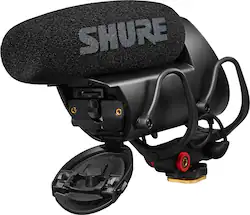
Shure - VP83F LensHopper Camera Mount Condenser Shotgun Microphone with Flash Recording - Black
- Key Specs
- Microphone Type: Shotgun microphones, Condenser microphones
- Wireless: false
- General
- Product Name: VP83F LensHopper Camera Mount Condenser Shotgun Microphone with Flash Recording
- Brand: Shure
- Model Number: VP83F
- Color: Black
- Features
- Microphone Type: Shotgun microphones, Condenser microphones
- Wireless: false
- Compatibility
- Camera/Camcorder Compatible: true
- Other
- UPC: 042406277006
VP83F LensHopper Camera Mount Condenser Shotgun Microphone with Flash Recording
- SHOTGUN DESIGN: Highly directional supercardiod / lobar polar pattern
- NO VIBRATION NOISE: Integrated Rycote Lyre shock mounting system to provide isolation
- EASE OF USE: Three position audio gain switch
- INTEGRATED RECORDING: Integrated digital flash recording to microSD cards, up to 15 hours of audio on a 8GB card
- For DSLR cameras and HD camcorders: It offers digital flash recording / playback (MicroSDHC) capabilities that enable WAV file capture at 24-bit / 48 kHz sampling rate
Whats Included
- VP83F LensHopper Camera Mount Condenser Shotgun Microphone with Flash Recording
Q: Will this microphone work's with Nikon D850?
A: undefined
Q: Will this mic work with a Sony AX53 camcorder?
A: Yes, since it has an aux microphone input the mic is compatible.
Customers are saying
Customers have good things to say about the VP83F LensHopper Camera Mount Condenser Shotgun Microphone's audio quality and ease of use, with many praising its intuitive controls and bright LCD screen for easy menu navigation. The built-in LCD screen is a frequently cited advantage, providing helpful information and simplifying setup. However, some users express concerns regarding the microphone's battery life and the need for frequent battery changes.
Customer Images
The vast majority of our reviews come from verified purchases. Reviews from customers may include My Best Buy members, employees, and Tech Insider Network members (as tagged). Select reviewers may receive discounted products, promotional considerations or entries into drawings for honest, helpful reviews.
- Rated 5 out of 5 stars
Great alternative to built-in camera mic.
This product was sent to me for the purpose of this review. I am not being paid by Shure or BestBuy for this review. The opinions expressed are my own and are not influenced in anyway by either source. From the company that makes two of the most iconic microphones comes a pretty good Camera mic with built-in SD flash recorder. First this mic comes packaged very well. It is in custom cut-out foam inside the box to secure it in shipping. Yes, batteries are included as well. A rare feature of any manufacturer is the included full-size manual written in several languages. Also included is paperwork for the warranty, a safety and warning paper an addendum written in what appears to be Chinese and a sticker. Not a huge fan of product stickers. Shure save your money on printing and do not include them please. Mounting the mic is as simple as mounting a flash. It attaches to the flash shoe on top of the camera. This mic can be used with cameras with or without a mic in jack as it has an internal recorder that uses a microSD card. This is a nice feature as it also gives you a backup recording of the audio if your camera for some odd reason did not record a good audio track. The LCD screen on the back provides access to the menu for adjustments of the mic settings, which there are several and it is very user friendly. There is mic gain, headphone volume, camera output volume, low-cut filter (to remove low frequency rumble) as well as setting for screen brightness and contrast. However setting the proper gain level can be quite tricky if you are a solo YouTuber or other platform creator. It is trial and error until you find the right level as you cannot see the screen while you are standing in front of the mic/camera. Also on the back, there are power and record buttons as well as a joystick that allows you to move around the screen to set various settings like mic gain and headphone output. The mic also has two output jacks for monitoring with headphones and an output for connecting to a camera. It also runs on 2 AA batteries which are included. Shure did not cut corners here, they are using name brand batteries to power the mic. The sound quality is pretty good. If you are recording in a room in your house, be prepared for a bit of room echo. As with any recording at home this is to be expected unless you have sound treatment, even cheap moving blankets hung on the wall will help with this. If you are planning to import the file into a video editing software that allows you to tailor the audio, this really will not be an issue. If you can mount the mic closer to the source you are recording it helps lower the gain needed to record an acceptable audio sample to sync with the video later and help cut out unwanted room noise. The build quality is what to expect from Shure. The mic body seems to be aluminum mounted in a shock mount to help stop vibrations from entering the sound recording. Seems to be built like a tank. They also have included a foam wind screen/ pop filter. You call also purchase a separate fur style wind screen that cuts wind noise by 25dB, according to the Shure web site. I have only recorded a short video to test this mic out vs. the onboard mic that is in my camera. Any external mic is better than what Is built into the camera. Overall impressions of the mic are rather good. The downsides I had found were where the battery polarity indicators are located. The front of the body opens to reveal the battery compartment and SD card slot. The battery compartment has its own door as well and when opened it covers the inside of the main door that has pictures of batteries to show which way, they are supposed to go in. I did not notice this at first and reading the instruction was of no help to show where to look for the polarity markings for proper battery placement. Also, the LCD screen is of no use when standing in front of the camera with the mic attached and trying to set the proper mic gain. These are not major faults to knock off any stars for this review, just a couple of minor annoyances that I found that needed to be pointed out.
Posted by George
- Rated 4 out of 5 stars
Clean, crisp sound, durable build, wide stage
The Shure VP83F is an easy-to-use camera-mountable condenser shotgun mic with built-it flash memory recording capability. It weighs about 10 oz as the body of the mic is made from a durable metal, and it comes pre-fitted with a foam windscreen and mounted on a Rycote Lyre shockmount. The mic requires 2 AA size batteries but can use various types including alkaline, Li-ion, or NiMH rechargeables. On a pair of alkalines you can expect about 9-10 hours of recording, NiMH 12-15 hours, and 17-23 hours using Li-ion batteries. While a bit on the hefty side, the build quality feels premium. I’m using this mic primarily with my compact mirrorless camera which nearly always produces noisy or unusable audio when recording video. I like that I can attach the Shure mic directly to the hot shoe on top of my camera. The sound captured from the Shure VP83F is clear and more focused with less noise and better clarity than the built-in microphone on my camera. While there was still a bit of ambient noise, even with the low-cut filter enabled, there was far less than what the camera mic picks up. Note that it captures mono audio only. Unfortunately, when used in the hot shoe of my camera, I cannot use my camera’s flip-up LCD for selfie-view nor can I use the electronic viewfinder that also requires the use of the hot shoe. Since the mic can also be mounted onto any ¼”-20 threaded mount, I’ve found that using a flash bracket and attaching it offset to the side of the camera, or simply on a tripod, works better for my particular setup. While the super cardioid/lobar polar pattern is supposed to reject unwanted off-axis sounds, I found that it doesn’t eliminate a whole lot of sound from the sides and back if they're not super quiet, so the sound stage is actually fairly wide for a shotgun style mic. Therefore, the closer you can be to your subject when recording with the VP83F the better, to get that really dialed-in focused audio. That’s why it’s great to have the option to mount it on a tripod off-camera if your camera is far away from your subject. You can output the VP83F’s audio directly into your camera (if it has a mic input jack) using the included AUX coil cable via the red jack located on the left-hand side of the mic and this will replace the onboard audio from the camera’s mic in your video recording. You can simultaneously record the LensHopper’s audio separately to flash memory (microSD card, not included) and sync the audio and video in post-production. The benefit here is that you have a backup copy of the audio track, and the audio recorded directly on the mic may offer better quality since a camera’s preamp could introduce some noise even when using an external mic. Output level to the camera can also be reduced by -20 or -40 dB in the settings depending on your camera’s pre-amp sensitivity. The max card size it can use is 32 GB which can store up to 64 hours of recorded audio in 24-bit 48kHz WAV format. The mic has a second output jack on the right-hand side for headphone monitors so you can listen to the mic’s audio feed live. The live monitoring is great because you can adjust some of the mic’s settings on-the-fly while recording as recording conditions change like mic gain, low-cut filter, and headphone volume (0 to 60). You can also adjust the mic gain from 0 to 60 dB and use the levels meter on the LCD to determine when you’ve got the optimal level of signal to reduce background noise (too little gain) but avoid clipping (too much gain). The levels meter will display when it detects clipping, so you can adjust your settings or distance to your audio source. Of course, if you’re a solo shooter and are also the subject in front of the camera, this feature isn’t as useful since you can’t see the LCD on the mic. I liked that you can also use the monitor headphones to listen to tracks recorded on the microSD card in playback mode right on the mic, so you don’t have to pull the tracks off the card in order to review them, saving me time if I need to reshoot right away. While I thought the tiny LCD screen would be way too small to be useful, I actually was quite impressed with its user-friendliness; it has a bright backlight and the 5-way joystick makes it easy to navigate the menus and settings on the screen to make adjustments. I wasn’t a fan of the shape and feel of the record button though because I found it a bit hard to press and more so when pressing and holding to end a recording since the microphone tends to shift in the shockmount when you try to press the button. The low-cut filter helps reduce low frequency noises and ambient sound like rumbling trucks passing by, machine hum, handling noise, and even wind noise to some degree, which I thought worked pretty well. If you record outdoors though, I highly recommend getting the optional fur windjammer (aka “dead cat” windscreen) to further buffer against noise from wind. Overall, I’m pretty happy with the improvement in sound over my camera’s onboard mic, though the sound in my opinion could be more directional, however, the feature set of the controls gives you a lot of flexibility and customization options to optimize the sound in different recording conditions.
Posted by ReviewedByPhil
- Rated 5 out of 5 stars
Internal SD recording is a game changer!
Pros: - SD recording in unit (Easily it’s best feature!) - relatively small and lightweight - easy to navigate menus - quickly adjust levels while recording - cold shoe and 1/4in threaded mount options - great recording quality for the average user - a run and gun staple - low cut filter (can be turned off) - adjustable camera out signal dependant on your camera preamp - headphone out for monitoring with separate volume control - Fine gain adjustment to get that sweet spot dialed in - Line out to camera with provided coil cable Cons: - AA battery vs a rechargeable in body battery (can use rechargeable AA though) - screen is a bit small for those with poor eyesight or in bad viewing conditions - battery compartment is not labeled for + and - (it’s a small detail but annoying and easy fix) - maybe not top quality audio you’d expect from Shure but 99% of ears won’t notice - without a “dead cat” windscreen, you’re going to get a lot of wind noise, even with a low cut on, so if you’ll be outside, you’ll need to purchase this separately. (Pretty common issue) THE GOOD: The Shure Vp83F lensHopper is a fantastic shotgun for anything from run and gun to boom mic-ing interviews. This little thing can be used in a ton of situations and can be your main audio source or a backup, or both when you use the optional SD card internal recording. And let’s talk about that available SD recording for a second. This adds so many possibilities to your setup that it’s really worth the extra cost vs a similar mic without internal recording, even the Shure VP83, which is basically the same mic, just without the SD recorder. Having available internal flash recording allows you to not only get a direct, clean recording, but also allows you to move the microphone away from the camera and use it to mic talking head interviews or lock down the camera for a wide shot, away from the subject, and boom mic over or under frame. Once in the editing room, you simply sync audio with your on board camera reference audio track and you’re all set. No longer are you tied to long mic cables or the limits of keeping your mic and camera in the same location. This also negates any bad preamp your camera body may utilize. (More common than you think.) Ok, awesome, but what if you’re doing more of a run and gun, or vlogging on the streets, maybe a walk and talk? The LensHopper is still a great option for that as well! You can mount it to your camera's cold shoe or a standard quarter inch thread anywhere on your camera rig and you’re ready to go. Keep in mind, if you use the cold shoe, depending on your camera body, the mic may block the flip up screen if you are trying to vlog in a “selfie” style shot. In this situation I would recommend an external monitor or moving the mic to a different mount. Regardless of how you mount it to your camera rig, the VP83F is perfect for youtubers and run and gun shooting like wedding receptions or events where you don’t have time to use a lav or set up your better audio equipment. And thanks to the aforementioned SD internal recorder, you can still record directly to the SD card AND into the camera with the provided coiled mic cable. Keep in mind, depending on your camera and the preamp on it, you may need to adjust the camera output levels on the microphone menu to get a good sound into your camera. For my setup with the A7iii (which has a controversial preamp debate) I was able to still get a good clean sound recorded in body but I still chose to use the SD direct recording because in theory, that will always be better. This does however give you a good backup, two audio source redundancy, so if you have a pop, drop out, or corrupt file, etc, you won’t lose your audio and have an embarrassing conversation with your client. THE CONS: A quick note about some of the “cons” I found while testing this mic. One very tiny detail but just bugged me; everywhere I looked, I could not find a little + or - for the battery compartment. I did see two springs at bottom and figured usually negative end to spring, but that didn’t work. I had to arrange the batteries a few times until it was correct and the power came on. Once you figure it out, no problem, but it’s just odd they didn’t bother to mark it. Also with the batteries, I’ve seen other reviews say the compartment is loose and will probably break open in the field. I don’t know if Shure has updated this or other reviewers were testing in earthquakes, but there are TWO latched compartments holding the batteries in and they are pretty tight latches. I don’t see how those could pop open on accident. Battery life seems like it may be an issue and unfortunately means my camera bag will once again be full of AA’s rolling around. The manual includes a general life expectancy for battery type and you’ll definitely want to get rechargeables or at least NiMH to get decent life out of them. Just remember, having extra batteries is the difference between newbies and pros. OVERALL: (TL:DR) I have only had this microphone for about 5 days so I haven’t tested it in EVERY real world situation but I did run it through a lot of simulated tests to avoid surprises out in the field and can say, overall, this is a fantastic little shotgun mic for the everyday user, youtuber, vlogger or run and gun videographer. So often audio is forgotten or done poorly, and this mic won’t make you magically sound better, it’s still a piece of professional equipment and requires professional training and expertise to use correctly. But if you take the time, learn how it works, what it does, and how to get the best out of your gear, then the Shure VP83F will give you nothing but good, clean, quality audio. Stop looking like an amateur by using your on camera mic and get this microphone to dive into the world of pro audio! For those of you looking for specs, I included a picture of the manual specs page with all the juicy details. I won’t get into them here because I think most readers don’t care or understand, but the info is there if you want it. Overall, I love this mic and will be taking it with me everywhere I shoot. It’s compact, powerful, and versatile with a beautiful sound representation for voice capture to help bring better sound to your videos.
Posted by bTobin
Most viewed










Today's top picks
Rating 3 out of 5 stars with 1 reviewfalse
(1)$799.00