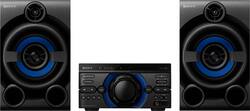
Sony - MHC-M20 High-Power Audio System - Black
- Key Specs
- Wireless Connectivity: Bluetooth (The manner in which a device sends data to another device over a short distance without the use of wires or cables.)
- General
- Product Name: MHC-M20 High-Power Audio System
- Brand: Sony
- Model Number: MHCM20
- Color: Black
- Audio
- Speaker Size(s): 2in Tweeter and 8in Woofer
- Playback Format(s): CD, CD-R, CD-RW, MP3
- Bass Boost: true (Circuitry that boosts the bass response of the amplifier, improving audio reproduction enhancing the sound of low frequencies. Fixed boost means the level of bass response is preset, whereas variable boost allows the user to make adjustments.)
- Equalizer: true (Allows for the control of different frequencies within an audio signal, such as adjusting treble and bass levels.)
- Tuner Type(s): FM only
- Features
- App Compatible: true (The product can be connected to a program or software application on a mobile device, which then receives collected data from the product.)
- Audio Player Type(s): CD player
- Number of AM/FM Presets: 20
- Remote Control Included: true
- CD-R/RW Compatible: true
- Sleep Timer: true (Allows the user to set a timer that automatically turns off the device/system after a preprogrammed length of time.)
- Connectivity
- Wireless Connectivity: Bluetooth (The manner in which a device sends data to another device over a short distance without the use of wires or cables.)
- Power
- Power Source: AC/DC Power (plug-in)
- Inputs
- Antenna Input: 1 x FM
- Dimensions
- Product Height: 16 inches (The out of box height of the item. Height is measured as the vertical distance from the bottom of the item to the top as it would be primarily used or placed.)
- Product Width: 10.1 inches (The out of box width of the item. Width is measured as the horizontal distance from one side of the item to the other as it would be primarily used or placed.)
- Product Depth: 8.75 inches (The out of box depth of the item. Depth is measured as the distance from the front of the item to the back as it would be primarily used or placed.)
- Product Weight: 11.3 pounds (The out of box weight of the item.)
- Other
- UPC: 027242908987
Play party music with this three-box Sony audio system. Its Digital Sound Enhancement Engine and S-Force Front Surround technology produce high-quality sound, and the built-in microphone input lets you engage in karaoke-style singing. This Sony audio system offers wireless streaming from Bluetooth devices, and its USB port and CD player provide extra connectivity to music sources.
- High-power audio system: Features Wireless Party Chain, Bluetooth technology and LDAC.
- Built-in CD player: This home audio system is compatible with CD, CD-R, and CD-RW discs, so you can enjoy everything from studio recordings to mixtapes and downloaded tracks.
- Digital Sound Enhancement Engine: Restores compressed digital files to produce high-quality sound.
- FM tuner: Offers 20 presets to set your favorite channels for one-touch recall.
- Two-way speakers: Feature a dynamic bass boost system for rich sound.
- S-Force Front Surround technology: Enjoy immersive, cinematic audio, and virtual surround sound in your living room.
- Inputs: Include one front analog audio port for easy access.
- Built-in Mic Input: Sing along to your favorite tunes. A mic input makes the MHC-M20 the perfect companion for karaoke parties.
- Outputs: Include two speaker output fronts.
- Multidevice connection: Connect up to 50 compatible speakers and synchronize the music and lighting.
Whats Included
- AC power cord
- FM Antenna
- Owner's manual
- Remote Control (batteries included)
- Sony MHC-M20 High-Power Audio System
Q: Does this audio system have lights in the speakers?
A: No, when I saw it on display they were light up but mine doesn't even though it's the same set
Q: How many CDs can be stacked to play in turn. DOES IT HANDLE MULTIPLE CDs AND IF SO, HOW MANY?
A: Hi JayS, It can only hold 1 disc at a time. You may refer to page 17 of this link: https://www.sony.com/electronics/support/res/manuals/4736/e01e45a770aa6892aca8d85a17bdbdf7/47360731M.pdf ~Ralph
A: This system is rated at 70 watts.
Q: Are the included Speakers hardwired? Or Bluetooth?
A: The speakers are hardwired to the receiver, but the receiver offers a Bluetooth connection to your phone. Sony does offer some stand alone Bluetooth speakers in this product line as well.
Q: How long are the wires that hook up to the main system?
A: They are short about 30" and are wired directly into speakers. Sound is very good.
A: Hi, rick! Unfortunately, the speakers are not wireless. ~Ralph
Q: Does it have an auxiliary input so I can connect my ancient i pod that does not have Bluetooth?
A: Hi, Oldskool! The unit doesn't have an auxiliary port. However, it does have an RCA audio input to support some older mobile devices. As a suggestion, please use an auxiliary-to-component audio adapter to connect your iPod. Regards, Sam
Q: Does this system have a remote control?a
A: Hello, Doodlebug1! Yes, there is a remote control supplied with this audio system. Happy to help, David