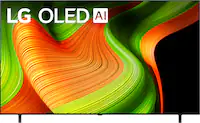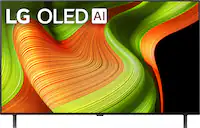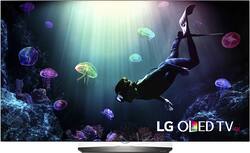
LG - 55" Class - (54.6" Diag.) - OLED - 2160p - Smart - 4K Ultra HD TV with High Dynamic Range
- Key Specs
- Display Type: OLED
- Screen Size Class: 55 inches (The group size measurement of a screen. This differs from a screen size measured diagonally from corner to corner.)
- High Dynamic Range (HDR): true (An HDR-compatible 4K TV or other HDR-compatible product displays HDR video content when it's available from sources like 4K Ultra HD Blu-ray Discs and 4K streaming services.)
- Smart Platform: webOS (Just like a computer, a smart TV needs an operating system (also called a smart platform) in order to access the Internet, connect with entertainment apps, and play streaming content. Some common TV smart platforms are; Roku TV, Android TV, and Chromecast.)
- General
- Brand: LG
- Model Number: OLED55B6P
- Product Name: 55" Class - (54.6" Diag.) - OLED - 2160p - Smart - 4K Ultra HD TV with High Dynamic Range
- Color: Silver
- Dimensions
- Product Height With Stand: 29.9 inches
- Product Width: 48.4 inches (The out of box width of the item. Width is measured as the horizontal distance from one side of the item to the other as it would be primarily used or placed.)
- Product Depth With Stand: 8.9 inches
- Product Height Without Stand: 28.1 inches
- Product Depth Without Stand: 1.9 inches
- Product Weight With Stand: 41 pounds
- Product Weight Without Stand: 33.7 pounds
- Display
- Display Type: OLED
- Screen Size: 54.6 inches (Size of the screen, measured diagonally from corner to corner.)
- Screen Size Class: 55 inches (The group size measurement of a screen. This differs from a screen size measured diagonally from corner to corner.)
- High Dynamic Range (HDR): true (An HDR-compatible 4K TV or other HDR-compatible product displays HDR video content when it's available from sources like 4K Ultra HD Blu-ray Discs and 4K streaming services.)
- Features
- Remote Control Type: Universal
- Smart Capable: true (Smart, or smart-capable devices are able to connect directly to your home network in order to stream content from the Internet, run Internet-based apps, or connect to other smart devices.)
- Smart Platform: webOS (Just like a computer, a smart TV needs an operating system (also called a smart platform) in order to access the Internet, connect with entertainment apps, and play streaming content. Some common TV smart platforms are; Roku TV, Android TV, and Chromecast.)
- TV Tuner: Analog (The ATSC TV Tuner is a component built into conventional TV sets or other devices for receiving over-the-air broadcast TV without a cable/satellite box. Digital tuners may be purchased separately and connected to a device if it does not have one built in.)
- Connectivity
- Number Of USB Port(s) (Total): 3 (The total number of USB ports including all generations and versions.)
- Compatibility
- VESA Wall Mount Standard: 300mm x 200mm (VESA wall mount standards refer to the spacing of screw holes built into a TV in order to fit with standard TV wall mounts. These standards are implemented into most TVs and monitors.)
- Audio
- Surround Sound Supported: Other (Surround sound systems use multiple audio channels and speakers to create an immersive sound experience for the listener. There are also various proprietary technologies that imitate this kind of sound via a device's built-in speakers or soundbar.)
- Speaker Output: 40 watts
- Power
- ENERGY STAR Certified: false (Devices carrying the ENERGY STAR service mark, such as computer products and peripherals, kitchen appliances, and other products, generally use 20% to 30% less energy than required by federal standards.)
- EPEAT Qualified: false (The Electronic Product Environmental Assessment Tool (EPEAT) was designed to provide an environmental assessment tool for purchasers. In order to qualify for EPEAT, a product must meet all 23 required criteria.)
- Estimated Annual Operating Cost: 21 United States dollars (Predicted cost of operating the product under average conditions for one year.)
- Estimated Annual Electricity Use: 175 kilowatt hours (Predicted amount of electricity needed to operate the product under average conditions for one year.)
- Box Dimension
- Height: 32.9 inches
- Width: 57.4 inches
- Depth: 9 inches
- CubicDimension: 16996 inches
- Other
- UPC: 719192603691
Explore a wide range of apps on your LG UHD 4K smart OLED TV. It has a user interface that lets you connect your mobile devices and enjoy watching shows from a variety of streaming services. This LG UHD 4K smart OLED TV has more than eight million pixels that deliver four times the resolution for an Ultra HD experience.
- 54.6" screen (measured diagonally from corner to corner): Large enough to provide an immersive experience for everyone in the room.
- 2160p resolution for breathtaking HD images: Watch 4K movies and TV shows at 4x the resolution of Full HD, and upscale your current HD content to gorgeous, Ultra HD-level picture quality.
- High dynamic range (HDR) creates a more realistic picture: HDR technology expands the contrast and color range of the existing pixels on your TV to reveal a better, brighter and more colorful image.
- Built-in Wi-Fi Smart TV means a huge world of entertainment: Stream movies, videos, music and more, and use the included Web browser to surf your favorite websites.
- OLED TVs perform well in all lighting conditions: They offer an extremely high degree of color accuracy, wide viewing angles and a picture that is virtually blur-free.
- 4 HDMI inputs for the best home theater connection: High-speed HDMI delivers up to 2160p picture and digital surround sound in one convenient cable. HDMI cable not included.
- 3 USB inputs: Easily connect your digital camera, camcorder or other USB device.
- 54.6" screen (measured diagonally from corner to corner): Large enough to provide an immersive experience for everyone in the room.
- 2160p resolution for breathtaking HD images: Watch 4K movies and TV shows at 4x the resolution of Full HD, and upscale your current HD content to gorgeous, Ultra HD-level picture quality.
- High dynamic range (HDR) creates a more realistic picture: HDR technology expands the contrast and color range of the existing pixels on your TV to reveal a better, brighter and more colorful image.
- Built-in Wi-Fi Smart TV means a huge world of entertainment: Stream movies, videos, music and more, and use the included Web browser to surf your favorite websites.
- OLED TVs perform well in all lighting conditions: They offer an extremely high degree of color accuracy, wide viewing angles and a picture that is virtually blur-free.
- 4 HDMI inputs for the best home theater connection: High-speed HDMI delivers up to 2160p picture and digital surround sound in one convenient cable. HDMI cable not included.
- 3 USB inputs: Easily connect your digital camera, camcorder or other USB device.
Whats Included
- LG OLED55B6P
- Universal remote control
- Stand
- LG Magic Remote control
- LG OLED55B6P
- Universal remote control
- Stand
- LG Magic Remote control
A: I researched OLED tvs for several weeks before purchasing mine. What I have been informed by several salesman and read on CNET is this. Curved tvs allow for better viewing when you are watching from an angle. OLEDS already allow for this in their flat tvs. So a curved OLED can do little more. One last item is that they promote curved tvs as providing added depth to the picture. CNET reviewed the same tv in a flat and curved model and stated they could not notice a difference between the two.
A: If it's the "support for" that's confusing you, you're not alone - I thought that was weird when I started researching. It's just an industry term for "it's capable of it." Like you might by a Nexus Smartphone that has "support for fast-charge" ... that means it's capable of fast-charge if you have the cables and converters that can do fast-charge. Here, the OLED B6 is capable of Dolby Vision if you're watching content that streams in Dolby Vision. That's all it means. *shrug.* Techies.
A: The OLED55B6P does have an RF antenna input. You can attach a TV antenna directly to the TV.
A: Make sure the 'True Motion' is set to off. This will fix the judder/skipping issue. You will need to do this for each picture mode. Don't know why LG doesn't just set True Motion to off from the factory as it causes problems when it is on.
Q: What is the size of the box LxWxH"????
A: The W x H x D dimensions for the carton that the LG - 55" Class - (54.6" Diag.) - OLED - 2160p - Smart - 4K Ultra HD TV - with High Dynamic Range, Model # OLED55B6P comes in are: 57.1" x 32.5" x 9.0" and weighs 57.3 lbs...^IFV
A: I'm using the ethernet cable on the back of this TV. It works perfectly but also supports wifi.
Q: Define OLED
A: An organic light-emitting diode (OLED) is a light-emitting diode (LED) in which the emissive electroluminescent layer is a film of organic compound that emits light in response to an electric current. OLED essentially provides higher contrast than normal LED. It will significantly increase the picture quality.