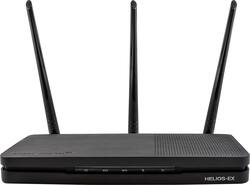
Amped Wireless - HELIOS-EX High Power AC2200 Tri-Band Wi-Fi Range Extender with DirectLink™ - Black
- Key Specs
- Wi-Fi Speed: 5000 megabits per second (The maximum rate at which data is transferred between a network device and wireless router.)
- Wireless Standard: AC, N (The wireless networking protocol used by the device. Each iteration of the protocol is based on the 802.11 standard developed by the Institute of Electrical and Electronics Engineers (IEEE) Standards Association. Denoted by letters following 802.11 (802.11a, 802.11ac, etc.), each version, published in alphabetical order, encompasses all previous versions.)
- Wi-Fi Range: 12000 Sq. Ft (The device will provide a Wi-Fi connection to this approximate area.)
- Form Factor: Freestanding, Mountable (The size, arrangement, and physical configuration of the product.)
- Band Technology: Dual (Refers to the number of frequency bands used to wirelessly transmit an internet signal. For example, dual-band devices may use one 2.4 and one 5 GHz band, while tri-band devices may use one 2.4 and two 5 GHz bands. Multiple bands also provide more flexibility for designating connected devices to specific band use.)
- Frequency Band: 2.4 GHz, 5.0 GHz (Bands may be grouped into categories such as low- and high-band VHF (Very High Frequency), low- and high-band UHF (Ultra High Frequency), or certain frequency channels (measured in MHz or GHz). Generally, higher frequencies transmit information faster but have shorter range than lower frequencies.)
- Antenna Type: Detachable, Internal
- Number of LAN Ports: 5 (Number of devices able to be connected to the Local Area Network (LAN). LAN ports allow wired connections to other networking devices (wireless access points, range extenders, etc.) in order to share the internet connection received through a WAN port.)
- General
- Product Name: HELIOS-EX High Power AC2200 Tri-Band Wi-Fi Range Extender with DirectLink™
- Brand: Amped Wireless
- Model Number: RE2200T
- Network
- Wi-Fi Range: 12000 Sq. Ft (The device will provide a Wi-Fi connection to this approximate area.)
- Attached Antenna: true
- Minimum Frequency: 2400 megahertz (The lowest signal frequency that the device is able to amplify or transmit. The higher the frequency, the more data that can be transmitted and the more easily the signal is attenuated (weakened over distance/passing through buildings).)
- Maximum Frequency: 5 gigahertz (The highest signal frequency that the device is able to amplify or transmit. Generally, the higher the frequency, the more data that can be transmitted and the more likely the signal is attenuated (weakened over distance/passing through buildings).)
- Maximum Coverage Area: 12000 square feet
- Features
- App Compatible: false (The product can be connected to a program or software application on a mobile device, which then receives collected data from the product.)
- Ports
- Number Of USB Port(s): 1 (The total number of USB ports including all generations and versions.)
- Compatibility
- System Requirements: 2.4GHz or 5GHz 802.11a/b/g/n or ac Wi-Fi Network, Computer, tablet or smartphone with a web browser (The software that a product must have for it to be able to integrate with another product.)
- Security
- Security Features: Guest Networks, User Access
- Dimensions
- Product Height: 5.5 inches (The out of box height of the item. Height is measured as the vertical distance from the bottom of the item to the top as it would be primarily used or placed.)
- Product Length: 1.1 inches (The out of box length of the item. Length is measured as the longest dimension of the item.)
- Product Width: 8.8 inches (The out of box width of the item. Width is measured as the horizontal distance from one side of the item to the other as it would be primarily used or placed.)
- Product Weight: 2 pounds (The out of box weight of the item.)
- Other
- UPC: 850535006639
Add stability to your home network with the Amped Wireless HELIOS-EX Wi-Fi Extender. With DirectLink technology, it avoids signal loss by adding another 5GHz Wi-Fi channel to the standard setup, which it then uses strictly for receiving signal from the source. This Amped Wireless HELIOS-EX Wi-Fi Extender covers an area of up to 12,000 sq. ft. and includes four Gigabit network ports.
- Up to 12,000 sq. ft. of coverage: Bring long-range, reliable Wi-Fi to your entire home or office.
- Eliminate Wi-Fi dead spots: Amplify Wi-Fi to the maximum with 12 amplifiers, 1 internal and 3 external high-gain antennas.
- DirectLink™ technology: Uses a dedicated link to the home network, delivering up to 2X the speed.
- Unmatched AC2200 Wi-Fi for flawless HD & 4K streaming: Move faster on all devices with speeds of up to 399Mbps on the 2.4GHz frequency and 866Mbps on the 5GHz.
- MU-MIMO technology: Delivers optimal performance when many devices are connected at once.
- AirPlay®, AirPrint ™ and Home Sharing: Compatible with all Apple networking features.
- High-power quad-core processor: Handles heavy traffic with ease for the best Wi-Fi experience.
- Built-in 5-port Ethernet switch: For wired connection of up to 5 computers.
- Share files with USB 3.0: Attach a USB drive to instantly share files locally at blazing-fast speeds (USB storage device not included).
- System requirements: Wireless 802.11a/b/g/n or ac 2.4GHz or 5GHz network computers, tablets or smartphones with a web browser.
Whats Included
- 3x Detachable High Gain Antennas
- Amped Wireless HELIOS-EX High Power AC2200 Tri-Band Wi-Fi Range Extender with DirectLink™
- Power adapter
- Setup guide
Product Manuals
Q: Can it use the same SSID as my TWC modem?
A: No, however you can have the extender kind of clone your SSID close to it. I.E if you SSID on your original router is "ONE" the extender would be "ONE_RE" for the 5ghz and "ONE_RE_2.4" for the 2.4 ghz.
A: Hello, All of our extenders only work through a WIFI connection. If you need to hard wire a unit to your router you need to use an access point like the APA1300 or APA2600.
Q: Why is the power flashing on and off on it?
A: undefined
A: Hello! A second extender is ok if the repeater is connected to the router directly just like the other extender. To ensure repeater is connecting to the router directly, the extended network must have different name from the main network of the router.
A: Yes, you can extend a Wi-Fi service up to 12,000 sq. ft.
A: If you setup that way
A: The device acts as its own DHCP server (it creates a new network, but may take advanced routing changes to keep others not on it from seeing the devices. This I am not sure of), creates a new WiFi network, and lets you put a password on it. I have not done this myself, but I would assume the answer is yes.