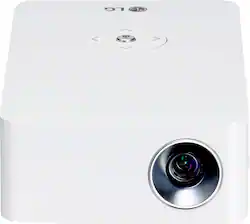
LG - PH30JG 720p Wireless DLP Projector - White
- Key Specs
- Product Weight: 1.1 pounds (The out of box weight of the item.)
- Light Source: LED
- Resolution: HD (720p) (Refers to the number of pixels, both horizontally and vertically, used to capture video/images. The higher the resolution the finer the detail that can be seen.)
- Contrast Ratio: 10,0000:1 (Measured difference between a displayed image's brightest whites and darkest blacks. The larger the first number, the more detail and color that can be displayed.)
- Projector Use: Home Theater
- General
- Product Name: PH30JG 720p Wireless DLP Projector
- Brand: LG
- Projector Mount Pattern: Universal (Universal mounts can be adjusted to support a variety of devices. Dedicated mounts are designed to fit a specific device.)
- Model Number: PH30JG
- Series: PH30J (Part of a group of the same product type with similar features.)
- Dimensions
- Product Height: 1.4 inches (The out of box height of the item. Height is measured as the vertical distance from the bottom of the item to the top as it would be primarily used or placed.)
- Product Width: 3.4 inches (The out of box width of the item. Width is measured as the horizontal distance from one side of the item to the other as it would be primarily used or placed.)
- Product Depth: 5.8 inches (The out of box depth of the item. Depth is measured as the distance from the front of the item to the back as it would be primarily used or placed.)
- Product Weight: 1.1 pounds (The out of box weight of the item.)
- Display
- Light Source: LED
- Display Technology: DLP (Denotes the product’s visual process, sometimes manufacturer specific, used to display an image.)
- Resolution: HD (720p) (Refers to the number of pixels, both horizontally and vertically, used to capture video/images. The higher the resolution the finer the detail that can be seen.)
- Resolution (Native): 1280 x 720 (Native resolution of a screen refers to its single, fixed resolution. Sometimes screens must scale an image up or down in order to fit the native resolution. This can cause a loss of resolution or detail.)
- 3-Chip Technology: false (Projectors with this technology are able to display images with optimal brightness, color, and detail. Because of their high-performance design, these projectors are primarily used in large venues and digital cinemas.)
- High Dynamic Range (HDR): false (An HDR-compatible 4K TV or other HDR-compatible product displays HDR video content when it's available from sources like 4K Ultra HD Blu-ray Discs and 4K streaming services.)
- Contrast Ratio: 10,0000:1 (Measured difference between a displayed image's brightest whites and darkest blacks. The larger the first number, the more detail and color that can be displayed.)
- Aspect Ratio: 16:9 (The measurement of the width of a screen compared to the height of a screen, expressed as a ratio.)
- Throw Ratio Range: 1.3 (This measurement indicates what size of projected image can be produced from a certain distance. The smaller the ratio, the closer the projector can be to the screen while still producing a large image.)
- Digital Keystone Correction: true ("Keystone effect" refers to the distortion of an image when it is projected on an angled surface or when the projector is positioned too high or too low from the center of the display. Projectors with a digital keystone correction feature are able to scale the image as needed before it is projected, resulting in the correct image orientation no matter where it is displayed.)
- Horizontal Scan Rate: 27to67.5Khz (Number of horizontal lines displayed per second on the device.)
- Vertical Scan Rate: 24to60Hz (Number of vertical lines displayed per second on the device.)
- Response Time: 52 milliseconds (The speed at which pixels can change colors is called response time. It is measured in milliseconds (ms).)
- 3D Technology: false
- Viewing
- Minimum Projector Distance: 1.9 feet (Minimum distance that the projector can be placed from the screen to produce a display with acceptable visual performance.)
- Maximum Projector Distance: 9.4 feet (Maximum distance that the projector can be placed from the screen to produce a display with acceptable visual performance.)
- Minimum Viewable Screen Size: 20 inches
- Maximum Viewable Screen Size: 100 inches
- Features
- Projector Use: Home Theater
- Remote Control Included: true
- TV Tuner: false (The ATSC TV Tuner is a component built into conventional TV sets or other devices for receiving over-the-air broadcast TV without a cable/satellite box. Digital tuners may be purchased separately and connected to a device if it does not have one built in.)
- Screen Mirroring: Mobile to screen (Casts the screen of one device onto another wirelessly, using a common protocol (typically Bluetooth).)
- Exposure Control
- Focus Adjustment: Manual (The method used to focus the device in order to view or display a sharper image.)
- Optical Zoom: None (The optical zoom uses a combination of lenses that magnify the image prior to it being registered at high resolution by the imaging sensor.)
- Digital Zoom Capability: true (Projectors with this feature allow for digital adjustment to the projected image size without changing the location of the projector.)
- Connectivity
- Bluetooth Version: 3.0 + HS (The Bluetooth specification formalized by the Bluetooth Special Interest Group. All versions of the Bluetooth standard are backwards compatible with previous versions.)
- HDMI Audio Return Channel (ARC): false
- Audio
- Sound Mode: Mono
- Integrated Speaker(s): true
- Speaker(s) Included: true
- Watts Per Channel: 1 watts
- Compatibility
- Voice Assistant Built-in: No (A digital assistant built into the device that uses voice commands to answer questions and control smart devices.)
- Certifications Listings & Approvals
- ENERGY STAR Certified: false (Devices carrying the ENERGY STAR service mark, such as computer products and peripherals, kitchen appliances, and other products, generally use 20% to 30% less energy than required by federal standards.)
- Warranty
- Manufacturer's Warranty - Parts: 1 year
- Manufacturer's Warranty - Labor: 1 year
- Other
- UPC: 719192614031
Share HD content on a bigger screen with this LG LED projector. It produces an image size of up to 100 inches, and its wireless screen-sharing functionality lets you stream videos from a Miracast or WiDi device. Pair this LG LED projector with a Bluetooth speaker for enhanced audio output.
- Pocket design: Weighs just 17.28 oz. for easy transport to meetings, presentations and more.
- Built-in Wi-Fi and Bluetooth enabled: Allow simple connectivity to external devices.
- DLP image technology: Offers crisp visuals.
- 250 lumens white brightness: Help ensure clear on-screen images.
- 100,000:1 contrast ratio: Provides a multitude of shades between black and white for rich color saturation.
- 1280 x 720 resolution: Delivers crisp, detailed high-definition images.
- HDMI input: Makes it easy to connect to high-definition sources.
- RGB LED lamp: Delivers up to 30,000 hours of lamp life in normal mode for extended use.
- Built-in 1W speaker: Provides crisp sound.
- 4 hours battery life: Usable in places with no access to power outlet.
- Included remote: Provides simple control from across the room.
Whats Included
- LG PH30JG
- Wireless remote control, power adapter
Product Manuals
Q: Can I use this projector while it charges?
A: undefined
Q: does this projector has built-in wifi..??
A: Yes, this projector has built-in Wi-Fi.
Q: Can I use this with a MacBook Pro?
A: The Screen Share feature (with Miracast, WiDi supporting device) on the LG HD LED Portable MiniBeam Projector w/ up to 4 hour battery life, Model # PH30JG will not work with iOS so it will not work with your iPhone. Apple is not compatible with Miracast or WiDi. Screen sharing using a Mac or iOS device requires an Apple TV streaming device. The compact USB Type-C™ port enables convenient screen mirroring from a compatible laptop, tablet or smartphone, plus device charging at the same time over a single cable. Ice Cream Sandwich, Jellybean, Kitkat, Lollipop, Marshmallow and Nougat versions of LG’s Android devices are guaranteed to be compatible. Page 44 of its owner's manual has step by step instructions for how to set the wireless settings. ^CP
Q: Can you watch regular station and use this as a TV inserted of a regular one?
A: There's no built in analog or digital tuner on this particular device to receive OTA broadcasts. You can use an external tuner but that's less elegant and more bulky a solution.
Q: Which Roku device would pair with this projector?
A: The PH30JG has a HDMI port which you can connect a Roku device to. We would recommend checking with the devices manufacturer to ensure the unit is powered correctly. ^CP
Q: More destila: Brightness (Lunens) Dimensions Weight
A: The PH30JG has up to 250 lumens and has the following dimensions: (WxHxD) 3.4" x 1.4" x 5.8" and weighs 1.08 lbs. ^CP