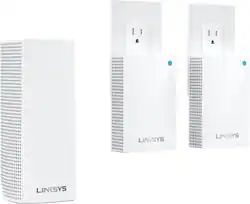
Linksys - Velop Tri-Band Mesh WiFi System (1 Node+2 Plug-in) 3-pack
- Key Specs
- Wi-Fi Mesh System: true (A single wireless network consisting of a main router (connected directly to a modem) that connects to a series of satellite modules or nodes placed around the home. Routers with this capability promote stronger, faster wireless signals as well as increase Wi-Fi coverage by reducing interference and eliminating dead zones.)
- Number of Wi-Fi Satellites Included: 2 (Quantity of Wi-Fi satellite modules/nodes for a Wi-Fi Mesh System that come with the product.)
- Number Of LAN Ports: 2 (Number of devices able to be connected to the Local Area Network (LAN). LAN ports allow wired connections to other networking devices (wireless access points, range extenders, etc.) in order to share the internet connection received through a WAN port.)
- Internet Service Provider (ISP) Compatibility: Universal (The internet service provider(s) that the device is able to work with and/or connect to with minimal setup.)
- General
- Product Name: Velop Tri-Band Mesh WiFi System (1 Node+2 Plug-in) 3-pack
- Brand: Linksys
- Model Number: WHW0203P
- Security
- Data Encryption: true
- Encryption Type: WPA2-Personal (The security protocols or certification programs that protect the Wi-Fi network.)
- Firewall Type: Other (The method the firewall uses to filter and process data to increase network security, primarily by blocking malicious traffic requests while allowing legitimate traffic through.)
- Parental Controls: true (Allows user to block unwanted content, signals, channels, networks, etc. from being received or accessed.)
- Network
- Band Technology: Tri (Refers to the number of frequency bands used to wirelessly transmit an internet signal. For example, dual-band devices may use one 2.4 and one 5 GHz band, while tri-band devices may use one 2.4 and two 5 GHz bands. Multiple bands also provide more flexibility for designating connected devices to specific band use.)
- Ethernet Standard: 10/100/1000 (Each standard is a variation of the IEEE 802.3 set of computer networking technologies known as Ethernet. New versions evolved to include higher bandwidth, different physical media, and other new and improved features. Standards are often denoted by speeds (in Megabits per second). For example, a 10/100/1000 Ethernet port transmits at 10 Mbps, 100 Mbps, and 1000 Mbps (1 Gbps).)
- Number of Antennas: 6
- Frequency Band: 2.4 GHz, 5.0 GHz (Bands may be grouped into categories such as low- and high-band VHF (Very High Frequency), low- and high-band UHF (Ultra High Frequency), or certain frequency channels (measured in MHz or GHz). Generally, higher frequencies transmit information faster but have shorter range than lower frequencies.)
- Wireless Networking Standard: Wi-Fi 6 (The wireless networking standard used by the device. Each iteration of the standard developed by the Wi-Fi Alliance corresponds to an existing IEEE 802.11 protocol; for example, standard 802.11ac (or AC) is termed Wi-Fi 5. Refers specifically to the standard the device is designed to use, but ultimately determines product interoperability and backward compatibility including previous versions.)
- Wireless Standard: AC, N (The wireless networking protocol used by the device. Each iteration of the protocol is based on the 802.11 standard developed by the Institute of Electrical and Electronics Engineers (IEEE) Standards Association. Denoted by letters following 802.11 (802.11a, 802.11ac, etc.), each version, published in alphabetical order, encompasses all previous versions.)
- Number of 2.4Ghz Streams: 1 (A router's streams are like lanes on a highway. The more streams a router has, the less traffic congestion. Because the 2.4 GHz band is used to transmit wireless signals to a wide variety of devices, there is often high amounts of traffic on that stream. But with multiple streams, each can be designated to a specific device for optimal performance. For example, if one 2.4 GHz stream is assigned to one device, such as a desktop computer, it leaves the remaining streams open for guest users, devices that use more data, or devices with specific band compatibility.)
- Number of 5.0Ghz Streams: 2 (A router's streams are like lanes on a highway. The more streams a router has, the less traffic congestion. The 5.0 GHz band provides high speed, short-range data transmission and typically has less traffic than the 2.4 GHz band. With multiple streams, each can be designated to a specific device for optimal performance. For example, if one 5.0 GHz stream is assigned to one device, such as a streaming media player, it leaves the remaining streams open for guest users, devices that need less data, or devices with specific band compatibility.)
- Wi-Fi Mesh System: true (A single wireless network consisting of a main router (connected directly to a modem) that connects to a series of satellite modules or nodes placed around the home. Routers with this capability promote stronger, faster wireless signals as well as increase Wi-Fi coverage by reducing interference and eliminating dead zones.)
- Number of Wi-Fi Satellites Included: 2 (Quantity of Wi-Fi satellite modules/nodes for a Wi-Fi Mesh System that come with the product.)
- Number of Wi-Fi Satellites Supported: 2 (Maximum quantity of Wi-Fi satellite modules/nodes that are able to be connected to the main router in a Wi-Fi Mesh System.)
- Certifications Listings & Approvals
- ENERGY STAR Certified: false (Devices carrying the ENERGY STAR service mark, such as computer products and peripherals, kitchen appliances, and other products, generally use 20% to 30% less energy than required by federal standards.)
- Features
- App Compatible: true (The product can be connected to a program or software application on a mobile device, which then receives collected data from the product.)
- App Name: Linksys App
- Integrated Modem: true
- Wireless: true
- Ports
- Port Type(s): RJ-45 (USB 2.0 connects external drives, gaming controllers, smartphones, MP3 players and other accessories.USB 3.0 transfers data faster than USB 2.0, but only when used with USB 3.0 devices.USB Type-C provides fast speeds and versatile power, featuring connectors with identical ends that plug in upside down or right side up. Adapters allow for video as well as backward compatibility.Thunderbolt provides ultra-high bandwidth for fast data transfer between devices featuring a Thunderbolt or MiniDisplayPort connection.HDMI allows you to connect a projector or display HD media on your HDTV or monitor.Media card slots allow you to transfer photos from your digital camera or camcorder.)
- Number Of LAN Ports: 2 (Number of devices able to be connected to the Local Area Network (LAN). LAN ports allow wired connections to other networking devices (wireless access points, range extenders, etc.) in order to share the internet connection received through a WAN port.)
- Speed
- Gigabit Ethernet Speed: true (Supports the gigabit Ethernet networking standard, which has a data rate of at least one gigabit per second, or 1,000 Mbps.)
- Auto Speed Sensing: true
- Compatibility
- Bluetooth Enabled: true (The device is capable of communicating with another device via Bluetooth, provided they are within the required range of each other. A Bluetooth-enabled device must also be the same Bluetooth version or higher than the accessory it is intended to pair with.)
- Internet Service Provider (ISP) Compatibility: Universal (The internet service provider(s) that the device is able to work with and/or connect to with minimal setup.)
- Warranty
- Manufacturer's Warranty - Parts: 3 Year
- Manufacturer's Warranty - Labor: 3 Year
- Other
- UPC: 745883766758
Velop is a flexible Whole Home Mesh Wi-Fi system of modular nodes that work together to provide a flawless signal for any home. Now with new plug-in nodes that fit all wall sockets, you'll be assured coverage in traditionally underused areas, and the sleek design only uses a single outlet. Velop works with any Internet Service Provider (ISP), making customization simple, and with Tri-Band performance and Intelligent Mesh™ technology, you'll always be on the fast path to the Internet.
- Works with all Internet Service Providers (ISPs): Enjoy flawless Wi-Fi with all Internet Service Provider-supplied equipment and speeds.
- Whole Home Mesh Wi-Fi system: Easily customize your perfect Wi-Fi system with a flexible family of nodes.
- Wireless-AC technology: Utilizes the MIMO smart antenna design to deliver improved range while eliminating drops and dead zones.
- Up to 1300 Mbps data transfer rates with Wireless-AC: Ensure fast, efficient operation.
- MU-MIMO technology: MU-MIMO gives every compatible device its own dedicated full-speed Wi-Fi connection so that multiple devices can connect at the same time without slowing down the network.
- Intelligent Mesh™ technology: Velop optimizes and adapts to your needs to consistently deliver fast and flawless Wi-Fi.
- Wi-Fi protected access with WPA2-Personal Encryption: Protects your network against hackers and eavesdroppers.
- Linksys Aware: Subscription service that uses your existing Intelligent Mesh WiFi network to sense motion without the use of cameras or additional hardware, ensuring privacy and convenience throughout your home.
- Linksys SHIELD: Protect Your Family's Connected Life with Linksys Shield* and have greater control over your network while being protected against online security risks.
- Parental Controls: Easily block content for safety and pause the Internet for family time.
Whats Included
- Ethernet cable
- Linksys Velop Tri-Band Mesh WiFi System (1 Node+2 Plug-in) 3-pack
- Owner's manual
- Power adapter
Q: Will this unit be able to replace a router I currently rent from my Service provider?
A: Yes, that is why I did it. I replaced my Xfinity combo router/modem.
A: Yes, MDD. You can cascade the Velop nodes to your existing router or set it to Bridge mode. Moreover, we recommend using the Velop system as the main router to fully utilize its features.
Q: Will this work if I used it in Mexico?
A: Hi, Jm. The Linksys Velop Extender (WHW0203P) has an Output Voltage of Internal AD / DC power supply 100 - 240 V ~ 1 A, 50 / 60 Hz. If your location doesn't exceed the power specification then, the extender should work.
Q: I have a Verizon router that I bought will improve my system ?
A: Hi, cerra. The Velop Mesh System will boost and optimize your overall Wi-Fi experience. However, you need to set the Velop as the main router and have your existing router act like a child node. Please reach out to us at [email protected] for more inquiries.
Q: Can this be used with a modem
A: Yes, we have Spectrum as our cable/internet provider but upgraded to our own modem with 32 channels as compared to their 16 channel modem to improve responsiveness. At their monthly modem charge it took only 9 months to break even on the purchase.