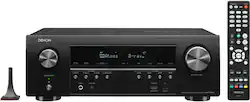
Denon - AVR-S750H (165W X 7) 7.2-Ch. with HEOS and Dolby Atmos 4K Ultra HD HDR Compatible AV Home Theater Receiver with Alexa - Black
- Key Specs
- Number of Channels: 7.1 (The number of discrete channels of sound output. This can be a single number or multiple numbers separated by decimal(s). The first number is the primary, horizontally directed audio channels. The number after the first decimal, if applicable, is the number of subwoofer outputs or channels. The number after the second decimal, if applicable, is the number of height or atmospheric channels designed to immerse the listener by producing overhead sound effects.)
- Audio Only Inputs: 1 x Coaxial digital audio, 2 x Optical digital audio, 1 x Phono
- Video Pass-through: HDR, 2160 (4K) (Devices with this feature allow video signals to travel from their source to a target device without alteration. For example, a receiver with 4K pass-through would allow 4K video signal from a Blu-ray player to pass to a target TV with surround sound; without the pass-through ability, the receiver would not allow both 4K video and surround sound to be transmitted simultaneously.)
- Works With: Amazon Alexa, Google Assistant, Siri (Compatible with or able to be connected to other smart devices or applications.)
- General
- Product Name: AVR-S750H (165W X 7) 7.2-Ch. with HEOS and Dolby Atmos 4K Ultra HD HDR Compatible AV Home Theater Receiver with Alexa
- Brand: Denon
- Model Number: AVR-S750H
- Color: Black
- Audio
- Number of Channels: 7.1 (The number of discrete channels of sound output. This can be a single number or multiple numbers separated by decimal(s). The first number is the primary, horizontally directed audio channels. The number after the first decimal, if applicable, is the number of subwoofer outputs or channels. The number after the second decimal, if applicable, is the number of height or atmospheric channels designed to immerse the listener by producing overhead sound effects.)
- Surround Sound Supported: DTS-HD Master Audio, DTS:X, DTS Virtual:X, DTS Neural:X, Dolby Surround (Surround sound systems use multiple audio channels and speakers to create an immersive sound experience for the listener. There are also various proprietary technologies that imitate this kind of sound via a device's built-in speakers or soundbar.)
- Equalizer: true (Allows for the control of different frequencies within an audio signal, such as adjusting treble and bass levels.)
- Inputs
- Audio Only Inputs: 1 x Coaxial digital audio, 2 x Optical digital audio, 1 x Phono
- Number of HDMI Inputs (Total): 5
- Number of USB Inputs: 1
- Video
- Video Pass-through: HDR, 2160 (4K) (Devices with this feature allow video signals to travel from their source to a target device without alteration. For example, a receiver with 4K pass-through would allow 4K video signal from a Blu-ray player to pass to a target TV with surround sound; without the pass-through ability, the receiver would not allow both 4K video and surround sound to be transmitted simultaneously.)
- High Dynamic Range Format: Dolby Vision, HDR 10, Hybrid Log-Gamma (HLG) (There are a few HDR formats that tell the TV or other HDR-compatible product how to best utilize its capabilities to display HDR content. HDR technology can support one or multiple formats, each with various benefits to picture quality.)
- Outputs
- Speaker Connection Type: RCA
- Number of HDMI Outputs (Total): 1
- Headphone Jack: true (The device features an interface that allows for the connection of headphones.)
- Features
- Auto Calibration: true (Home theater systems and receivers with an autocalibration function can automatically determine basic settings like speaker volume, crossover point, equalization, and more.)
- Remote Control Included: true
- Connectivity
- Wireless Multi-Room Audio: true (Technology that allows multiple speakers and/or soundbars to be connected wirelessly and play audio in separate rooms.)
- Wireless Multi-Room Technology: Apple AirPlay, Apple AirPlay 2, Denon Heos, Google Cast (Proprietary technology that allows multiple speakers and/or soundbars to be connected wirelessly and play audio in separate rooms.)
- Compatibility
- Works With: Amazon Alexa, Google Assistant, Siri (Compatible with or able to be connected to other smart devices or applications.)
- Dimensions
- Product Height: 9.13 inches (The out of box height of the item. Height is measured as the vertical distance from the bottom of the item to the top as it would be primarily used or placed.)
- Product Width: 20.59 inches (The out of box width of the item. Width is measured as the horizontal distance from one side of the item to the other as it would be primarily used or placed.)
- Product Depth: 17.13 inches (The out of box depth of the item. Depth is measured as the distance from the front of the item to the back as it would be primarily used or placed.)
- Product Weight: 23.4 pounds (The out of box weight of the item.)
- Other
- UPC: 883795004831
Power truly immersive home theater experiences with the Denon avr-s750h. Enter the action with Dolby Atmos, Dolby Atmos height virtualization technology, DTS: x and DTS virtual: x. The avr-s750h features an advanced HDMI section (6 inputs/1 Output) and the latest video technologies including Dolby Vision, HDR10, HOG and ear support. Play your MP3, WAV, FLAC, ALAC and DSD (2. 8/5. 6MHz) files via the front-panel USB, or stream Spotify, Pandora, Tidal and more with HEOS wireless multi-room music streaming technology. Works with Apple airplay 2, Alexa and Google Assistant for seamless voice control. Get set up in minutes with the award-winning Denon setup assistant.
- UNPRECEDENTED 3D REALISM WITH NEW FEATURES: 3D Audio & Dolby Atmos Height Virtualization, experience heightened sound effects like never before. Be it a helicopter or torrential rains, it will sound so real that you'll think it's happening right there!
- ENHANCED PICTURE QUALITY ON YOUR 4K ULTRA HD TV & PROJECTOR: This 7.2 channel stereo receiver features HLG, HDR10, eARC support, BT.2020, Wide Color Gamut & 4:4:4 Pure Color sub-sampling and delivers exceptional brightness, contrast & color
- EXTEND THE REACH OF YOUR MUSIC: Extend music to any room in the house via Wi-Fi, Airplay or Bluetooth with HEOS MULTI-ROOM WIRELESS SPEAKERS – No Command Center or extra hardware required. Get Hi-Fi sound around your home with Pandora, Spotify, TuneIn, Deezer & more
- FULL VOICE CONTROL COMPATIBILITY WITH VOICE CONTROL: Use the Google Assistant or Amazon Alexa to sit back and enjoy music without having to reach out for the remote! Adjust the volume, change the track or switch the inputs absolutely hands-free
- AWARD-WINNING ON-SCREEN SETUP ASSISTANT: Easy walkthrough with clear simple instructions to connect your TV, specific EQ settings & helps you optimize your surround sound. Denon's legacy & Japanese precision technology makes it a must-have for your home!
Whats Included
- Denon AVR 7.2-Ch. Bluetooth Capable With HEOS HDR Compatible A/V Home Theater Receiver
A:
Hey Patrick,
Yes, the AVR-S750H is capable of playing audio in multiple rooms with its Zone 2 capability. You will be able to play audio in the Main Zone in a 5.1 setup and a set of stereo speakers in Zone 2.
Thanks,
Denon North America
Q: There is any way to connect wireless surround speakers?
A: Not with out an external transmitter and receiver for the speakers. You lose some quality doing it that way.
A: Objectively, the AVR-S750H is a better model but it includes features that may not be needed based on individual setup for the extra $100. Main differences between the two models follow: AVR-S750H: 6 HDMI inputs AVS-S650H: 5 HDMI inputs AVR-S750H: 165 w per channel (7) AVR-S650H: 150 w per channel (5) AVR-S750H: Multi-room (dual output zones) - Yes AVR-S650H: Multi-room (dual output zones) - No AVR-S750H: Dolby Vision, Dolby Atmos, DTX AVR-S650H: Dolby Vision AVR-S750H: 5.1, 7.1 AVR-S650H: 5.1
A: Staying with all one brand is probably one expensive way to solve it. I’ve soured on Sony receivers, but I’d go all Sony, or no Sony. You’re not alone, I had the same volume issue with a Sony AVR, along with now the Samsung TV remote and my new Denon. My TV/all remote will successfully control the stereo volume, then not, then maybe. Like it loses the signal or something. Both are new products. I’ve heard and tried several things: turn on the tv or dvd first, unplug the TV to reset it, maybe try that with the blue ray? I think the HDMI cable may be an issue as well, because the remotes all work fine with their own products. I’m going to get a better cable and see what happens. Or maybe eARC just isn’t quite ‘there’ yet? Good luck! I’m actually pretty happy so far with the Denon AVR Itself and It’s features. Love Airplay and internet radio, I’m listening to more music now because of it.
A: Impedance is the total resistance (reactive & DC) that a speaker or any electrical component has to electrical current flow. The less impedance, the less resistance to current flow, or put another way, the more current will flow through the device. Higher impedance "impedes" current flow, so the amplifier will deliver less current through the speaker. Impedance varies depending on frequency, so a quoted ohm rating for a speaker is just an average - although good speaker design should have the impedance curve without sharp peaks or substantial variations. These can cause an amplifier to overload, cause distortion, or even damage the amplifier. Older analog amplifiers were usually capable of driving 4 ohm loads, or two parallel 8 ohm speaker sets. New "digital amps" have switching power supplies and outputs which do not have the high current, low impedance capabilities of the older analog amps... so you most often see amplifiers today rated for 6-8 ohm loads. When presented with a lower impedance load (for example, 2 sets of 8 ohm speakers in parallel), the amplifier safety circuit may shut down or disconnect the load to prevent damage to itself. Older analog amps were often capable of driving low impedance loads with ease, due to the nature of their design (and the massive high current stepdown power transformers & full wave line voltage bridge rectifiers used in the power supply).. But, they were bulky, heavy, and not as efficient as modern switch-mode power supplies, and the digital switching type output amplifier itself (class D or above). My old MacIntosh MC2300 amp can drive 16, 8, 4, or 2 ohm loads with ease... sounds great even today, but does weigh over 100 lbs. If your amplifier output is rated for 4 ohms, then it could not only drive a pair of 8 ohm speakers in parallel, but had twice the power output at 4 ohms than it would at 8 (in theory). I.E., if your amp is rated at 100W at 8 ohms, but can safely drive 4 ohm loads, then in theory the amp can produce 200W. So, your 6 ohm rated amp output is better than 8 ohms, because it can produce more current (power) in theory. But, you would need speakers rated at 6 ohms to take advantage of that. Another reason to want lower output impedance in your amp output is for something called damping factor. The lower the impedance, the higher the damping factor. It's complicated, but basically high damping allows the amp to control unwanted speaker cone movement better, especially a woofer which has a lot of mass and therefor inertia. High damping factor helps reduce speaker overshoot and ringing, which are forms of distortion. SO, you can safely use 8 ohm speakers on your receiver/amp with 6 ohm output impedance (and that is a MIN rating, not max)... but you should NOT use 4 ohm speakers on a 6 ohm rated amp. Most amps these days have overcurrent and other safety circuits built in, but you could possibly still damage the amp or speakers under certain circumstances. Anyway, lower amplifier output impedance is usually a good thing, so just make sure your speaker are the same NOMINAL impedance or HIGHER and you should be fine.
A: Yes, my PS4 will do this automatically if the receiver isn’t on.
A: Yes, you can connect your iPhone out of the box. No accessories needed.
Q: Can I play xm radio through system
A:
Hey CK,
Yes, you can play SiriusXM thru the HEOS app.
Thanks,
Denon North America