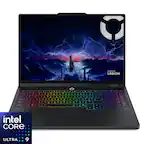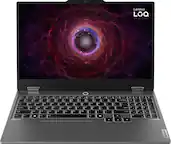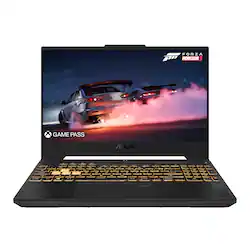
ASUS - TUF 15.6" Gaming Laptop - Intel Core i7 with 16GB Memory - NVIDIA GeForce RTX 4070 - 1TB SSD - Mecha Grey
- Key Specs
- Screen Type: IPS
- Screen Size: 15.6 inches (Size of the screen, measured diagonally from corner to corner.)
- Screen Resolution: 1920 x 1080 (Full HD) (Screens come in a range of resolutions (measured in pixels, horizontal x vertical). The higher the resolution, the greater the picture quality.)
- Touch Screen: false (Touch-screen devices make navigating more intuitive. Using a touch-screen display, you can do things such as tap to select, hold and drag to move items, swipe to scroll, and pinch to zoom.)
- Refresh Rate: 144Hz (The number of frames per second the device can produce natively without enhancement. Higher rates help produce smooth, seamless pictures.)
- Processor Model: Intel 12th Generation Core i7 (Your computer's processor is like its brain. Working in combination with system memory, the power of the processor determines the complexity of software you can run, how many programs you can have open at the same time, and how fast those programs will run. Most computers feature an AMD, Intel or Snapdragon processor.)
- Storage Type: SSD
- Total Storage Capacity: 1000 gigabytes
- System Memory (RAM): 16 gigabytes (Random-access memory (RAM) is a computing device's short-term data storage, which allows active information to be accessed quickly. The size and type of RAM determines how efficiently the device can handle large amounts of information at one time. For example, gaming or video editing requires more RAM for optimal performance.)
- Graphics: NVIDIA GeForce RTX 4070 (Often referred to as a "graphics processing unit" (GPU), this device is responsible for displaying image content and decoding/encoding video content in programs and games.)
- Display Connector(s): 1 x HDMI 2.1 (The number and type of connectors used to connect to an external display.)
- Battery Life (up to): 8 hours (Battery life will vary depending on the product configuration, product model, applications loaded on the product, power management setting of the product and the product features used by the customer. As with all batteries, the maximum capacity of this battery will decrease with time and usage.)
- 2-in-1 Design: false (A laptop and a tablet combined in one lightweight, portable device. Sometimes referred to as "convertible" or "hybrid" laptops, these devices deliver the processing power and keyboard of a laptop. When you're ready to play, either detach the screen or fold your 2-in-1 into tablet mode to comfortably watch movies, play games, read an e-book and more.)
- Backlit Keyboard: true (Integrated lights allow for visibility of the keys in low-light conditions.)
- General
- Product Name: TUF 15.6" Gaming Laptop - Intel Core i7 with 16GB Memory - NVIDIA GeForce RTX 4070 - 1TB SSD
- Brand: ASUS
- Model Number: FX507ZI-F15.I74070
- Year of Release: 2023
- Color: Mecha Grey
- Display
- Screen Type: IPS
- Screen Size: 15.6 inches (Size of the screen, measured diagonally from corner to corner.)
- Screen Resolution: 1920 x 1080 (Full HD) (Screens come in a range of resolutions (measured in pixels, horizontal x vertical). The higher the resolution, the greater the picture quality.)
- Touch Screen: false (Touch-screen devices make navigating more intuitive. Using a touch-screen display, you can do things such as tap to select, hold and drag to move items, swipe to scroll, and pinch to zoom.)
- Refresh Rate: 144Hz (The number of frames per second the device can produce natively without enhancement. Higher rates help produce smooth, seamless pictures.)
- Processor
- Processor Brand: Intel
- Processor Model: Intel 12th Generation Core i7 (Your computer's processor is like its brain. Working in combination with system memory, the power of the processor determines the complexity of software you can run, how many programs you can have open at the same time, and how fast those programs will run. Most computers feature an AMD, Intel or Snapdragon processor.)
- Processor Model Number: 12700H
- Storage
- Storage Type: SSD
- Total Storage Capacity: 1000 gigabytes
- Solid State Drive Capacity: 1000 gigabytes (The amount of data that can be stored on the device's solid state drive (SSD). SSD is a flash-based storage with faster speeds than a hard disk drive (HDD).)
- Solid State Drive Interface: PCIe (Connects the solid state drive to the host system. PCI and SATA interfaces are the most common; PCI interfaces are typically faster, but SATA interfaces are compatible with a wider range of systems.)
- Memory
- System Memory (RAM): 16 gigabytes (Random-access memory (RAM) is a computing device's short-term data storage, which allows active information to be accessed quickly. The size and type of RAM determines how efficiently the device can handle large amounts of information at one time. For example, gaming or video editing requires more RAM for optimal performance.)
- Type of Memory (RAM): DDR4 (Each type of RAM delivers a different level of speed, bandwidth, energy efficiency and performance.)
- System Memory RAM Speed: 3200 megahertz (How fast the information-storing hardware operates. The faster the RAM, the faster memory can be transferred to other system components. Ultimately, faster RAM improves operational efficiency.)
- System Memory RAM Expandable To: 32 gigabytes (Adding more random-access memory (RAM) to a computer speeds up performance and improves efficiency. Upgrades to memory are limited by the number of expansion slots for additional RAM and existing RAM installed on the device.)
- Graphics
- Graphics Type: Dedicated (Dedicated graphics uses a separate graphics card for processing video images. Because it does not use memory from the system's RAM, there is no extra burden on the CPU and graphics are processed more efficiently. Integrated graphics shares system RAM to process video images.)
- GPU Brand: NVIDIA
- Graphics: NVIDIA GeForce RTX 4070 (Often referred to as a "graphics processing unit" (GPU), this device is responsible for displaying image content and decoding/encoding video content in programs and games.)
- Advanced Graphics Rendering Technique(s): DLSS 3 (Deep Learning Super Sampling), Ray tracing (Imaging technology designed to improve graphics rendering.)
- GPU Video Memory (RAM): 8 gigabytes (Random-access memory (RAM) is a GPU’s, or graphics cards, short-term data storage, which allows active information to be accessed quickly. The size and type of RAM determines how efficiently the GPU can handle large amounts of information at one time. For example, larger amounts of RAM for gaming or video editing increases performance.)
- Compatibility
- Operating System: Windows 11 Home (The operating system manages all software and hardware, including files, memory and connected devices. Most importantly, it lets you interact with your device and your programs in a visual way; otherwise, you'd be typing computer code to get anything done.)
- Connectivity
- Display Connector(s): 1 x HDMI 2.1 (The number and type of connectors used to connect to an external display.)
- Number of HDMI Outputs (Total): 1
- USB Ports: 2 x USB-C 3.1, 2 x USB-A 3.1 (The number and type of USB ports the product has.)
- Number of USB Ports (Total): 4
- Wireless Connectivity: Wi-Fi (The manner in which a device sends data to another device over a short distance without the use of wires or cables.)
- Wireless Standard: AX (The wireless networking protocol used by the device. Each iteration of the protocol is based on the 802.11 standard developed by the Institute of Electrical and Electronics Engineers (IEEE) Standards Association. Denoted by letters following 802.11 (802.11a, 802.11ac, etc.), each version, published in alphabetical order, encompasses all previous versions.)
- Wireless Networking Standard: Wi-Fi 6 (The wireless networking standard used by the device. Each iteration of the standard developed by the Wi-Fi Alliance corresponds to an existing IEEE 802.11 protocol; for example, standard 802.11ac (or AC) is termed Wi-Fi 5. Refers specifically to the standard the device is designed to use, but ultimately determines product interoperability and backward compatibility including previous versions.)
- Cooling
- CPU Cooling System: Air
- Power
- Battery Life (up to): 8 hours (Battery life will vary depending on the product configuration, product model, applications loaded on the product, power management setting of the product and the product features used by the customer. As with all batteries, the maximum capacity of this battery will decrease with time and usage.)
- Battery Cells: 4-cell
- Camera
- Front-Facing Camera: true
- Features
- 2-in-1 Design: false (A laptop and a tablet combined in one lightweight, portable device. Sometimes referred to as "convertible" or "hybrid" laptops, these devices deliver the processing power and keyboard of a laptop. When you're ready to play, either detach the screen or fold your 2-in-1 into tablet mode to comfortably watch movies, play games, read an e-book and more.)
- Backlit Keyboard: true (Integrated lights allow for visibility of the keys in low-light conditions.)
- Media Card Reader: true (A hardware device that allows for access to data on a memory card and enables the transfer of its files to a computer. These devices may have one or multiple slots for various types of memory cards, and may be integrated into the computer or available as an external device.)
- Audio Technology: Smart AMP Technology
- Speaker Type: 2x 2.5W speakers
- Dimensions
- Product Height: 0.89 inches (The out of box height of the item. Height is measured as the vertical distance from the bottom of the item to the top as it would be primarily used or placed.)
- Product Width: 9.92 inches (The out of box width of the item. Width is measured as the horizontal distance from one side of the item to the other as it would be primarily used or placed.)
- Product Depth: 13.97 inches (The out of box depth of the item. Depth is measured as the distance from the front of the item to the back as it would be primarily used or placed.)
- Product Weight: 4.85 pounds (The out of box weight of the item.)
- Certifications Listings & Approvals
- ENERGY STAR Certified: false (Devices carrying the ENERGY STAR service mark, such as computer products and peripherals, kitchen appliances, and other products, generally use 20% to 30% less energy than required by federal standards.)
- EPEAT Qualified: false (The Electronic Product Environmental Assessment Tool (EPEAT) was designed to provide an environmental assessment tool for purchasers. In order to qualify for EPEAT, a product must meet all 23 required criteria.)
- Included
- Optical Drive Type: None (An optical disk drive (ODD) uses a laser light to read data from or write data to an optical disc. These discs include CDs, DVDs, and Blu-ray Discs. This allows you to play music or watch movies using prerecorded discs.)
- Numeric Keypad: true
- Other
- UPC: 197105032958
The latest Intel 12th Core i7 processor with GeForce RTX4070 graphics also equipped with a large 15.6" FHD 144hz display. Personalize your laptop with RGB keyboard.
- Windows 11 Operating System: Family, friends, passions, music, creations, games – Windows 11 is the one place for it all. With a fresh new feel and tools that make it easier to be efficient, it has what you need for whatever’s next.
- 12th Generation Intel Core i7-12700H: Power your games with the latest Intel Core i7-12700H CPU.
- NVIDIA RTX 4070 8GB GDDR6 Graphics: NVIDIA GeForce RTX 4070 8GB GDDR6 with ROG Boost at 80W (105W with Dynamic Boost 2.0) for an ultrafast GPU to fuel your games.
- 15.6" FHD 144Hz Display: The 144Hz Full HD 1920x1080 display features adaptive sync to minimize screen tearing, while playing your favorite games.
- 16GB of next generation, dual-channel, DDR4 3200Mhz system memory: 16GB memory significantly increases performance, compared to single-channel, and the blazing fast 3200MHz DDR4 next generation memory standard allows this model to multitask with ease.
- 1TB PCIe Solid State Drive: Save files fast and store more data. With massive amounts of storage and advanced communication power, PCI-e SSDs are great for major gaming applications, multiple servers, daily backups, and more.
- Weighs 4.85 lbs and Measures 0.89" Thin: TUF Dash 15 is a true featherweight for its class, weighing in at just 4.85 lbs and only 0.89" thin. This extremely lightweight chassis means the TUF Dash is exceptionally portable, fitting in even small bags and carrying cases.
- Robust Connectivity with Thunderbolt 4: TUF Dash 15 is ripe with connectivity. With a dedicated USB Type-C with Thunderbolt 4 support, one USB 3.2 Gen 2 Type-C port, two USB 3.2 Gen 1 Type-A ports, and an RJ45 LAN port, the machine has excellent options even for high speed external devices.
- Wireless/Wired connectivity (Wi-Fi 6): Wi-Fi 6 (802.11ax) ensures lower latency and better network connections, even on crowded Wi-Fi networks.
- Basic Software Package Included: 30-days trial of Microsoft Office 365.
- Additional ports: Headphone/microphone combo jack. Note: This laptop does not include a built-in DVD/CD drive.
Q: Why is it cheaper than other laptops on the market?
A: Hold on, the panel is not low quality. A 100% RGB panel that can reach 144 Hz is not low quality, it is just lower resolution. Also, the screen gets uncomfortably bright in darker rooms and I had to turn it down. For the other stuff, the top cover is 100% Metal, the GPU is better than anything else in this class, and it has a 90 Watt Hour battery, which is insane considering many others are are 70. So, there are certainly compromises like 12th Gen CPU, 1080P display, and DDR4, but for the most part the laptop is fantastic for the money.
A: The RTX 4070 GPU has a total graphics power of 115 watts + 25 watts for dynamic boost.
Q: Is the usb-c port thunderbolt 4?
A: This model does have 1x Thunderbolt 4 port which supports DisplayPort.
Q: How much is the maximum ram memory? Are the two slots accessible or is one soldered?
A: There are two RAM slots available that supports a total maximum size of 32GB, that is 16GB stick per slot.
A: Yes the model does have HDMI 2.1
Q: Does this have second NVME slot?
A: Yes
A: Yes, the ASUS TUF FX507ZI has 1x USB 3.2 Gen 2 Type-C port which supports DisplayPort™ and power delivery of up to 20V/5A (100W).
A: This has the RTX 4070 GPU with 8GB VRAM, not a RTX 4070 Ti. We will contact the appropriate department in order to make the necessary correction.