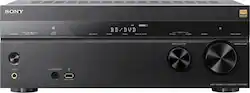
Sony - 1155W 7.2-Ch. with Dolby Atmos 4K Ultra HD HDR Compatible A/V Home Theater Receiver - Black
- Key Specs
- Number of Channels: Not Available (The number of discrete channels of sound output. This can be a single number or multiple numbers separated by decimal(s). The first number is the primary, horizontally directed audio channels. The number after the first decimal, if applicable, is the number of subwoofer outputs or channels. The number after the second decimal, if applicable, is the number of height or atmospheric channels designed to immerse the listener by producing overhead sound effects.)
- Video Pass-through: 2160 (4K), 3D (Devices with this feature allow video signals to travel from their source to a target device without alteration. For example, a receiver with 4K pass-through would allow 4K video signal from a Blu-ray player to pass to a target TV with surround sound; without the pass-through ability, the receiver would not allow both 4K video and surround sound to be transmitted simultaneously.)
- General
- Product Name: 1155W 7.2-Ch. with Dolby Atmos 4K Ultra HD HDR Compatible A/V Home Theater Receiver
- Brand: Sony
- Model Number: STRDN1080
- Audio
- Number of Channels: Not Available (The number of discrete channels of sound output. This can be a single number or multiple numbers separated by decimal(s). The first number is the primary, horizontally directed audio channels. The number after the first decimal, if applicable, is the number of subwoofer outputs or channels. The number after the second decimal, if applicable, is the number of height or atmospheric channels designed to immerse the listener by producing overhead sound effects.)
- High Resolution Audio: true (Hear music the way musicians and sound technicians intended it to be heard. Products that support hi-res audio deliver audio signals with a dynamic range and bandwidth far greater than that of a standard CD so you'll be able to enjoy pure music with outstanding sound quality. The device supports high-resolution audio signals, which more closely resemble the quality of music as it was originally recorded, with more texture and detail than can be heard via typical music streaming services or CDs.)
- Surround Sound Supported: DTS:X, Dolby Atmos (Surround sound systems use multiple audio channels and speakers to create an immersive sound experience for the listener. There are also various proprietary technologies that imitate this kind of sound via a device's built-in speakers or soundbar.)
- Maximum Sampling Rate Supported: 5.6 MHz (DSD 128) (Generally, the higher the sampling rate, the greater the quality of audio and/or video.)
- Speaker A/B Switching: true (Allows a user to select between one of two sets of primary speakers.)
- Supported File Formats: WAV, AIFF, MP3, FLAC, DSD, ALAC
- Equalizer: true (Allows for the control of different frequencies within an audio signal, such as adjusting treble and bass levels.)
- Inputs
- Number of HDMI Inputs (Total): 6
- Video
- Video Pass-through: 2160 (4K), 3D (Devices with this feature allow video signals to travel from their source to a target device without alteration. For example, a receiver with 4K pass-through would allow 4K video signal from a Blu-ray player to pass to a target TV with surround sound; without the pass-through ability, the receiver would not allow both 4K video and surround sound to be transmitted simultaneously.)
- Outputs
- Number of HDMI Outputs (Total): 2
- Headphone Jack: true (The device features an interface that allows for the connection of headphones.)
- Features
- App Compatible: true (The product can be connected to a program or software application on a mobile device, which then receives collected data from the product.)
- Featured Streaming Services: Pandora, Spotify, TuneIn, YouTube, iHeartRadio (Streaming services and other programs are available on this device. Keep in mind, there may be more services supported than just those shown here.)
- Auto Calibration: true (Home theater systems and receivers with an autocalibration function can automatically determine basic settings like speaker volume, crossover point, equalization, and more.)
- Digital Content Protection: HDCP 2.2 (High-bandwidth Digital Content Protection (HDCP) is designed to prevent copying of digital audio and video content as it travels across connections. Newer versions of HDCP support more connection types, increase security, and resolve weaknesses of previous versions.)
- Remote Control Included: true
- Connectivity
- Wireless Multi-Room Audio: true (Technology that allows multiple speakers and/or soundbars to be connected wirelessly and play audio in separate rooms.)
- Wireless Multi-Room Technology: Apple AirPlay (Proprietary technology that allows multiple speakers and/or soundbars to be connected wirelessly and play audio in separate rooms.)
- IP Control: false (Allows electronic devices to be controlled over a home network via a web-based interface. Typically refers to devices not traditionally controlled in this manner, such as A/V receivers.)
- Dimensions
- Product Height: 6.1 inches (The out of box height of the item. Height is measured as the vertical distance from the bottom of the item to the top as it would be primarily used or placed.)
- Product Width: 16.9 inches (The out of box width of the item. Width is measured as the horizontal distance from one side of the item to the other as it would be primarily used or placed.)
- Product Depth: 13 inches (The out of box depth of the item. Depth is measured as the distance from the front of the item to the back as it would be primarily used or placed.)
- Product Weight: 21.4 pounds (The out of box weight of the item.)
- Certifications Listings & Approvals
- ENERGY STAR Certified: false (Devices carrying the ENERGY STAR service mark, such as computer products and peripherals, kitchen appliances, and other products, generally use 20% to 30% less energy than required by federal standards.)
- Warranty
- Manufacturer's Warranty - Parts: 2 years
- Manufacturer's Warranty - Labor: 2 years
- Other
- UPC: 027242901896
Hear music in rich clarity with this Sony home theater AV receiver. Powerful surround sound makes movies come alive on your home theater system, and nine speaker channels flex their output to match your physical layout. This Sony home theater AV receiver works with a wide variety of audio formats, such as Google Home, Chromecast and Spotify. Includes HDMI 4K Ultra HD and 3D pass-through technologies for compatibility with 3D TVs, Blu-ray players and gaming consoles and 4K Ultra HD TVs.
- Up to 4K HDMI passthrough: Transfers 4K video and audio signals from your set-top devices to the TV via the AV receiver.
- 3D passthrough: Passes through 3D content from a variety of devices through your AV receiver to your TV or projector.
- 165W RMS power x 7 channels: For powerful sound.
- Smart Enabled: Get access to a world of instant entertainment with this product. Just connect to the Internet and stream movies, listen to music, and access a wide variety of other content.
- Connect to the Internet: Via built-in Wi-Fi for access to YouTube, Pandora, Deezer, Napster, NPR, Spotify, TuneIn, Google Play Music, iHeartRadio, TIDAL, Qobuz, Chromecast and 7Digital.
- Enjoy an easy full-resolution connection with eARC: With eARC, the STR-DN1080 receiver can relay full-resolution sound, including the latest immersive audio formats like Dolby Atmos and DTS:X, directly to and from your TV without routing through an alternate media source.*
- Surround sound decoders: Include Dolby Atmos and DTS:X for crystal surround sound.
- Dual-zone capability and Apple AirPlay support: Support distributed audio playback in another room, so you can enjoy music throughout your home.
- HDR color technology: Produce vibrant hues for a lifelike picture.
- Hi-Res audio support: Lets you enjoy high-quality audio playback via LAN, USB, Bluetooth.
- Remote: Lets you control the receiver from afar.
- FM tuner: Lets you listen to your favorite stations.
- Headphone jack: Enables private listening.
- USB port: Enables simple connection of a variety of USB-enabled devices.
- Auxiliary input: Makes it easy to connect a variety of devices.
- 6 HDMI inputs, 2 HDMI outputs: HDMI cable not included. High-speed HDMI cable is the only connection that can deliver a full high-definition experience with a full 1080p picture and digital surround sound.
- Enjoy AirPlay audio: Lets you stream music from your Apple® iPod®, iPhone® or iPad®.
- Bluetooth technology: Supports simple wireless music streaming via compatible devices. Advanced music optimizer technology promotes quality sound when streaming audio.
Whats Included
- Sony 1155W 7.2-Ch. with Dolby Atmos 4K Ultra HD HDR Compatible A/V Home Theater Receiver
A: The 6 0hm figure that Sony uses is just their way of getting around the U.S. requirements for stating output power. The receiver should be able to handle speakers from 4 to 16 ohms, if you just remember that as the nominal impedance of a speaker rises, there will be less current available to drive it. 4 ohm speakers will take more current (hence, somewhat louder for the same volume setting, and easier to drive the amp too hard), but it's unlikely that you'll have any problems unless you drive them way too hard. Remember also that the stated impedance of a speaker varies wildly with frequency, but the amp never spends too long on a single frequency in the very low impedance range. I would avoid highly capacitive loads like electrostats (e.g., Martin-Logan) with this receiver and any speaker known to drop below 4 ohms for a significant part of the frequency range (fairly rare birds). Sony's using the 6 ohm figure with only one channel driven to state their power output suggests that they did not go out of their way to produce a robust and stable power supply, but so far, I've been quite satisfied with the sound I'm getting using the front and rear surround/height outputs to biamp my tower speakers in front, and using the remaining outputs for the rear channels (explained pretty clearly in the manual). If you're electronically paranoid, avoid 4-0hm speakers or buffer them with a 2-0hm, 50 watt resistor in series with the + terminal on each speaker. (A 4-ohm resistor would effectively suck up half the amp's power, so you would probably get 35-40 watts per channel, rather than the 75 watts it normally produces for a speaker with all speakers driven; this would mean a 3dB drop in output, or a just noticeable difference (JND) in perceived volume. Most of the time, you're probably listening at 1 to 2 watts output, anyhow. This Sony has a very good Protection circuit, so it will shut off quickly if it's unhappy with the speaker's impedance. If you're only getting sound from the front speakers, check all connections carefully, then recalibrate the receiver with its calibration microphone and choose the setting that gives you a balanced surround. You may have to play with recalibration for a while, and the menu is very informative as to how well you are doing. It will tell you, graphically, what you have done.
A: Connect the DVR and bluray to an HDMI input each. HDMI to the TV from the receiver using the ARC port on both sides. Optical is from the TV to the receiver for TV audio, HDMI carries audio for the other sources. Turtable via RCA red/white to the SACD/CD inputs (or the the others and leave the video open). Your turntable will need a preamp to line level, may be built in to it.
Q: I have a new 4K tv. Do I really need Ulta HD Pass-through to enjoy the full 4K experience?
A: No. Most 4k TVs have multiple HDMI inputs and optical outputs. This means that you can use your TV to switch between sources and have the audio sent to the receivers optical or digital audio input connection. That being said, I do have to point out that the Sony 1080 sounds amazing. It totally smokes my previous Denon receiver in sound quality. The one area that my Sony 1080 receiver is weak is in interconnection, it doesn't control other Sony components as promised and requires that I keep multiple remote controls handy to work different sources. This despite the use to HDMI 2.0b certified cables and following directions. My system consists of a 65in Sony x900 LED TV (XBR65X900E), Sony X800 4k blue ray player (UBPX800), Xbox, and Sony 1080 receiver (STRDN1080). Hope this helps .
Q: Can the 2 HDMI outs play different sources?
A: Hi DrPhil, yes. Treat all the HDMI outs of this receiver as independent ports where you can play or output audio or video from different sources. Thanks, -Mark
A: I have successfully found the manuals on the Sony eSupport website for all Sony products. Perhaps the link below will work or you can search for "Sony eSupport" https://esupport.sony.com/US/p/model-home.pl?mdl=STRDN1080&template_id=1®ion_id=1&tab=manuals#/manualsTab
A: The way I understand AFD, is that it automatically decodes the signal in the way it was originally encoded. You would have to select a differenf sound field for it to stay the same. I leave mine in AFD so as to reproduce the sound the way it was meant to be heard
Q: Does this work with Amazon Echo?
A: Yes, alexa or Google ,there are apps to use one control for stereo ,tv, computer, ect.
Q: Does anybody else notice a high pitched noise coming from the receiver when it is turned off?
A: I haven't noticed any high pitched noises coming from the STRDN1080 while it's off but my hearing isn't that great. It wouldn't surprise me if it was. I do know that the STRDN1080 makes an audible buzz or hum while the unit is on as does all of Sony's latest model A/V receivers, even the ES models are not immune. It's due to an inferior power supply. Even with my less then stellar hearing I was able to hear the buzz all the way from the couch. This was unacceptable to me and it was because of this reason that I returned the unit and went with a quality integrated amp. I suppose the STRDN1080 would be fine if your priority was movies but if you're serious about music then I recommended passing on all the latest Sony A/V receivers as they just aren't built all that well.